On the mind of every retail CEO: the Amazon threat

Add Axios as your preferred source to
see more of our stories on Google.
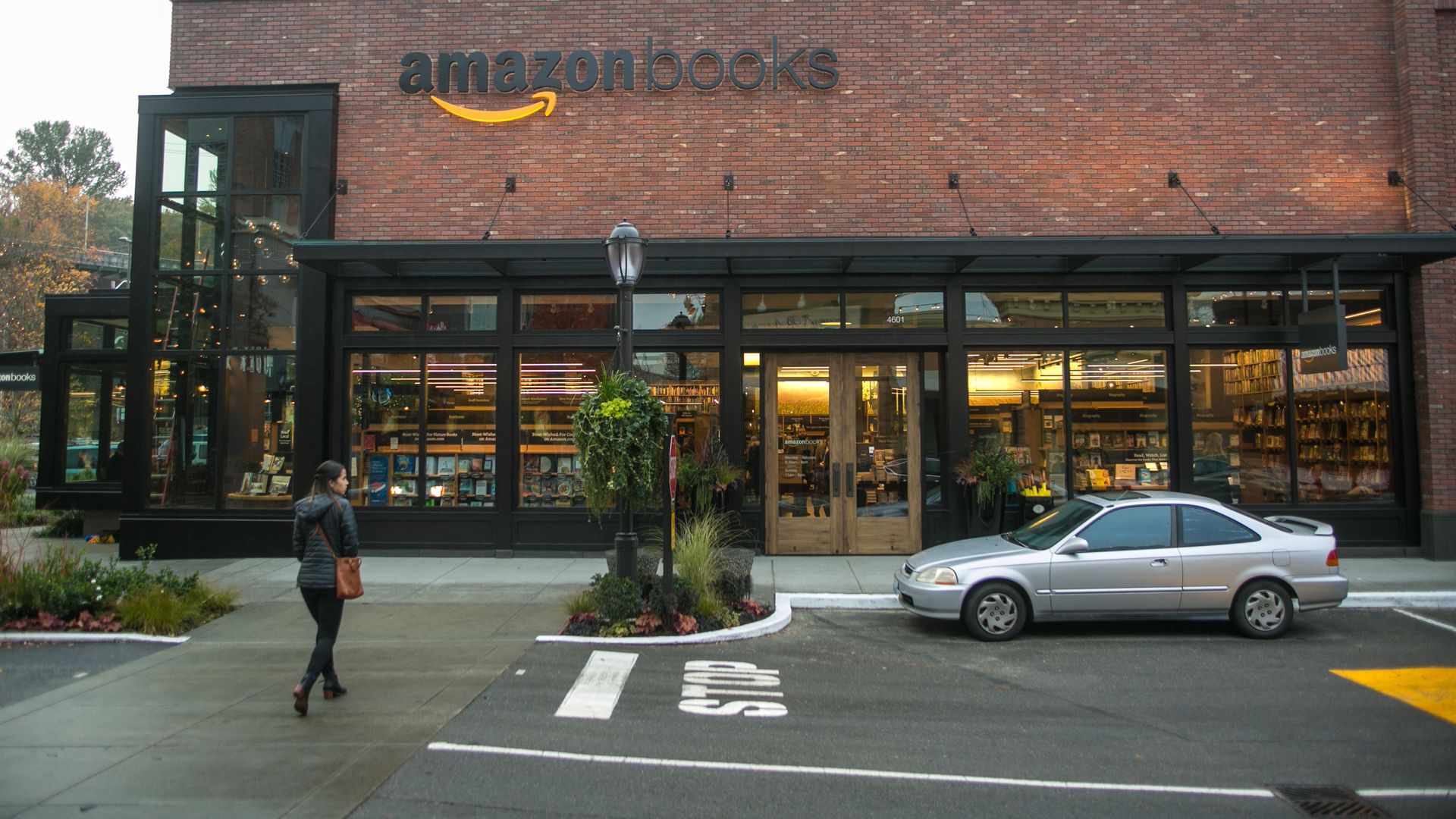
In Seattle. Photo: George Rose/Getty
In the last year, Amazon earned 50 cents of every dollar spent online in the U.S. At nearly $1 trillion, its market cap grew to triple the combined value of Sears, JCPenney, Best Buy, Macy's, Target, Kohl's, Nordstrom and Walmart.
Driving the news: As I learned at a conference in New York yesterday, Jeff Bezos' tech giant has quickly become the existential crisis facing almost every e-commerce and brick-and-mortar firm, whose CEOs are faced with a singular question: How do I beat — or even survive — Amazon?
Three top retail and e-commerce CEOs — Tobi Lütke of Shopify, Binny Bansal of Flipkart and Jeff Gennette of Macy's — fielded that same question at Recode's Code Commerce conference. Amazon seemed to be mentioned every few minutes even though the company sent no speakers to the event.
- Venture capitalists and other conference participants seemed less interested in what retailers were working on than in how they were responding to Amazon.
What they're saying: It's "impossible" to beat Amazon at its own game, says Scott Galloway, a professor at NYU's Stern School of Business and author of "The Four," a critique of Big Tech, including Amazon.
But each of the CEOs argued that there are chinks in the e-commerce king's armor. Here is how they are attacking the threat:
1. Be friendly
Lütke says that Shopify champions its business clients while Amazon thinks "merchants don't matter."
- Shopify's model is to provide small businesses the tech to sell online. It relies on the success of these brands — large and small — to succeed itself.
- According to Lütke, Amazon conversely terrifies brands, who worry it will wipe them out with super-low prices, selection and convenience.
2. Know your (foreign) market
Amazon and Flipkart, its homegrown rival in India, are locked in a fight for the world's fastest-growing e-commerce market. But Bansal thinks he can win, relying on intimate knowledge of the country.
- "We had to build out our own last-mile delivery system. The kind of logistics reach we have in the country is almost unfathomable," he says.
- To defend against Amazon, Flipkart has teamed up with Walmart, which owns 77% of the Indian company.
3. Play to your (physical) strengths
Macy's physical presence gives it deceptive power, Gennette says. To put this in context, about 90% of U.S. retail sales still take place in physical stores, not online.
- "All retailers, even Amazon, are going to need an omnichannel presence," Gennette says. "A lot of customers still want a guide that will help them on their way to their purchase."
