White House pushes Pentagon to jumpstart a national 5G network

Add Axios as your preferred source to
see more of our stories on Google.
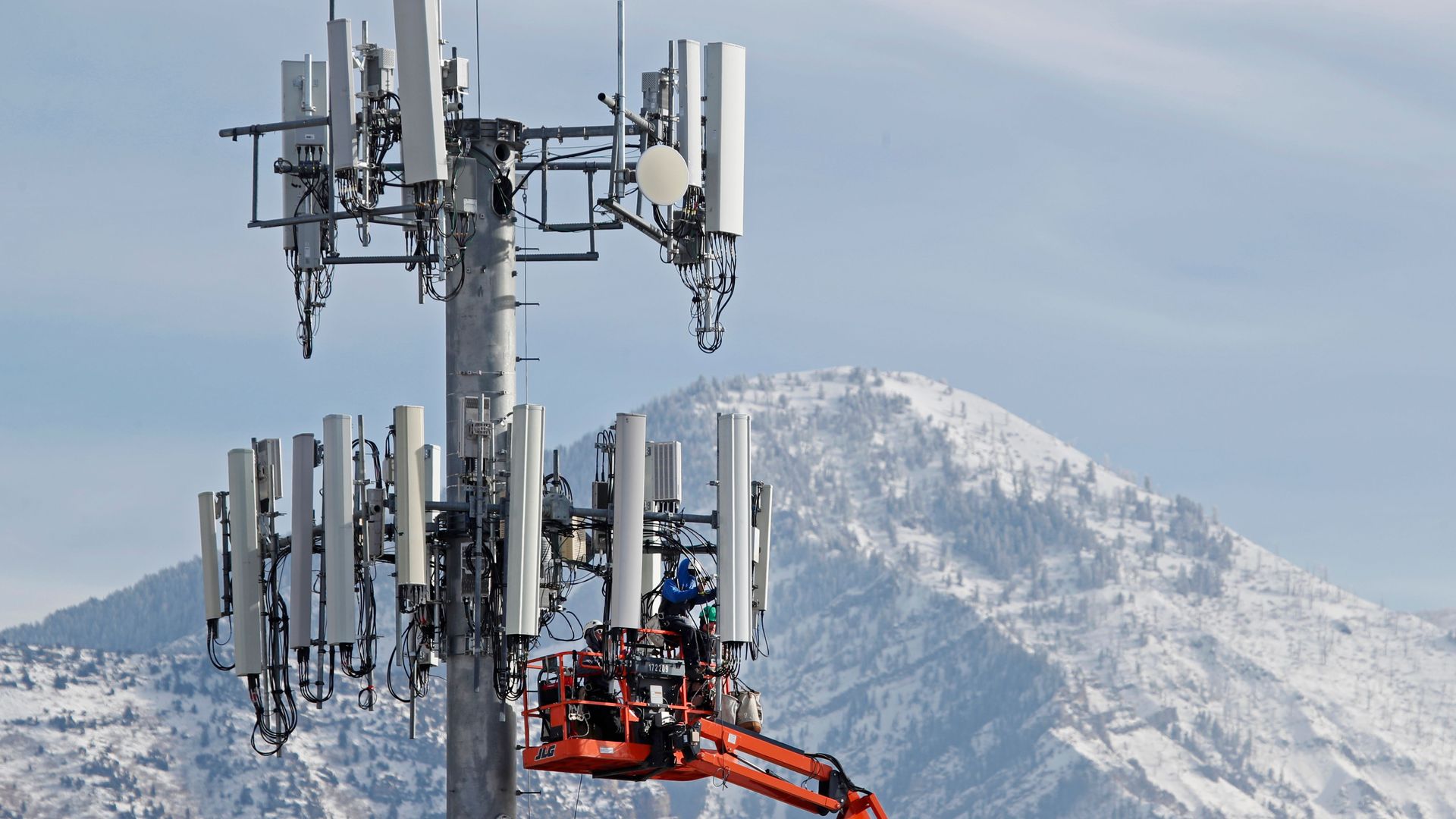
Verizon upgrades a cell tower near Orem, Utah for 5G service. Photo: George Fret/AFP via Getty Images
White House chief of staff Mark Meadows is leaning on the Pentagon to move ahead with a plan to stand up a 5G wireless network, sources tell Axios, and the idea, despite opposition from key government and private-sector players, could well outlive the Trump administration.
Why it matters: The Department of Defense could lease out capacity to wireless carriers and other companies in need of the ubiquitous, high-speed connectivity that 5G technology promises. That prospect makes this the Trump administration's most serious push toward a federally backed national 5G network since it first floated the idea in 2018.
What we're hearing: Meadows has taken a strong recent interest in the idea and is behind the White House nudging the Pentagon to move it along, people familiar with the state of play said.
- DoD is gathering input until next week on whether and how to move forward with the plan, which, if it happens, would likely take the form of a private company landing a federal contract to operate a 5G network on the government's behalf, using airwaves held by DoD.
- The upshot would be a public-private partnership analogous to FirstNet, the dedicated communications network for first responders that AT&T operates under a federal contract.
- Wireless providers are firmly opposed to the idea, viewing it as the government hand-picking a single winner in the deployment of nationwide 5G, though some in Washington believe they could change tacks and vie for the contract if DoD moves ahead with the plan.
The White House is urging DoD, sources said, to move quickly to follow the outstanding request for information with an actual solicitation for proposals from companies that would bid to run the network.
- DoD is already at work drafting that request, the Wall Street Journal reported Friday, and one telecom industry official Axios spoke with expects the request to be issued within the next two weeks..
Yes, but: There's also a chance the process will derail. The push has rankled some top DoD officials, sources say, with Defense Secretary Mark Esper said to be among those wary of the idea.
- Some officials at the Federal Communications Commission are also troubled by the national 5G plan. There's bipartisan consensus at the FCC against establishing a federally backed 5G network. (The FCC is also working to auction off a decent-sized chunk of 5G-friendly airwaves now controlled by the Pentagon.)
Between the lines: Proponents of past proposals for federally backed 5G in the Trump camp have pushed the national-network idea as a way to edge out China in the race to build the best next-generation wireless technology.
- They also see it as a bid to bring high-speed wireless internet to rural America.
- Both arguments could motivate the pre-election timing of this latest push for the plan.
The intrigue: There's agreement in Washington telecom circles that the national-network idea won't die even if Trump loses.
- Telecom firm Rivada Networks has been a central player throughout the national 5G saga, enlisting GOP figures including Karl Rove and Newt Gingrich to advocate for its proposal to run a network that matches the contours of the one now under consideration.
- But telecom insiders believed the politically connected Rivada could also pivot quickly to lobby a Biden administration — and that other, larger firms could be interested in bidding and pitch Democrats on the benefits the national 5G might confer for security, connectivity and global competitiveness.
Our thought bubble: Democrats could well bite — the idea tracks with their arguments that the internet is critical infrastructure akin to a utility and merits more federal resources.
One person to watch is former Google CEO Eric Schmidt, who said at a telecom industry virtual conference last month that falling behind China on 5G is a "national emergency" and that the Pentagon standing up a network it can share with the private sector is our best chance of averting disaster.
- Schmidt's interest has telecom insiders wondering if, though he no longer has any formal ties to Google, he could sway his old company to bid on operating the network. It's not a total stranger to moonshot telecom projects; sister company Loon is working to deliver internet service to rural parts of the world using high-altitude balloons.
- Perhaps more likely, Schmidt could use Schmidt Futures, his philanthropic-cum-venture-capital organization to fund a bid by another party.
Go deeper:
