Catch up on the day's biggest business stories

Subscribe to Axios Closer for insights into the day’s business news and trends and why they matter

Please enter a valid email.

Please enter a valid email.

Subscription failed
Thank you for subscribing!

Stay on top of the latest market trends

Subscribe to Axios Markets for the latest market trends and economic insights. Sign up for free.

Please enter a valid email.

Please enter a valid email.

Subscription failed
Thank you for subscribing!

Sports news worthy of your time

Binge on the stats and stories that drive the sports world with Axios Sports. Sign up for free.

Please enter a valid email.

Please enter a valid email.

Subscription failed
Thank you for subscribing!

Tech news worthy of your time

Get our smart take on technology from the Valley and D.C. with Axios Login. Sign up for free.

Please enter a valid email.

Please enter a valid email.

Subscription failed
Thank you for subscribing!

Get the inside stories

Get an insider's guide to the new White House with Axios Sneak Peek. Sign up for free.

Please enter a valid email.

Please enter a valid email.

Subscription failed
Thank you for subscribing!

Communicate like Axios

Keep teams engaged and aligned with Axios-style communications crafted with Axios HQ.

Learn moreArrow

Catch up on coronavirus stories and special reports, curated by Mike Allen everyday

Catch up on coronavirus stories and special reports, curated by Mike Allen everyday

Please enter a valid email.

Please enter a valid email.

Subscription failed
Thank you for subscribing!

Want a daily digest of the top Denver news?

Get a daily digest of the most important stories affecting your hometown with Axios Denver

Please enter a valid email.

Please enter a valid email.

Subscription failed
Thank you for subscribing!

Want a daily digest of the top Des Moines news?

Get a daily digest of the most important stories affecting your hometown with Axios Des Moines

Please enter a valid email.

Please enter a valid email.

Subscription failed
Thank you for subscribing!

Want a daily digest of the top Twin Cities news?

Get a daily digest of the most important stories affecting your hometown with Axios Twin Cities

Please enter a valid email.

Please enter a valid email.

Subscription failed
Thank you for subscribing!

Want a daily digest of the top Tampa Bay news?

Get a daily digest of the most important stories affecting your hometown with Axios Tampa Bay

Please enter a valid email.

Please enter a valid email.

Subscription failed
Thank you for subscribing!

Want a daily digest of the top Charlotte news?

Get a daily digest of the most important stories affecting your hometown with Axios Charlotte

Please enter a valid email.

Please enter a valid email.

Subscription failed
Thank you for subscribing!

Sign up for Axios NW Arkansas

Stay up-to-date on the most important and interesting stories affecting NW Arkansas, authored by local reporters

Please enter a valid email.

Please enter a valid email.

Subscription failed
Thank you for subscribing!

Please enter a valid email.

Please enter a valid email.

Subscription failed
Thank you for subscribing!

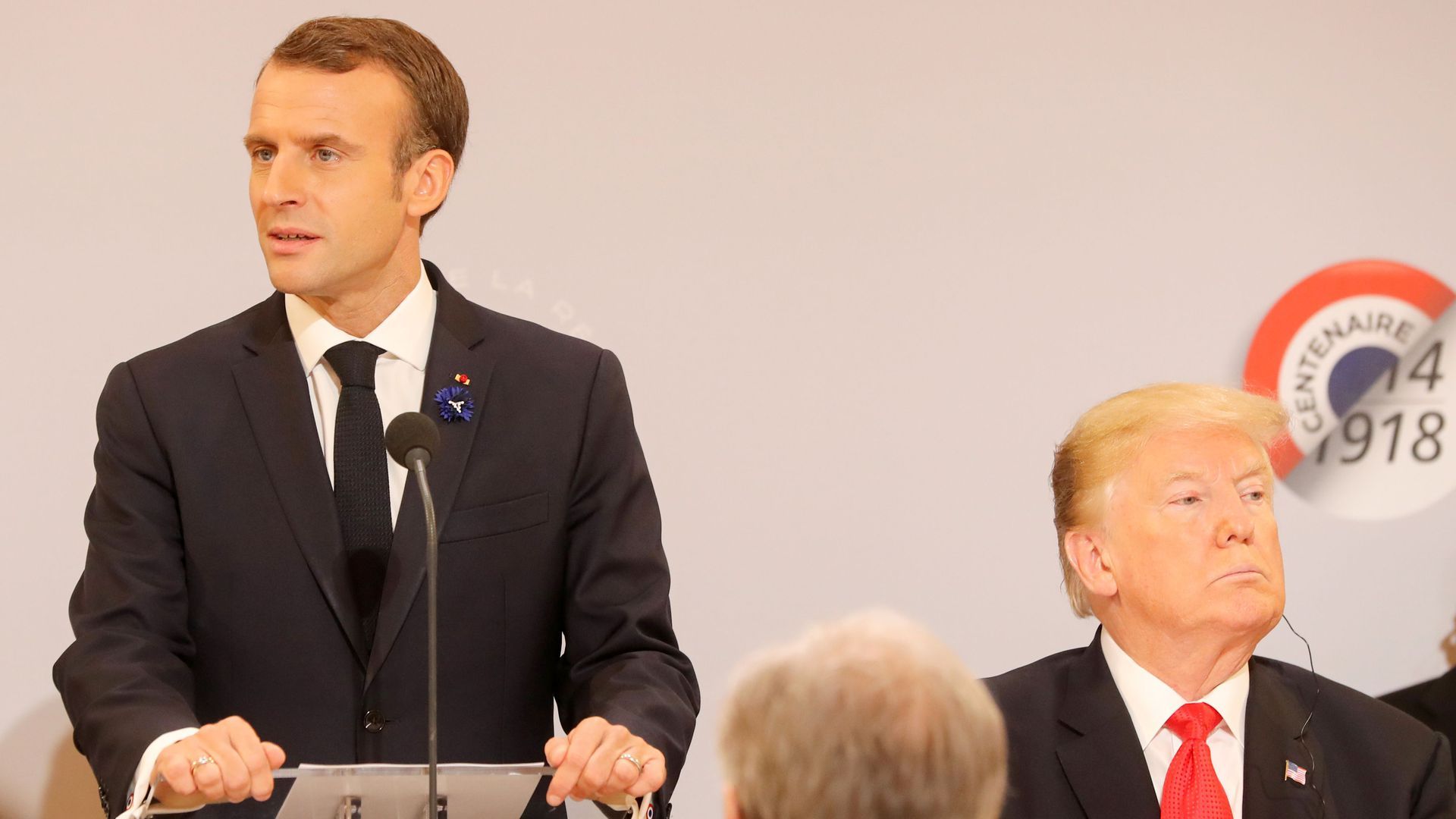
French President Emmanuel Macron appears with President Trump before a lunch at the Elysee Palace in Paris on Nov. 11. Photo: Jacques Demarthon/AFP via Getty Images

The United States has not signed the Paris Call for Trust and Security in Cyberspace, a pact between 51 countries and hundreds of the important companies in tech, nonprofits and universities. At least, not yet.

The big picture: Signatories tell Axios that the U.S. hasn't shut the door on the agreement of general principles for internet security. The agreement, a first-of-its-kind document involving both the public and private sector, could be a significant step toward a global understanding of what countries are and aren't permitted to do online — but that's likely only if the U.S. lends its heft.

What they're saying: "It is a missed opportunity for the U.S., especially because the agreement is nonbinding," Peter Singer, a strategist and senior fellow at the New America Foundation, told Codebook via email.

The Paris Call is a handshake establishing principles, including:

  • Human rights should extend to online spaces.
  • Countries should work together to prevent the theft of intellectual property (as China is accused of doing), election tampering (as Russia is accused of orchestrating) and destabilizing the core of the internet (as China may have done through BGP hijacking).
  • Countries should never release malware causing indiscriminate harm to the public (as Russia and North Korea are accused of doing with NotPetya and WannaCry).
  • The private sector will not risk collateral damage by "hacking back" their hackers.

Other odds and ends: It also stipulates:

  • Disclosure programs and other basic cybersecurity measures are generally good.
  • The private sector must play a role in comprehensive security plans.

Who didn't sign: The U.S. is not the only nation that didn't sign the Paris Call. But many of the other nonsignatories skew in an unflattering direction: They include North Korea, Russia, Iran and China.

  • 3 out of 5 of the nations in the powerful Five Eyes alliance signed the accord. (The U.K., Canada and New Zealand did. The U.S. and Australia did not.) Israel didn't sign, either.

The intrigue: The United States appears to have two motivations not to sign.

1. Trump hates these things. President Trump likes deals, not agreements. He likes bilateral, transactional things where he feels like the U.S. comes out ahead. This is more of a zero-sum affair, where everyone in the world benefits because everyone gives something up.

  • "The problem is that so many threats to U.S. security simply can't be solved in that way. Whether it is cybersecurity or environmental or nuclear nonproliferation issues, they are multilateral and multilayered," said Singer.

2. Big dogs don't like fences. And nearly all the major cyber powers (U.S., North Korea, China, Iran, Russia and Israel) stayed out of the agreement, likely hesitant to place even nonbinding restrictions on how they act. One exception is the United Kingdom, who signed the agreement.

  • "While the goal of the Call is laudable, and the list of industry signatories in particular is impressive, without the U.S. and other offensive-minded states as signatories, it feels a bit like the players on the sidelines telling the ones in the game to stop playing," said Betsy Cooper, a one-time attorney and adviser at the Department of Homeland Security who was just named director of the new Aspen Tech Policy Hub.

Go deeper

New York region's historic floods send deadly climate change lesson

A motorist drives a car through a flooded expressway in Brooklyn, NY early on Sept. 2, 2021. (Ed Jones/AFP via Getty Images)

The remnants of Hurricane Ida brought a tropical deluge of unprecedented proportions to the New York City metro area on Wednesday night into Thursday.

Driving the news: The flooding that resulted from the heavy rainfall shut down Newark Airport, and turned city and country roads in all five boroughs and surrounding areas of New Jersey and Pennsylvania into rivers.

Updated 10 mins ago - Politics & Policy

Texas banned abortion after 6 weeks. Here’s what happens next

Photo: Saul Loeb/AFP via Getty Images

The most restrictive abortion ban in the U.S. went into effect in Texas on Wednesday, effectively making the procedure illegal after six weeks — well before many women know they are pregnant.

Details: The Texas law does not provide any exceptions for rape or incest. It also allows for people to sue anyone suspected of helping a person to obtain an abortion, regardless of whether they have a direct relationship with the person or not. Those who are successful can be awarded at least $10,000.

Latest meme stock, Support.com, shows shorting is still riskier than ever

Illustration: Aïda Amer/Axios

The stock market's relentless upward momentum this year has lined the pockets of all kinds of investors, from veteran market players to Robinhood first-timers. It's also made shorting stocks a lot more risky than it already was.

Why it matters: The meme stock phenomenon changed the game. After an initial upheaval that wiped out GameStop and AMC shorts in spectacular fashion, shorting stocks based on fundamentals has become a move that can turn lethal on a dime.