Get the latest market trends in your inbox

Stay on top of the latest market trends and economic insights with the Axios Markets newsletter. Sign up for free.

Please enter a valid email.

Please enter a valid email.

Subscription failed
Thank you for subscribing!

Catch up on coronavirus stories and special reports, curated by Mike Allen everyday

Catch up on coronavirus stories and special reports, curated by Mike Allen everyday

Please enter a valid email.

Please enter a valid email.

Subscription failed
Thank you for subscribing!

Denver news in your inbox

Catch up on the most important stories affecting your hometown with Axios Denver

Please enter a valid email.

Please enter a valid email.

Subscription failed
Thank you for subscribing!

Des Moines news in your inbox

Catch up on the most important stories affecting your hometown with Axios Des Moines

Please enter a valid email.

Please enter a valid email.

Subscription failed
Thank you for subscribing!

Minneapolis-St. Paul news in your inbox

Catch up on the most important stories affecting your hometown with Axios Twin Cities

Please enter a valid email.

Please enter a valid email.

Subscription failed
Thank you for subscribing!

Tampa Bay news in your inbox

Catch up on the most important stories affecting your hometown with Axios Tampa Bay

Please enter a valid email.

Please enter a valid email.

Subscription failed
Thank you for subscribing!

Charlotte news in your inbox

Catch up on the most important stories affecting your hometown with Axios Charlotte

Please enter a valid email.

Please enter a valid email.

Subscription failed
Thank you for subscribing!

Please enter a valid email.

Please enter a valid email.

Subscription failed
Thank you for subscribing!

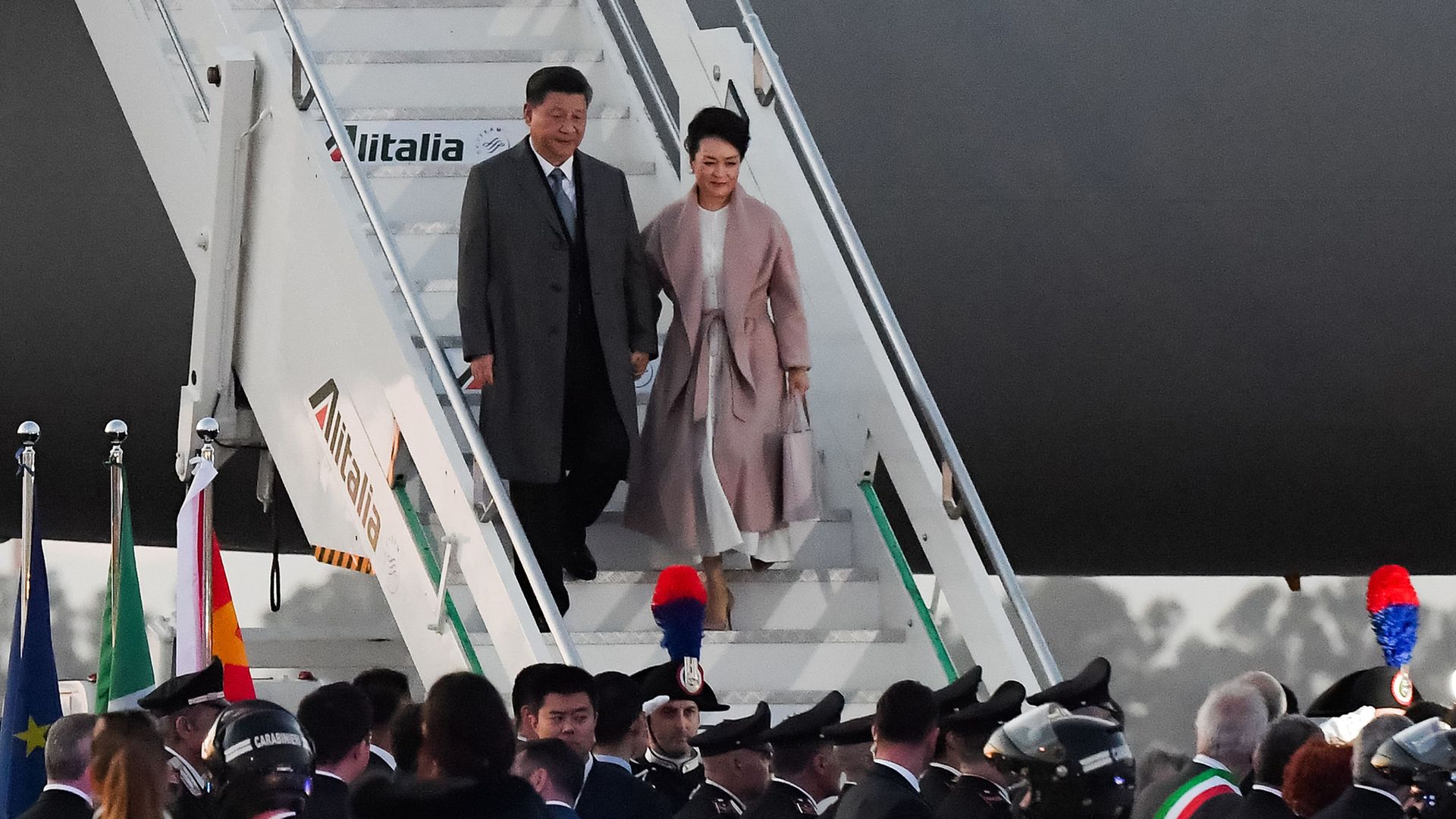
China's President Xi Jinping and his wife, Peng Liyuan, at Rome's Fiumicino airport on March 21, 2019. Photo: Tiziana Fabi/AFP/Getty Images

Xi Jinping arrived in Italy today to sign a memorandum of understanding for the Belt and Road Initiative (BRI), a development that has already drawn criticism from the U.S.

The big picture: Washington’s frustration is understandable, but it plays right into Beijing’s hand. Publicly criticizing Italy’s decision gives unwarranted weight to vague documents that, like the BRI itself, overpromise and underdeliver.

If anything, these memorandums of understanding (MOUs) highlight some of the BRI’s biggest flaws:

  • Weak terms: As Italy’s draft document notes: “This Memorandum of Understanding does not constitute an international agreement which may lead to rights and obligations under international law. No provision of this Memorandum is to be understood and performed as a legal or financial obligation or commitment of the Parties.”
  • Vague and generic promises: Chinese officials make a point of claiming that the BRI will be tailored to promote local development goals, but the MOUs use boilerplate language. Occasionally, a mention is made to “link” or “align” the BRI with a partner’s development plan, but how that will happen is not spelled out.
  • Narrow, typically bilateral scope: China is pushing to give the BRI a multilateral sheen, but in practice, it is a sea of bilateral deals. That way Beijing always gets to be the big party at the negotiating table. 
  • Diluted value: Chinese state media claim that cooperation documents have been signed with over 150 countries and international organizations, but participation is no guarantee of investment. The longer the list of BRI cooperation documents grows, the less signing them means.

Between the lines: Rather than inflate the importance of these documents, U.S. officials should continue to focus on the BRI’s specific failings. There are plenty to highlight — lack of transparency, contributions to corruption, unsustainable debt, environmental damage, bias toward Chinese firms — and many countries that have signed BRI cooperation documents have found the experience disappointing, even painful.

The bottom line: Ultimately, nothing speaks louder than better alternatives. Consider the difference between a BRI MOU and a high-standard regional trade deal. The former is weak, vague and bilateral. The latter is legally binding, specific, multilateral — and conspicuously absent from the U.S. economic playbook.

Jonathan Hillman is director of the Reconnecting Asia Project at the Center for Strategic and International Studies.

Go deeper

Updated 2 hours ago - Politics & Policy

Coronavirus dashboard

Illustration: Sarah Grillo/Axios

  1. Health: One startup's plan to deliver at-home COVID tests — Why Americans will be demanding proof of vaccination — Biden says our "darkest days" are ahead of us.
  2. Vaccine: U.S. buys another 100 million doses of Pfizer vaccine — Fauci, Azar and other top health officials publicly receive Moderna's COVID-19 vaccineBioNTech says it could produce vaccine for COVID-19 variant in 6 weeks if needed.
  3. Politics: Trump asks Congress to increase stimulus paymentsPelosi responds: "Let's do it!"
  4. Axios-Ipsos survey: Surviving COVID makes people take it more seriously.
  5. World: Antarctica reports first coronavirus casesTaiwan reports first coronavirus case in 8 months — EU recommends member states lift blanket ban on travel from U.K. over new virus variant.

Scoop: Pistol-packing freshmen prompt Congress gun review

Freshman Rep. Lauren Boebert (R-Colo.) in 2018. Photo: Emily Kask / AFP

Several incoming House freshmen have inquired about carrying guns into the Capitol, leading a board overseeing congressional security to rethink a regulation banning members from packing heat under the dome, a House aide with direct knowledge of the board review told Axios.

Why it matters: Some Democratic members say expanded gun carrying on Capitol Hill would be a "provocation" in light of the current political climate. Some Republicans consider it an expression of a citizen's Second Amendment rights.

3 hours ago - World

Exclusive: Moroccan foreign minister urges Biden to keep Trump's deal

Bourita (C) with Kushner (L) on Tuesday in Rabat. Photo: Fadel Senna/AFP via Getty

Moroccan Foreign Minister Nasser Bourita is urging the incoming Biden administration to preserve the deal sealed by President Trump earlier this month, under which the U.S. agreed to recognize Moroccan sovereignty over Western Sahara and Morocco agreed to resume diplomatic relations with Israel.

What he's saying: "We realistically think the administration will find a good rationale to preserve this," Bourita told me in an exclusive interview on the sidelines of a trilateral U.S.-Israel-Morocco summit on Tuesday in Rabat.