Jobs market poised to reverse gains as coronavirus surges

Add Axios as your preferred source to
see more of our stories on Google.
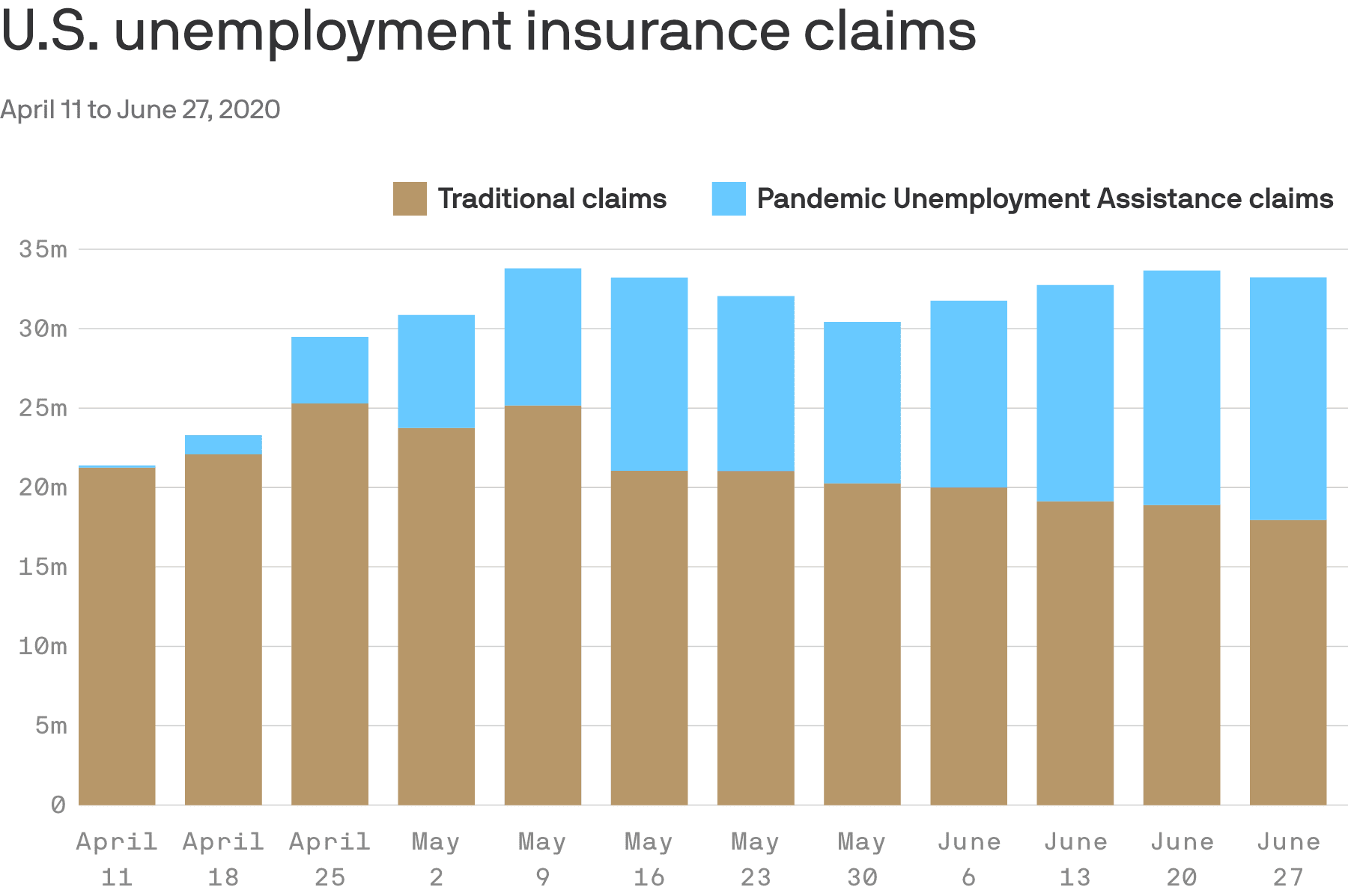
Nearly four months after the coronavirus pandemic began to rock the economy, the number of people filing claims for unemployment insurance because of COVID-19-related job losses is increasing.
By the numbers: Applicants for the newly created Pandemic Unemployment Assistance program have risen consistently since the week ending April 11 when the government first started reporting claims figures.
- It is now hovering at around 1 million new claims a week, while the number of continued claims, or people approved for and receiving aid under the program, rose to 14.3 million for the week ending July 4.
- Pandemic Unemployment Emergency Compensation — a separate program that provides additional benefits to individuals who previously collected state or federal unemployment compensation but exhausted those benefits — is rising toward 1 million weekly claims, with new claims touching more than 936,000 for the week ending June 27.
Why it matters: The increases in pandemic-specific unemployment claims started well before the recent surge of coronavirus infections.
- That suggests the job losses were the result of firms laying off workers because of lost business rather than government-mandated closures or caution due to the virus.
- That likely means a significant increase in claims is coming as more municipalities lock down to prevent further spread of the virus.
The big picture: A total of 32 million people were receiving unemployment benefits, according to the latest total from the Department of Labor.
- But those numbers were two weeks behind in counting the number of people approved for traditional unemployment benefits and three weeks delayed for PUA and PUEC recipients.
- Including traditional and PUA unemployment claims, another 2.4 million people filed first-time jobless claims for the week ending July 11.
Between the lines: Jobless claims are still more than double the worst weeks in U.S. history.
- The previous record high was 695,000, set in 1982.
- The U.S. has now seen 17 straight weeks of claims totaling over 1 million.
What's next: "The risk of a surprise drop in employment in July is rising, pointing to a rollercoaster recovery as the labor market starts to turn down again,” Glassdoor senior economist Daniel Zhao told Yahoo Finance.
Of note: This week's unadjusted claims number shows an increase of almost 109,000 from the prior week, while the seasonally adjusted figure shows unemployment claims down 10,000 from the prior week's level.
- Seasonal adjustments are typically used to smooth out data, but have caused significant changes in numbers and sometimes even turned employment losses into gains since the waves of mass job losses started in March.
