Timeline: The early days of China's coronavirus outbreak and cover-up

Add Axios as your preferred source to
see more of our stories on Google.
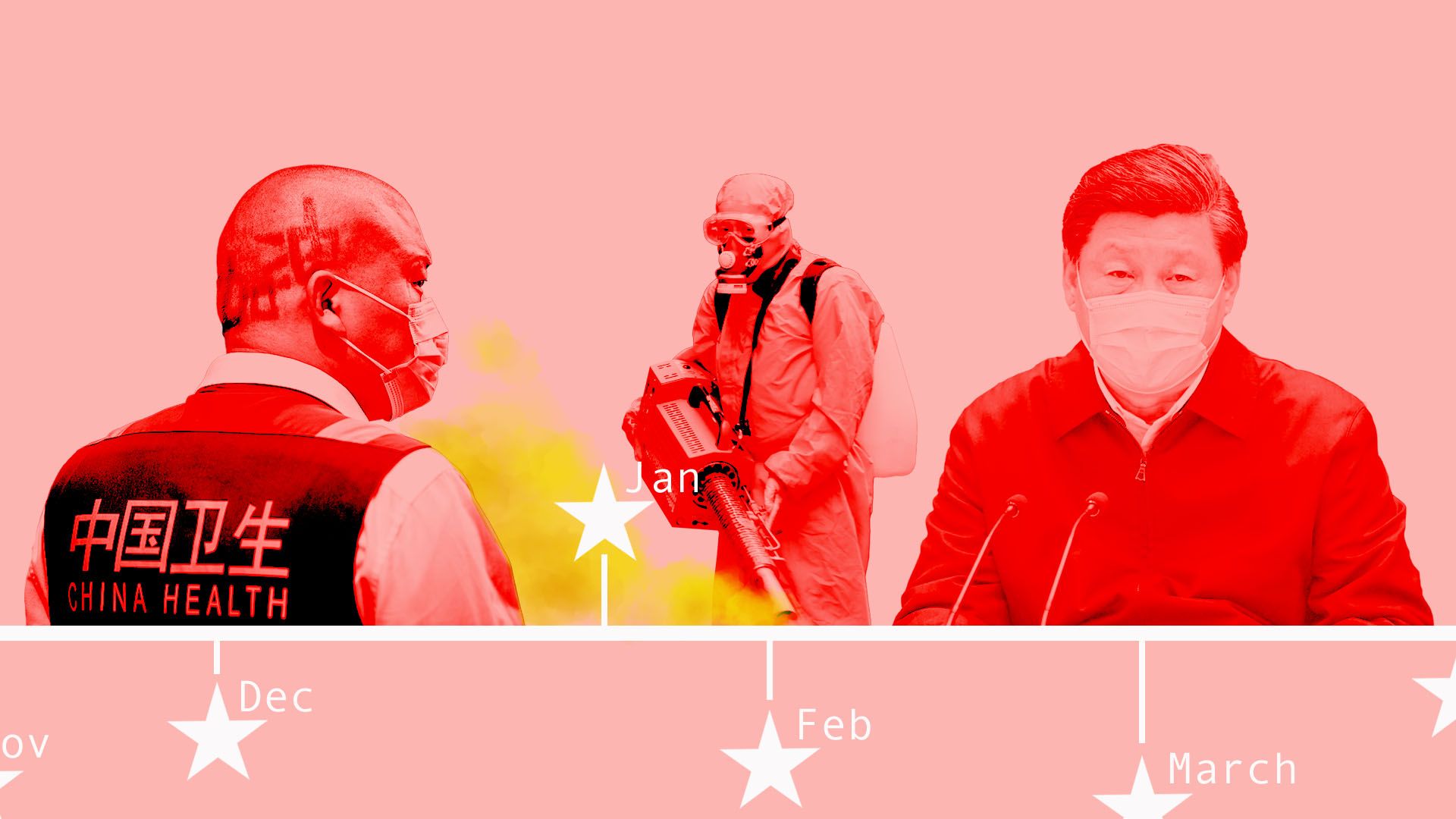
Photo Illustration: Sarah Grillo/Axios Photos: Stringer/Getty Images, Feature China/Barcroft Media via Getty Images, Peng/Xinhua via Getty via Getty Images
Axios has compiled a timeline of the earliest weeks of the coronavirus outbreak in China, highlighting when the cover-up started and ended — and showing how, during that time, the virus already started spreading around the world, including to the United States.
Why it matters: A study published in March indicated that if Chinese authorities had acted three weeks earlier than they did, the number of coronavirus cases could have been reduced by 95% and its geographic spread limited.
This timeline, compiled from information reported by the Wall Street Journal, the Washington Post, the South China Morning Post and other sources, shows that China's cover-up and the delay in serious measures to contain the virus lasted about three weeks.
Dec. 10: Wei Guixian, one of the earliest known coronavirus patients, starts feeling ill.
Dec. 16: Patient admitted to Wuhan Central Hospital with infection in both lungs but resistant to anti-flu drugs. Staff later learned he worked at a wildlife market connected to the outbreak.
Dec. 27: Wuhan health officials are told that a new coronavirus is causing the illness.
Dec. 30:
- Ai Fen, a top director at Wuhan Central Hospital, posts information on WeChat about the new virus. She was reprimanded for doing so and told not to spread information about it.
- Wuhan doctor Li Wenliang also shares information on WeChat about the new SARS-like virus. He is called in for questioning shortly afterward.
- Wuhan health commission notifies hospitals of a “pneumonia of unclear cause” and orders them to report any related information.
Dec. 31:
- Wuhan health officials confirm 27 cases of illness and close a market they think is related to the virus' spread.
- China tells the World Health Organization’s China office about the cases of an unknown illness.
Jan. 1: Wuhan Public Security Bureau brings in for questioning eight doctors who had posted information about the illness on WeChat.
- An official at the Hubei Provincial Health Commission orders labs, which had already determined that the novel virus was similar to SARS, to stop testing samples and to destroy existing samples.
Jan. 2: Chinese researchers map the new coronavirus' complete genetic information. This information is not made public until Jan. 9.
Jan. 7: Xi Jinping becomes involved in the response.
Jan. 9: China announces it has mapped the coronavirus genome.
Jan. 11–17: Important prescheduled CCP meeting held in Wuhan. During that time, the Wuhan Health Commission insists there are no new cases.
Jan. 13: First coronavirus case reported in Thailand, the first known case outside China.
Jan. 14: WHO announces Chinese authorities have seen "no clear evidence of human-to-human transmission of the novel coronavirus."
Jan. 15: The patient who becomes the first confirmed U.S. case leaves Wuhan and arrives in the U.S., carrying the coronavirus.
Jan. 18:
- The Wuhan Health Commission announces four new cases.
- Annual Wuhan Lunar New Year banquet. Tens of thousands of people gathered for a potluck.
Jan. 19: Beijing sends epidemiologists to Wuhan.
Jan. 20:
- The first case announced in South Korea.
- Zhong Nanshan, a top Chinese doctor who is helping to coordinate the coronavirus response, announces the virus can be passed between people.
Jan. 21:
- The U.S. Centers for Disease Control and Prevention confirms the first coronavirus case in the United States.
- CCP flagship newspaper People’s Daily mentions the coronavirus epidemic and Xi's actions to fight it for the first time.
- China's top political commission in charge of law and order warns that “anyone who deliberately delays and hides the reporting of [virus] cases out of his or her own self-interest will be nailed on the pillar of shame for eternity."
Jan. 23: Wuhan and three other cities are put on lockdown. Right around this time, approximately 5 million people leave the city without being screened for the illness.
Jan. 24–30: China celebrates the Lunar New Year holiday. Hundreds of millions of people are in transit around the country as they visit relatives.
Jan. 24: China extends the lockdown to cover 36 million people and starts to rapidly build a new hospital in Wuhan. From this point, very strict measures continue to be implemented around the country for the rest of the epidemic.
The bottom line: China is now trying to create a narrative that it's an example of how to handle this crisis when in fact its early actions led to the virus spreading around the globe.
Go deeper: China's coronavirus cover-up was among worst in history, congressman says
Editor's note: This story will be updated as more information is reported.
Sign up for Bethany's weekly newsletter, Axios China.
