Why student success needs a new definition

A message from: Digital Promise
As AI, neuroscience and new models of teaching converge, schools are rethinking what it means to help every student thrive.
Digital Promise CEO Jean-Claude Brizard shares how redefining student success and personalizing learning can help close long-standing gaps and empower every learner.
1. First things first: How would you describe the shift from focusing on education systems and structures to reimagining how students actually learn?
Brizard: For so long, we've focused on structural reforms. There is consensus now that unless one is impacting the relationship between learners, teachers, families and high-quality content, nothing will meaningfully change. It has to come down to what happens in classrooms, and we in education have not focused enough on the neuroscience of learning.
For example, there are folks who would say that poverty impacts learning. What we now better understand is that the stresses associated with poverty have a detrimental effect on the developing brain, which impacts learning.
The school of psychology is finally connected to the school of education.
2. The strategy: As AI changes what and how we learn, how should we redefine student "success" at the national level?
Brizard: AI is not going to reshape how our students learn; AI is going to help us better understand how to implement strategies to improve learning in our classrooms. We will have no choice but to elevate our curricula, pedagogy and assessment.
People have historically focused on what I refer to as a myopic definition of success — focusing on reading and math proficiency, which are critical, but are means to an end. They are necessary, but not sufficient conditions for success.
Parents have a much broader goal for their children: happiness, economic mobility, agency, success in life, health and well-being, etc.
A child lives in an active ecosystem, but too often we boil it down to narrow data points, whereas AI can help us make connections across the different parts of the 360 degrees of a child's life to really understand what's going on, so interventions, accelerations and support can all be put in play.
3. What you need to know: Neuroscience and learning sciences have uncovered new insights about how people learn. How can these findings reshape classroom practice and support learner variability?
Brizard: The school of psychology has understood learner variability for a long time.
Every single person has a jagged learner profile, but everything in education is built around the 'average' person: the three-hour test, a 45-minute period, the Carnegie unit.
Now we're seeing the connection between AI and neuroscience in practice. One very specific example of that is a project we have here at Digital Promise called the U-GAIN Reading Center.
It's investigating how to use GenAI to improve reading instruction and individualize reading supports, particularly for multilingual learners at the elementary school level.
That's where the magic is beginning to happen: where learning sciences, technology, innovation and practice are coming together to better serve all students, especially our growing population of multi-lingual learners.
4. Here's how: AI can transform learning — but it can also amplify inequities if used poorly. How is Digital Promise ensuring that technology empowers all learners?
Brizard: Educators will transform learning, and AI is a tool and perhaps an accelerator for making that actually happen.
There are so many people saying they want to wait for AI to be ethical before they use it. But it's already here. It's going to be ubiquitous. You can't wait for it to become ethical. What are you doing to make it safe, effective and ethical?
Districts have to be smart consumers, and organizations like Digital Promise and our partners are providing avenues, like product certifications — the EdTech Index — to help school systems understand what is efficacious and what is not; what is ethical and what is not.
We've developed an AI literacy guide that is now being used across the world. AI literacy and fluency are foundational to help mitigate the challenges that are presented in AI.
5. The goal: You've said education must become more human-centered. What does that look like in practice — for both students and teachers?
Brizard: Education is human development, and we have to keep remembering that you're developing a human being, not a widget. One way that can show up is to have learner-centered orientation.
The questions I keep asking are: Where is a student's voice in this? How is learner agency manifested in the work?
When I was a superintendent, I lived by a tagline: Every child is a work of art; create a masterpiece. It was a reminder that every child is different. They bring assets and challenges, but it's our collective work to create masterpieces; the best that each can be.
The curriculum itself has to demonstrate that you are always focusing on the needs of students, giving them a voice and agency in their own learning, and at the same time, thinking about learner variability.
6. Next steps: How is Digital Promise helping schools and partners across PK-12, postsecondary and industry reimagine learning to build the skills students need to thrive?
Brizard: Understanding the trajectory and the gap between bureaucracies is key.
At Digital Promise, we think about:
- What's happening in early learning.
- Transitions — PK to K, K-12 to post-secondary — and the kinds of workforce innovation being put in place to make sure someone is successful in life.
- The future of assessment.
- STEM education.
Why is it that we have such massive attrition in STEM majors, especially for underrepresented learners, who are historically and systematically excluded from full participation in our economy?
What can we do, for example, to redesign a university chemistry class to radically improve completion? We get to that granular level, but we also get into the entire trajectory of a learner's journey.
7. The takeaway: What gives you hope about the future of learning — and the role of organizations like Digital Promise in shaping it?
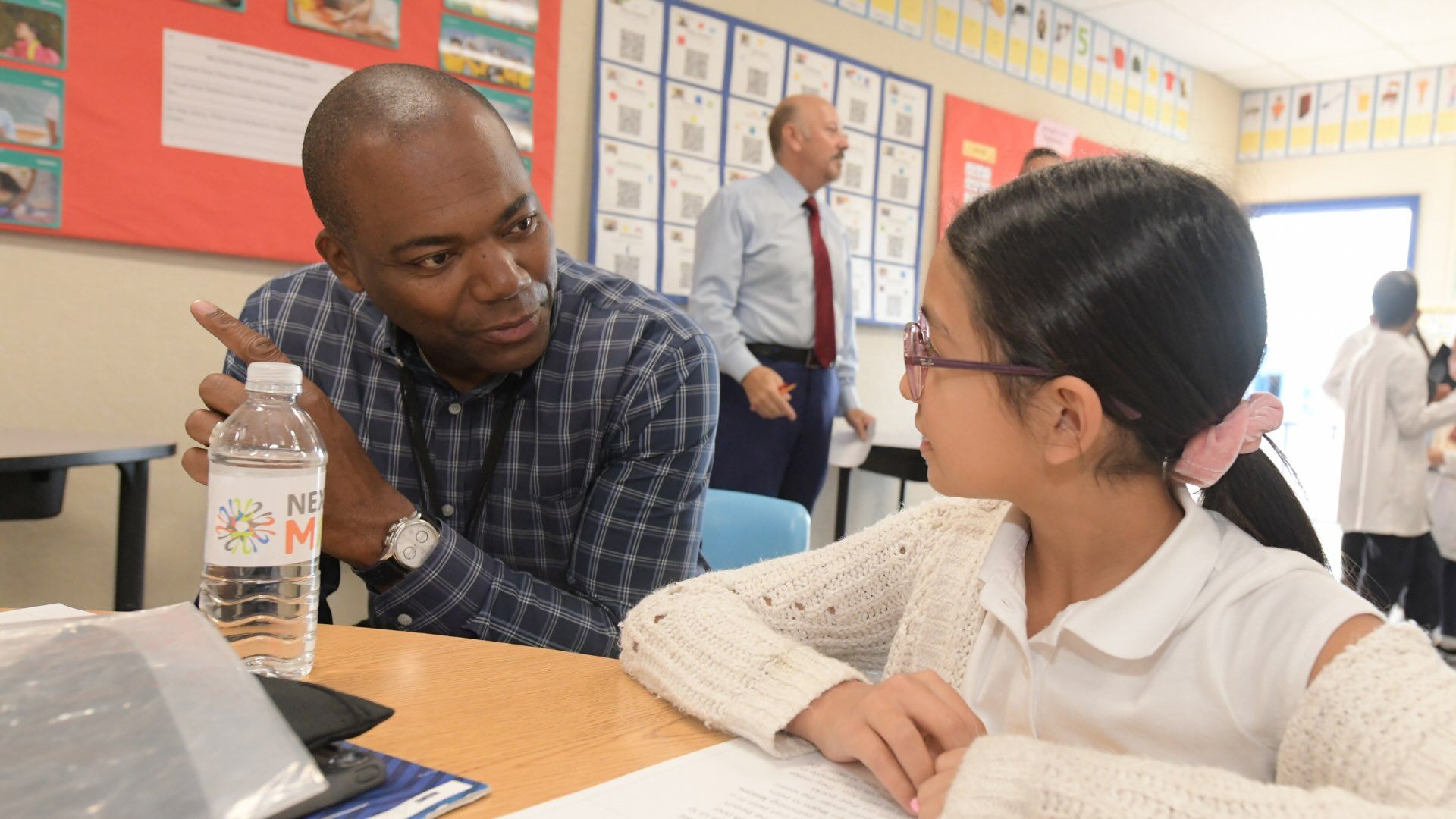
Brizard: As a first-year principal, I had a mentor say: 'You're going to get depressed in this job. You're gonna get upset. Whenever that happens, find a good teacher and a good classroom and sit there for a while. And that will give you hope.'
I do that as often as I can. And when I see teachers and students engaging in real, powerful learning, it makes my heart sing.
What gives me hope is seeing that dedication being amplified by thoughtful, human-centered innovation. We have to make sure that AI is a powerful tool to augment, not replace, the roles of teachers and learners.
At Digital Promise, that's our focus. Through our research and our collaborative work with practitioners and those in edtech, we're leading the charge to leverage AI's potential for every learner. It's about taking that "powerful learning" I saw in the best classrooms and making it more attainable for kids everywhere.
Learn more about Digital Promise's approach to AI in education.