Why COPD needs more champions in Congress

A message from: Alliance for Patient Access
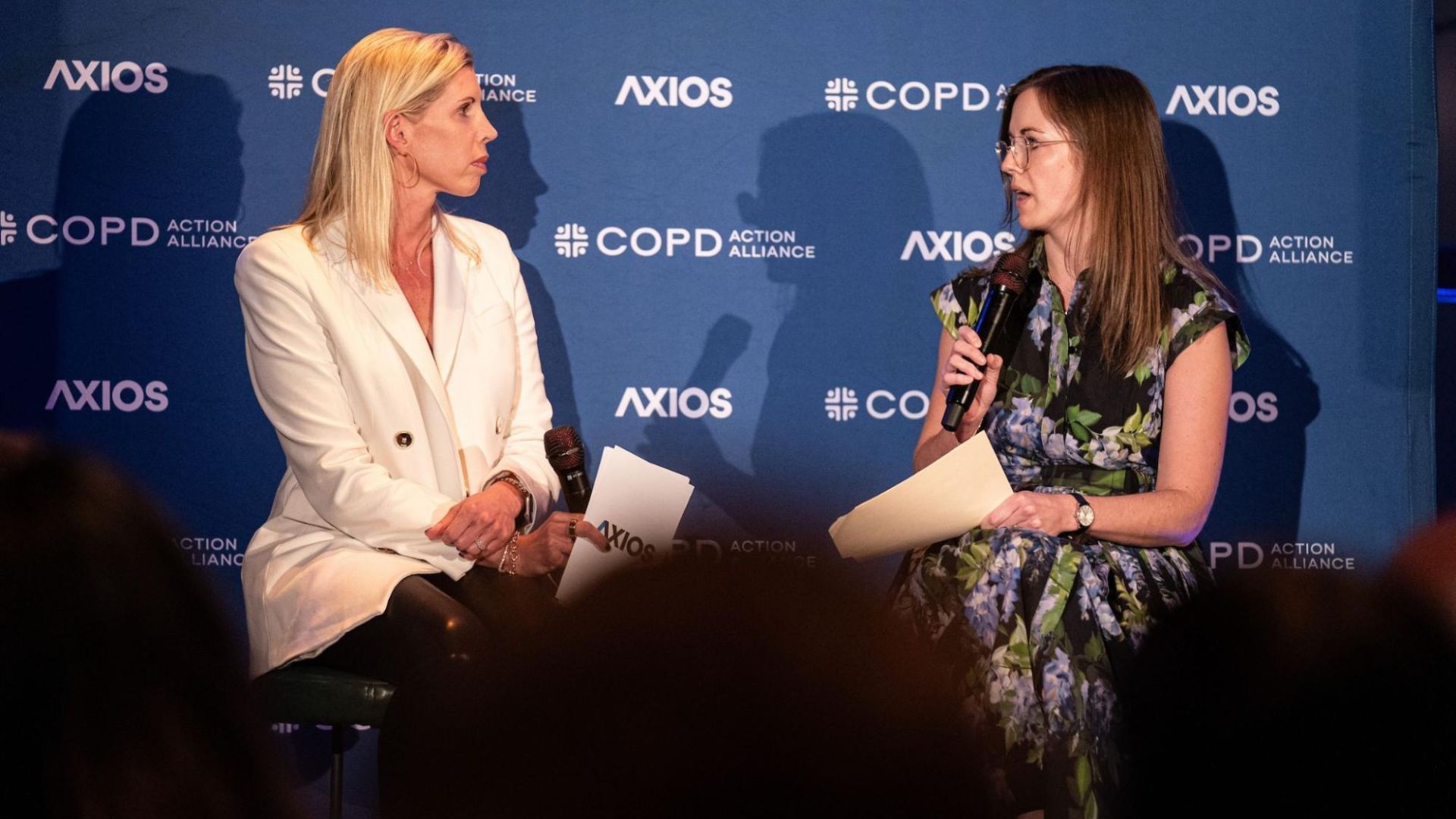
Kristen Burkhalter and Josie Cooper, executive director of the Alliance for Patient Access.
In honor of World Chronic Obstructive Pulmonary Disease (COPD) and COPD Awareness Month, Axios' Kristen Burkhalter spoke with Josie Cooper, executive director of the Alliance for Patient Access, about the urgent policy priorities in respiratory health and how the COPD Action Alliance is pushing for change.
The background: What are the key factors that are still out there that are making COPD one of the most significant public health crises?
Cooper:
- COPD is a progressive, debilitating lung disease. There are about 30 million Americans who are living with COPD, and almost 17 million of those, we estimate, are not even yet diagnosed. You're dealing with a massive challenge in an undiagnosed population.
- COPD is the sixth leading cause of death in the United States. I think sometimes people are really taken aback by that statistic, because frequently we know of some of the other leading causes of death, right? Cancer is discussed. It's talked about openly. It's prioritized. Heart disease, same thing. Unfortunately, what we find is in COPD, there is less willingness to talk about it, there's less policymaker prioritization. It's a community that, in a lot of ways, is unsupported by policy.
- There's a couple of key reasons why we think that's true. One is stigma. There is a continued kind of connection or belief in COPD as the smoker's disease, and that leads to a lot of challenges for patients who need care, who want to seek treatment, who maybe aren't prioritized.
- There are educational programs that are underfunded. COPD is woefully underfunded in terms of research dollars, and we don't have enough congressional champions for this community.
The story: What does the COPD Action Alliance do, and what is your organization doing to combat COPD?
Cooper:
- The COPD Action Alliance is a patient advocacy coalition that was established about a year ago, really with the aim of convening stakeholders in the COPD space to coalesce on shared priorities, to identify areas that we could collaborate, and then to do that from a shared voice.
- We have been doing that now for about a year, working with COPD-specific organizations, working with respiratory health organizations, provider groups, patient groups and care partner groups.
- We've been able to host a number of congressional meetings, events, state policy events — all with the aim of increasing policymaker, federal and state policymaker awareness of COPD and prioritization of the disease.
More info: What are the current policies that are addressing COPD and more importantly, what needs to be fixed and added?
Cooper:
- COPD is not a new issue for policymakers, though a lot of times it sometimes feels like one. Almost 10 years ago, with a lot of support from the COPD community, Congress recognized the burden of COPD, and they directed NIH to pull together a report. In 2018, NIH published the National Action Plan on COPD, which put forth forward-thinking ideas — a national blueprint on how we could more effectively diagnose, treat, screen and address the needs of the COPD community.
- It outlines five key pillars for how to move forward — including how to advance screening, prevention, diagnosis, treatment; how to ensure patients are empowered; how to move policy forward and translate it into actionable programs.
- But there were some limitations. The report left funding benchmarks up to Congress, and that has been a limiting factor in being able to move forward the recommendations that were put forth and put them into action. We're supportive of those pillars and what's been laid forward. But we need funding and we need increased focus on this from policymakers.
Worth a mention: At the congressional level, what action needs to be taken now? What was your call to action today?
Cooper: There's bipartisan legislation right now that the COPD community supports that would drive forward progress for patients.
- The first I'll mention is medication access. We did our first COPD Action Alliance patient survey earlier this year, really trying to understand the patient experience with COPD — getting access to a diagnosis, getting access to their treatments. One of the findings was that about a third of patients we surveyed said they had a medication access issue. These are patients who've gotten to the right treatment but find that insurance protocols won't necessarily let them get it.
- Utilization management used by health insurers limits access to treatments. Congress can pass the Safe Step Act, a bill that would help reform some of those insurance barriers by putting into place guardrails against step therapy, which is an insurance tactic that forces patients to try and fail the treatments their insurer wants before accessing their prescribed treatment.
- The SOAR Act would increase access to supplemental oxygen for Medicare patients — a critical part of COPD care. The COPD community has endorsed this because it would meaningfully help patients.
- Beyond that, we need longer-term solutions and congressional support for COPD patients. One of our core asks is for help to reestablish the Bipartisan Congressional Caucus. COPD needs more champions in Congress.
- We've also emphasized the importance of the appropriations process — both for funding and for setting clear priorities around COPD. We were very excited to see the Senate and House include language urging prioritization of COPD and asking CMS to take a closer look.
The takeaway: Is there one inspirational tidbit you'd like to share with the group?
Cooper: I'll just say, what we've been met with as we've done meetings is a lot of questions — but a lot of interest. When you can really help folks understand the burden and the impact of the disease — and the fact that this is treatable — it becomes easier for them to get behind.