The role of science in America's prosperity and progress
A message from: A Vision for American Science and Technology
Science and technology aren't just essential for solving some of the world's biggest problems.
- They're also key to maintaining U.S. leadership in an increasingly competitive global landscape.
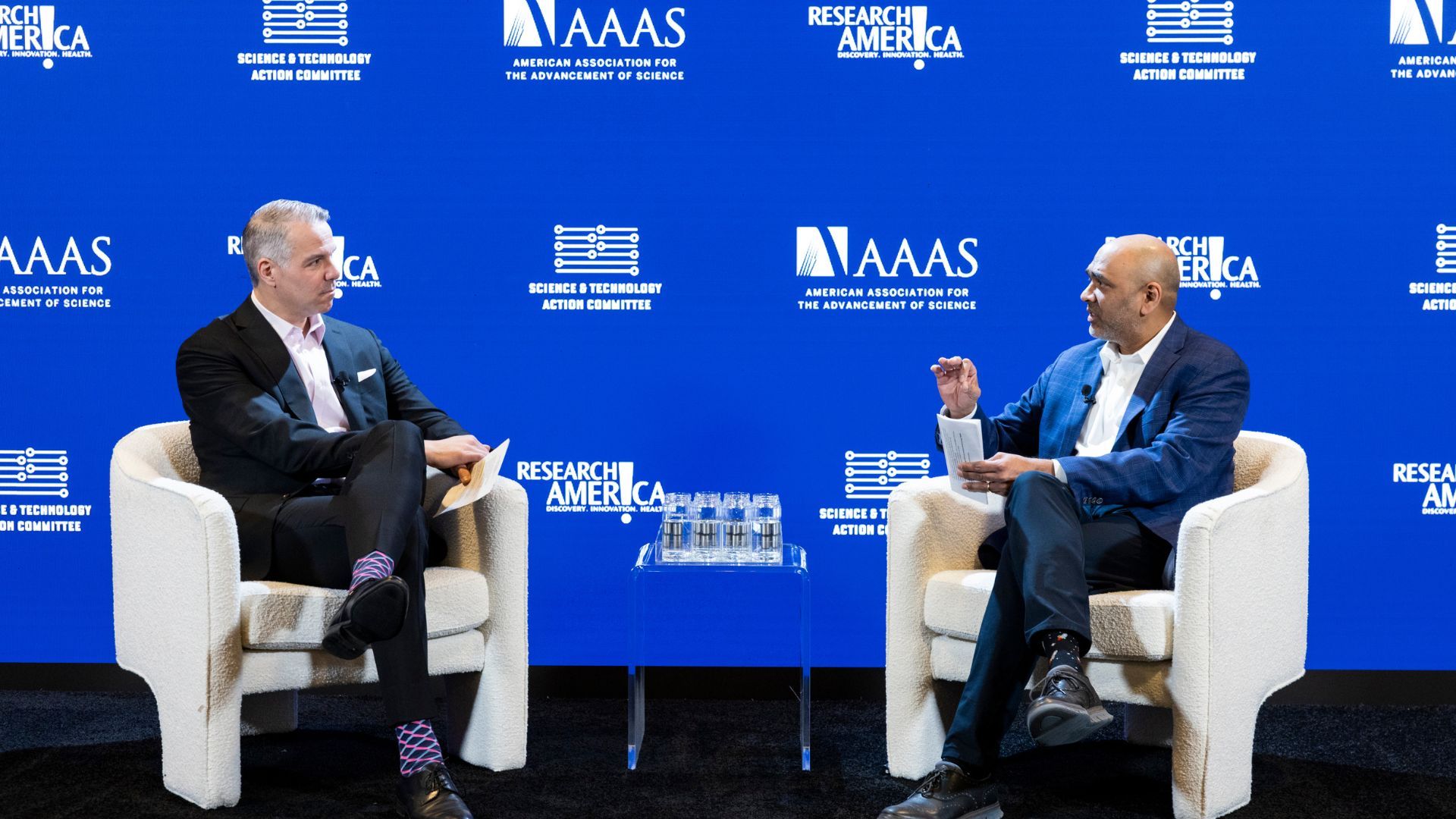
Sudip Parikh, Ph.D., chair of the Vision for American Science and Technology (VAST) Task Force, recently discussed why investing in innovation is critical.
1. First things first: What is the Vision for American Science and Technology (VAST)?
Dr. Parikh: We're in this existential race with other countries — and with big challenges.
- VAST is a game plan. We're not going to play defense. We're going to play offense.
We have to know what we want to conquer as a scientific enterprise and how it relates to and benefits the country.
2. What you need to know: What makes VAST unique?
Dr. Parikh: VAST recognizes that science and technology are not about scientists and labs alone. It's about the entire country. It's about mechanics. It's about factory workers. It's about farmers. This is an enterprise that brings in all of us.
- How are we going to feed 7 billion people? Ensure we have great jobs and great economic prosperity? Ensure we are going to live longer, healthier lives?
All of that has to be rolled into this enterprise, and VAST pulls together folks to represent that — the engineers, the investors and more.
3. Why now: What's at stake here?
Dr. Parikh: We are living in a moment of extraordinary progress. You see it across every domain. We also live in a moment when we are in an existential race with other countries around the world.
We've found that science and technology are the only things that enable us to have big step-function changes in our prosperity, health and well-being.
- If we are not the ones who are investing and creating the environment in which science and technology can flourish, other countries will — and it's really hard to catch back up.
- We also know there are really big existential challenges out there — like food and water insecurity and the need for energy that's easily transmitted around the country. If we don't solve those challenges, we'll be lesser for it.
4. Some solutions: How does VAST recommend we solve these problems?
Dr. Parikh: VAST has folks from across the political spectrum, geographies and occupations, and the consensus is real and powerful: We have to do three things.
First, we need to unleash the burdens around our science and technology enterprise. That means having the right tax policy to incentivize investment and reducing regulatory issues.
- For example, as a scientist, is there really a need for three different forms for the Department of Energy, the National Science Foundation and the National Institutes of Health when making a proposal for a biosketch? That's a lot of administrative burden.
Second, we need to create the workforce necessary for a leading science and technology enterprise. We have talent all across this country. How can we ensure those individuals have the opportunities and support to reach their full potential?
- We also want to continue to serve as a beacon for the talent we've drawn from around the world. It's made us a country where exciting things that change the course of humanity happen.
Third, we need to ensure we're investing properly. The U.S. government invests about $200 billion a year in science and technology. The private sector — industry and philanthropy — invests almost $800 billion a year.
- That $200 billion from the U.S. government is critical and enables the rest of the research. The more dollars we put in from the Feds, the more investment comes in from industry. In turn, we get job growth, economic success and national security.
5. Looking ahead: If we get this right, what does the future look like?
Dr. Parikh: If we get this right, we can build a country that has a strong economic foundation with domestic supply chains and manufacturing.
No other country has all these pieces: the scientists, the engineers, the industry, the finance and the philanthropy that's willing to take big risks. That is something we should be incentivizing.
- We need policies that recognize that science isn't just about those investments or just about science policy. It's about tax policy, immigration policy and education policy.
6. The takeaway: What's your message to policymakers and thought leaders?
Dr. Parikh: We are an extraordinary country. Over the last 80 years, we've really built the foundations of the modern world.
What got us here isn't going to get us to the next level, because we have to rise to the challenges of our own generation and make sure we have the proper policies.
- We've got to be willing to open our minds and say, "Science and technology are so important to the country that we are going to have an aspiration of what the enterprise ought to be, and then we are going to be inspired to make it happen."
That's offense, not defense.