The AI supercycle tests the world's network infrastructure

A message from: Nokia
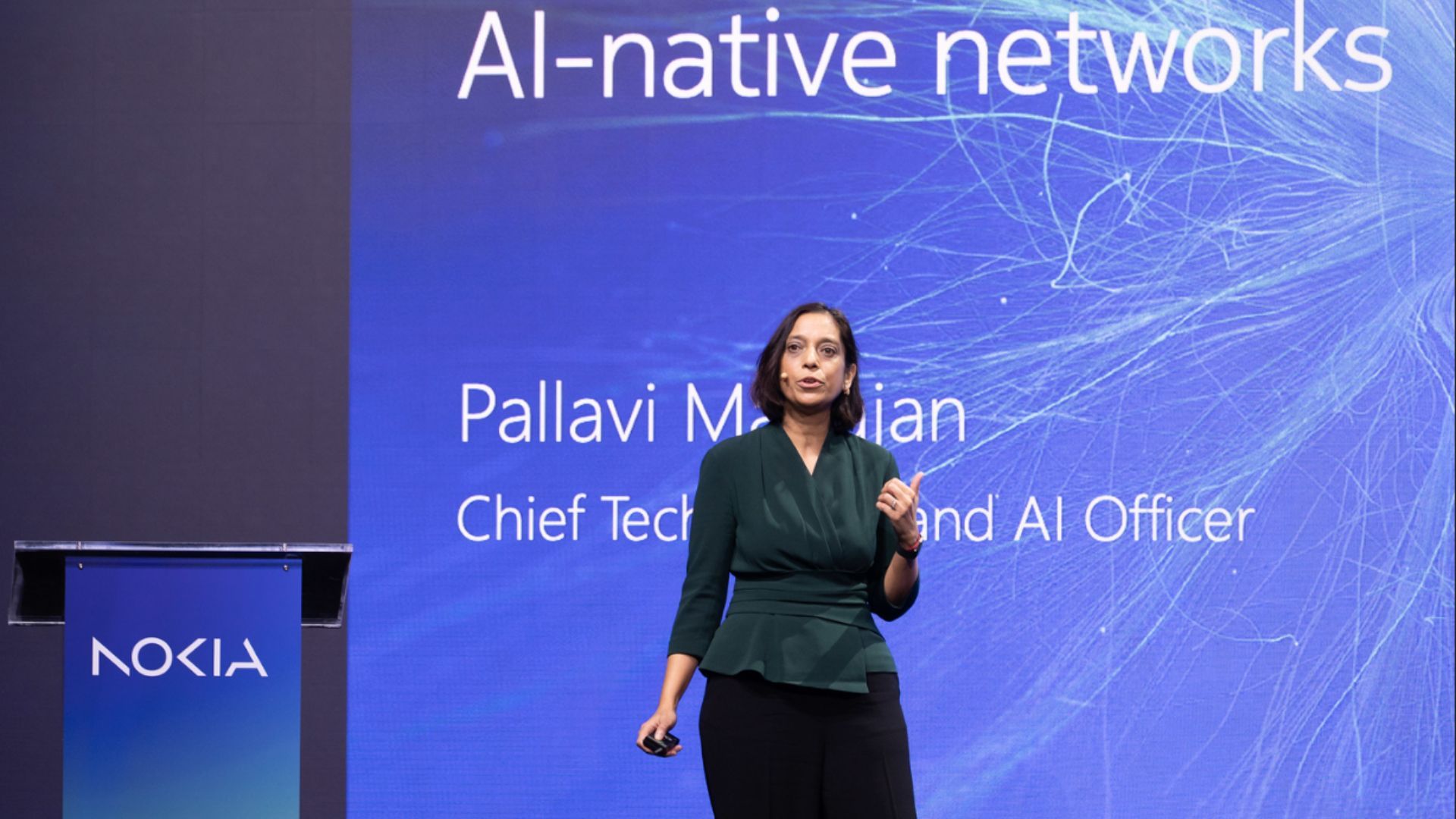
Nokia Chief Technology and AI Officer Pallavi Mahajan
Nokia-commissioned research in the U.S. and Europe points to a shared reality: AI is scaling faster than the networks built to support it.
The background: To understand how network infrastructure is holding back the next wave of innovation, Nokia conducted two major studies, one across the United States and one across Europe, surveying more than 2,000 senior technology decision-makers and analyzing where AI ambitions are hitting real-world limits.
The findings were clear: AI is outgrowing (and stressing) today's networks, which were originally engineered for downlink-focused consumer use, such as browsing websites and video streaming.
- Workloads are becoming more uplink-heavy, data flows are more distributed and expectations around latency, throughput, resilience, security and energy efficiency are rising.
AI applications — from autonomous vehicles and smart manufacturing lines to surveillance drones and remote health care diagnostics — generate large volumes of data at the edge that must be transmitted upstream for processing, making them uplink-intensive.
An expert take: As Nokia's Chief Technology and AI Officer Pallavi Mahajan explains, the global AI supercycle will be constrained without substantial network infrastructure investment.
- "Future waves of the AI supercycle demand more advanced, AI-native networks and substantial investment to strengthen network requirements. Connectivity, capacity, and low-latency performance are becoming ever more essential ingredients for transforming how devices interact, industries operate, and people live and experience technology as AI moves forward."
Why AI-ready networks matter
"AI is an economic stimulant," Mahajan says. "AI doesn't just reward the company that adopts it, it upgrades the whole ecosystem: partners plan better, operations run smoother, services get more reliable and productivity compounds across the value chain."
The result: If companies adopt AI, they become more productive, open new revenue streams and improve service delivery. If governments adopt it, public services can become more efficient.
- "An AI-ready economy is best positioned to drive growth and attract investment," she says. "Our North Star is to use advanced connectivity to create a brighter future — jobs, societal well-being and long-term prosperity."
Strategic network infrastructure choices now will determine who shapes the next decade of intelligent innovation.
Energy scarcity could reshape economies across regions
Energy figures prominently in any discussion about scaling AI growth. In both reports, respondents in the U.S. and Europe cited energy availability as a growing concern. In particular, today's electricity grids were designed many years ago without a sustained, AI-intensive workload in mind; and that is causing power bottlenecks and cost pressures.
- "AI is placing unprecedented strain not just on networks, but on the power grids that support them," Mahajan says. "As AI workloads drive denser compute, higher utilization and continuous operation, grid availability and energy efficiency are becoming critical constraints on where and how infrastructure can scale."
Key numbers:
- In the U.S., 54% of companies say energy costs will materially impact their AI expansion.
- In Europe, 61% are moving or considering moving compute abroad due to energy constraints and costs.
The consequences can stack quickly. Where energy is abundant, ecosystems grow — and where it isn't, they are capped.
Transatlantic opportunity for industry and policymakers
Nokia's latest research highlights a shared understanding across the network ecosystem, in the U.S. and Europe, that next-generation network capabilities are essential to support increasingly complex AI workloads.
- That includes perspectives from operators, enterprises and partners about the capabilities they need from next-generation infrastructure to scale AI effectively.
What this means: This environment presents an opportunity for collective action across industry and government to strengthen the digital foundation on which future AI innovation depends — to modernize networks together and ensure the U.S. and Europe fully capture the benefits of the AI supercycle.
- Nokia encourages collaboration across the network ecosystem and support for more simplified and predictable regulatory environments that enable timely network investment.
"Unlocking the full potential of AI will require coordinated action across operators, enterprises, policymakers and technology partners," Mahajan says. "Together, the U.S. and Europe have a unique opportunity to modernize networks, accelerate innovation and ensure AI delivers real-world impact at scale."
Learn more about Nokia's research and its vision for AI-ready infrastructure.