Study: Students have declining confidence that free speech is secure

A message from Knight Foundation
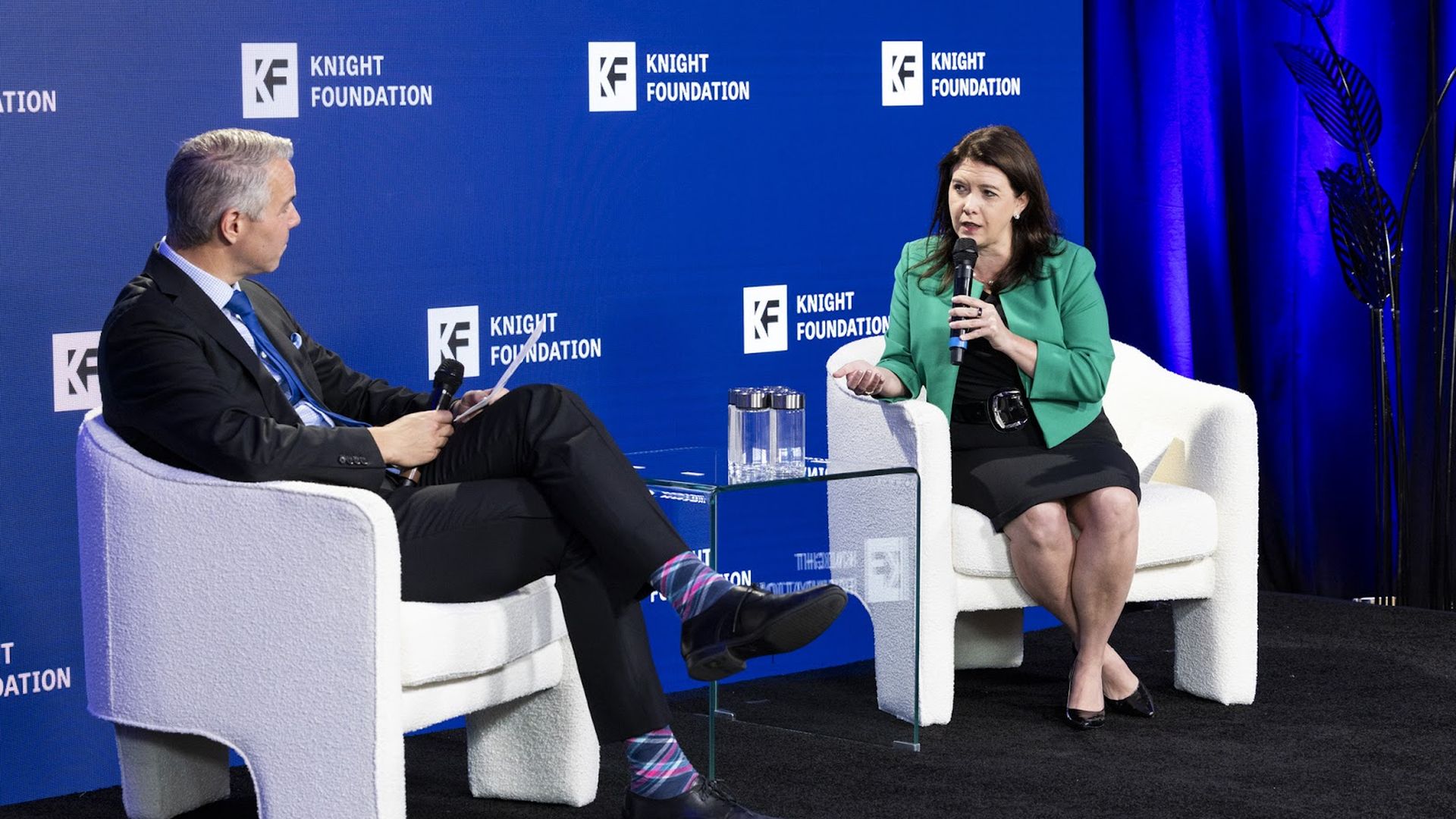
It's been a tumultuous year for college campuses as they reckon with protests that put free speech in the spotlight. Knight Foundation recently released a new study in partnership with Ipsos that analyzed free speech views among college students.
Chris Frates, founder of Storyline, sat down with Ashley Zohn, vice president of Learning and Impact at Knight Foundation, for a View From The Top segment to discuss the study's key findings.
1. First things first: Why is freedom of expression so important to Knight Foundation?
Zohn: We all know how important freedom of expression is to our democracy.
Knight Foundation was founded over 70 years ago by John S. and James L. Knight, who owned Knight Newspapers. They believed that a well-informed community is essential to a well-functioning and representative democracy.
- You can't have that without freedom of speech and freedom of the press. If we can't express ourselves, if we can't challenge authority, we can't pursue our own interests.
In addition to the grant-making that the foundation is known for, we have also commissioned research. We've studied everything from what makes you love, where you live, to trust in media.
We have a new partnership with the Pew Research Center called the Pew-Knight Initiative, which is all about how Americans engage with civic information.
- But our longest-running research series is on attitudes toward free expression, and it's actually been one of our most important research series over time.
2. The impact: Knight Foundation measures attitudes toward free expression among college students and recently put out a new study. What trends have you seen over the last eight years as you track this?
Zohn: We've been studying student attitudes for a long time. That's really important in this context, because we've been talking a lot about free speech on campus this year.
- We believe it's important to hear from the students whose lives are being shaped by the policies on campus. That's why we do this research.
We have seen some important trends over the last eight years. And the most important one is that since 2016, we've seen a dramatic decline in the percentage of students who feel like free speech is secure in America today.
- Back in 2016, 73% of students believed that free speech is secure. In the report, we just put out it's 43% of students. So that's a 30-percentage point drop in just eight years.
That being said, students value their speech. 90% of them say that free speech is important to them.
- When they're asked to choose whether the campuses should allow students to be exposed to speech that they might find offensive, or protect them from speech they might find offensive, the majority of students think speech should be allowed and that they should be exposed to speech.
- We are seeing, though, that the minority who want to be protected is growing. So, it's something that we think we need to pay attention to.
Overall, students think that their campus environments prevent people from saying things that others might find offensive.
3. On the other hand: How do college students view hate speech now compared to eight years ago?
Zohn: We do ask students if they think hate speech should be legally protected, and they're split about 50/50, a slight majority don't think hate speech should be protected.
- We're seeing more students now think hate speech should be protected, but they really don't want hate speech on their campus.
- 75% of students don't think hate speech should be allowed on campus.
A few other things I want to point out from the report:
We're really seeing students be much more uncomfortable with their own speech and their own ability to express themselves.
- This year, students are less likely to say that people like them can say whatever they want — and that's especially true for Black students.
For the first time this year, we dove into self-censorship and the extent to which students are not willing to say their own beliefs, particularly in the classroom. We wanted to understand how it affects the educational environment.
- Two-thirds of students believe that self-censorship hinders the educational value of things happening on campus. They know that it's affecting the environment, but they're afraid to say what they believe.
- We asked if in a classroom they might self-censor topics that might come up like race, gender, LGBTQ, religion, etc. On any given issue, between 25% and 40% of students would not say what they really believe.
4. The story: What does this research tell us about college students? What are the implications of what Knight Foundation found?
Zohn: The first thing is that they are interested in learning how to productively disagree.
Only about one-third of them know of any program on their campus to learn how to better have a constructive conversation with someone they disagree with.
- Among students with nothing like that on their campus, more than half desire that kind of programming.
The other thing we found is that there's a relationship between the extent to which students trust the faculty and administration and their own openness to sharing their ideas.
- So, if campuses work to improve the trust between the faculty and the administration, it's also likely to affect the speech environment.
5. Looking ahead: What should the audience take away from this year's study and where we're headed on this issue?
Zohn: We do this study to make sure that student voices are heard. So, journalists, national commentators, we're encouraging folks to listen to the students.
- And students can use it to elevate their own perspective. We really want campus leaders and faculty to hear that students are struggling. They want to figure out how to balance these free speech principles with this discomfort with speech.
We hope that colleges and universities will lean into this opportunity to really help students both express their ideas and engage in productive dialog. There's a lot to be done before the school year starts — but it's also an incredible opportunity for these campuses.
It's really about listening and building trust.