Preply report finds a growing gap in workforce learning

A message from: Preply
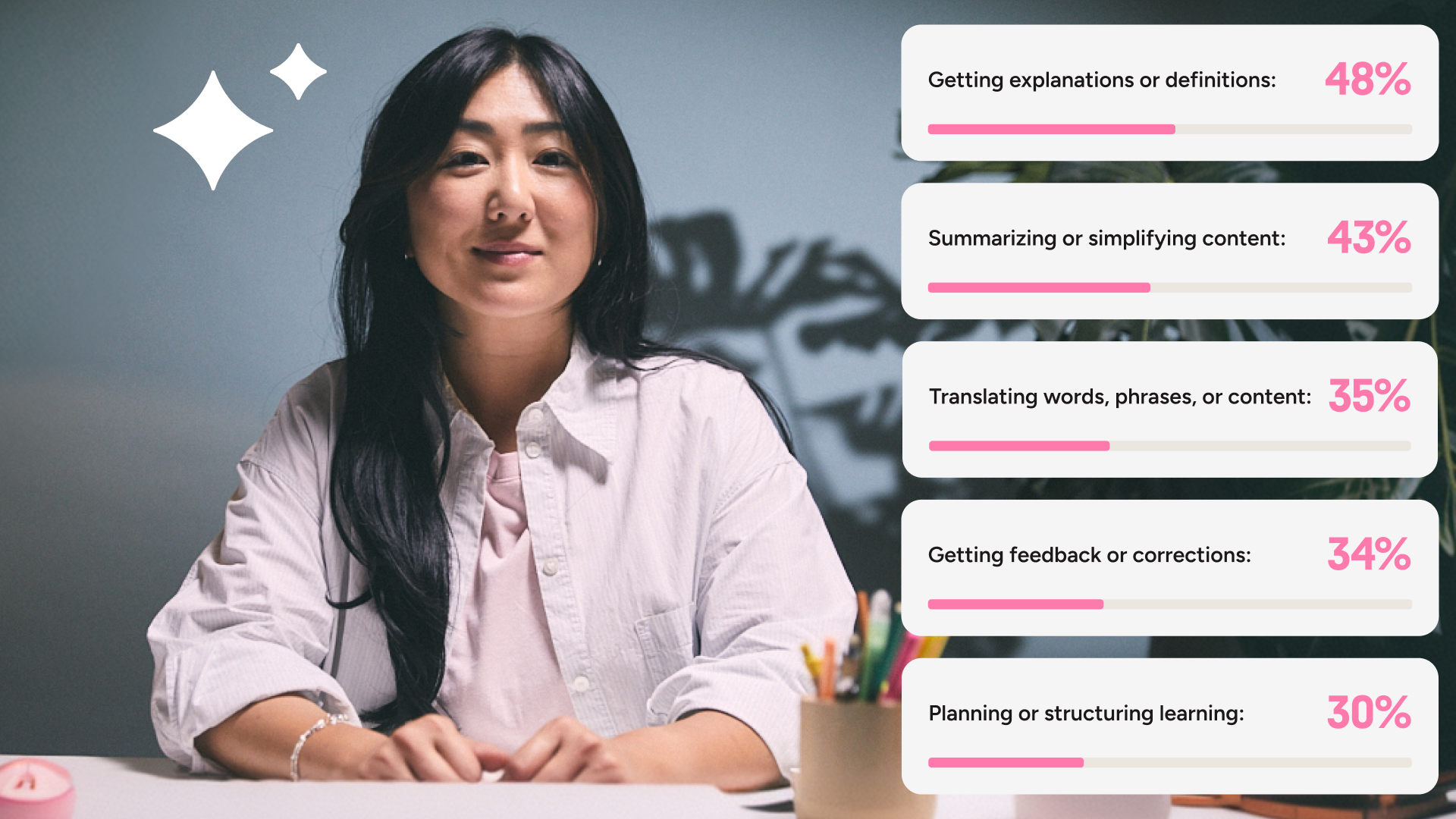
How people are using AI in learning today, according to a new report by Preply.
With the widespread adoption of AI, workers have never had more ways to learn. The harder question is whether all that learning is making them better at what they do.
AI can explain an unfamiliar concept almost instantly and answer questions on demand. But knowing something and being able to use it when the stakes are real are two different things.
- Preply calls the distance between the two the Progress Gap.
Why it's important: Digital learning has made activity remarkably easy to measure, from lessons completed to time spent learning. But activity isn't the same as ability.
As AI removes barriers to information, simply consuming more knowledge becomes a less useful measure of progress. What matters is whether someone can take what they've learned and apply it without an AI-generated answer in front of them.
- "AI is incredibly good at making knowledge more accessible, personalized and immediate, but knowing something and being able to use it are two different things," says Sofia Tavares, Chief Brand Officer at Preply. "Progress happens when people have opportunities to practice, get feedback, make mistakes, adjust and try again. That interaction is key."
The proof: Preply's first annual Progress Report surveyed more than 5,000 working professionals across nine countries and found a workforce putting more effort into learning without always feeling more capable.
- 82% say there are more ways to learn than ever before. Yet 63% feel busy learning without truly improving.
Nearly half maintain a learning routine for months and still struggle to apply those skills at work.
An example: You can watch videos about public speaking and still freeze when you step onstage. Having an extensive vocabulary doesn't necessarily prepare you to navigate the very human reality of eloquently speaking to a crowd.
The distance between those moments is where the Progress Gap lives.
The challenge: The tension is particularly pronounced among the generation most comfortable with AI.
Gen Z leads all generations in AI adoption in Preply's Progress Report, at 92%. Yet it also experiences the largest Progress Gap, with 71% saying they feel busy learning without improving.
- "Learning requires a degree of productive friction," continues Tavares. You have to retrieve information yourself, practice something you haven't mastered, make mistakes and respond to feedback. If AI consistently removes those moments rather than helping you work through them, you may become more productive without necessarily becoming more capable."
That's a meaningful distinction. AI can help someone finish a task faster without necessarily leaving them better equipped to perform that task independently next time.
Here's what else: Learners aren't rejecting AI. They're drawing a line around the role they want it to play.
90% of respondents want AI to support rather than lead their learning.
- That preference echoes Preply's Gen Z Aspirations and Learning Habits Survey, which found that practical, hands-on experience was the most preferred way to learn. Just 7% preferred learning through AI platforms.
The opportunity, then, isn't choosing between AI and human instruction. It's deciding which parts of learning each is best equipped to handle.
The idea: AI can remove friction where friction isn't useful. It can make explanations available on demand and give learners more opportunities to practice.
- Teachers are beloved for a reason. A great teacher can see when someone is struggling, know when to push or encourage them and help build the confidence to use a new skill in the real world. AI can change how we learn, but that human connection will remain essential.
Preply sees those roles as complementary.
How it's done: Preply combines AI-powered learning with a network of more than 150,000 human tutors across 180 countries.
- AI can support learners between sessions. Tutors can then use live interaction to test whether knowledge holds up when someone has to respond in the moment. That shifts the goal from completing more learning activities to building capability a learner can actually use.
The takeaway: AI is making knowledge abundant. That raises the bar for what learning needs to accomplish.
The next frontier of learning is helping people to cross the distance between understanding something and being able to do it.
In an AI-first world, the most revealing measure of progress may also be the simplest: Can you use what you've learned when it matters?
Explore Preply's Progress Report on how AI is transforming learning.