Nokia charts its course for the AI supercycle
A message from: Nokia
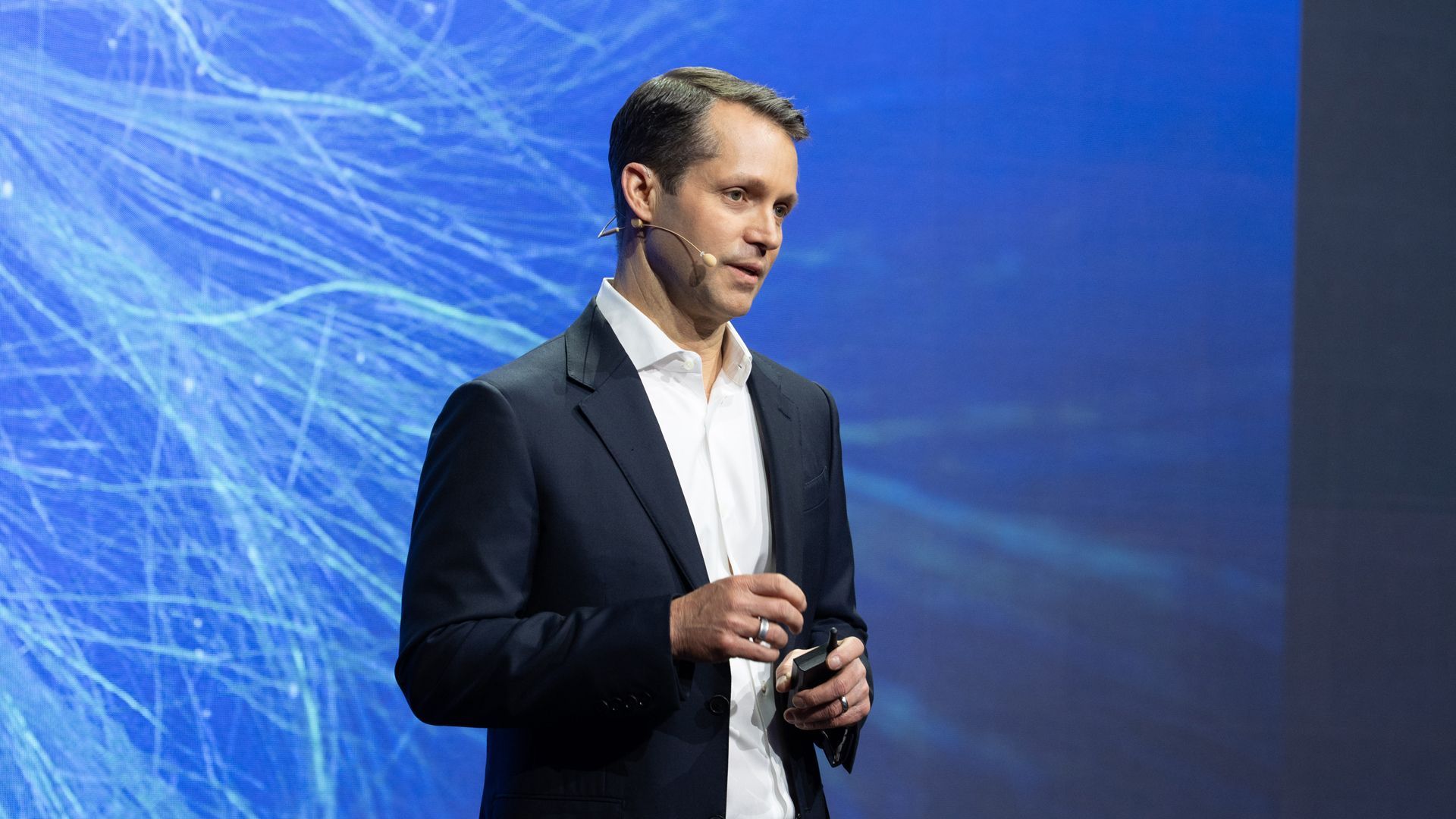
Justin Hotard, President and CEO of Nokia
Nokia just hosted its 2025 Capital Markets Day in New York, where it announced a new strategy and a simplified operating model to position the company on a strong path to lead, innovate, serve its customers and create shareholder value.
"Nokia once changed the world by connecting people. Today, we're ready to lead again, this time by connecting intelligence in a world that has already been transformed by the start of the AI supercycle," says Justin Hotard, President and CEO of Nokia.
Why it's important: The first wave of the AI Supercycle is already reshaping industries, economies and advancing human progress.
AI adoption is scaling faster than any technology in history — and that impact is redefining how networks are built, managed and monetized.
- Today's AI growth is driven by data-center construction and connecting these centers to one another.
- And as intelligence moves beyond the data center — into the physical world — it will transform how devices interact, how industries operate and how people live and experience technology.
Nokia's new strategy positions the company at the center of this shift for the years ahead.
"As the trusted western provider of secure and advanced connectivity, our technology is powering the AI supercycle," says Hotard. "To deliver intelligence everywhere, connectivity will need to be ubiquitous, trusted, adaptable and effectively invisible. Connectivity will need to be optimized in real time and able to support the demands of tokens with the right bandwidth, latency and security."
Nokia's new strategy will focus on five strategic priorities:
- Accelerate growth in AI and Cloud.
- Lead the next era of mobile connectivity with AI-native networks and 6G.
- Grow by co-innovating with customers and partners.
- Focus capital where Nokia can differentiate.
- Unlock sustainable returns.
Together, these priorities will focus Nokia on where it can lead, simplify how it operates, and strengthen its path to deliver growth and create value.
Structural clarity for an intelligent future
Nokia will reorganize its business into two primary operating segments, Network Infrastructure and Mobile Infrastructure. What sets Nokia apart from its competitors is that the company brings together the entire network — radio, core and transport — to solve its customers' most complex challenges.
- Network Infrastructure includes Optical Networks, IP Networks and Fixed Networks. This segment already sits at the center of the AI Supercycle, and it's where Nokia is already capturing the early waves of AI-driven demand.
- Mobile Infrastructure integrates Core Software, Radio Networks and Technology Standards, uniting the systems that make wireless networks intelligent, adaptive and ready for 6G. Nokia believes Mobile Infrastructure is where the next wave of innovation and opportunity will come from — as we lead the industry toward AI-RAN and, ultimately, AI-native 6G.
In addition, Nokia is also launching Nokia Defense as an incubation unit to serve as the central go-to-market and R&D hub for Nokia's defense portfolio.
The new unit will focus on defense-grade connectivity solutions based on Nokia's core technologies to provide secure, resilient systems designed to meet the needs of government partners in the AI era in the U.S., Finland and other allied countries.
- "Connectivity is essential for modern defense," Hotard says. "Our goal is to incubate this business and give it room to innovate."
The details: The reorganization, taking effect January 1, 2026, will give each business clearer focus, accountability and freedom to innovate at speed.
- Hotard says the new structure will sharpen focus by aligning capital, especially R&D, around areas of highest opportunity. "It's about focusing where we can deliver real value and differentiation for our customers," he says, citing large-scale markets like telecom, AI and cloud providers, and mission-critical enterprises in defense.
An organization focused on the AI supercycle
Nokia's transformation marks a return to the company's founding spirit of innovation, this time at the scale of intelligent networks.
"This is the next chapter of Nokia. Focused, differentiated and trusted — and putting points on the board in the AI era," Hotard concludes.
With sharper priorities, disciplined execution and a clear purpose to connect intelligence across industries and nations, Nokia is positioning itself once again as a company that shapes how the world communicates.
Learn more about Nokia's vision for the future of connectivity.