Minute by minute: How Visa's teams and tech fight fraud

A message from: Visa
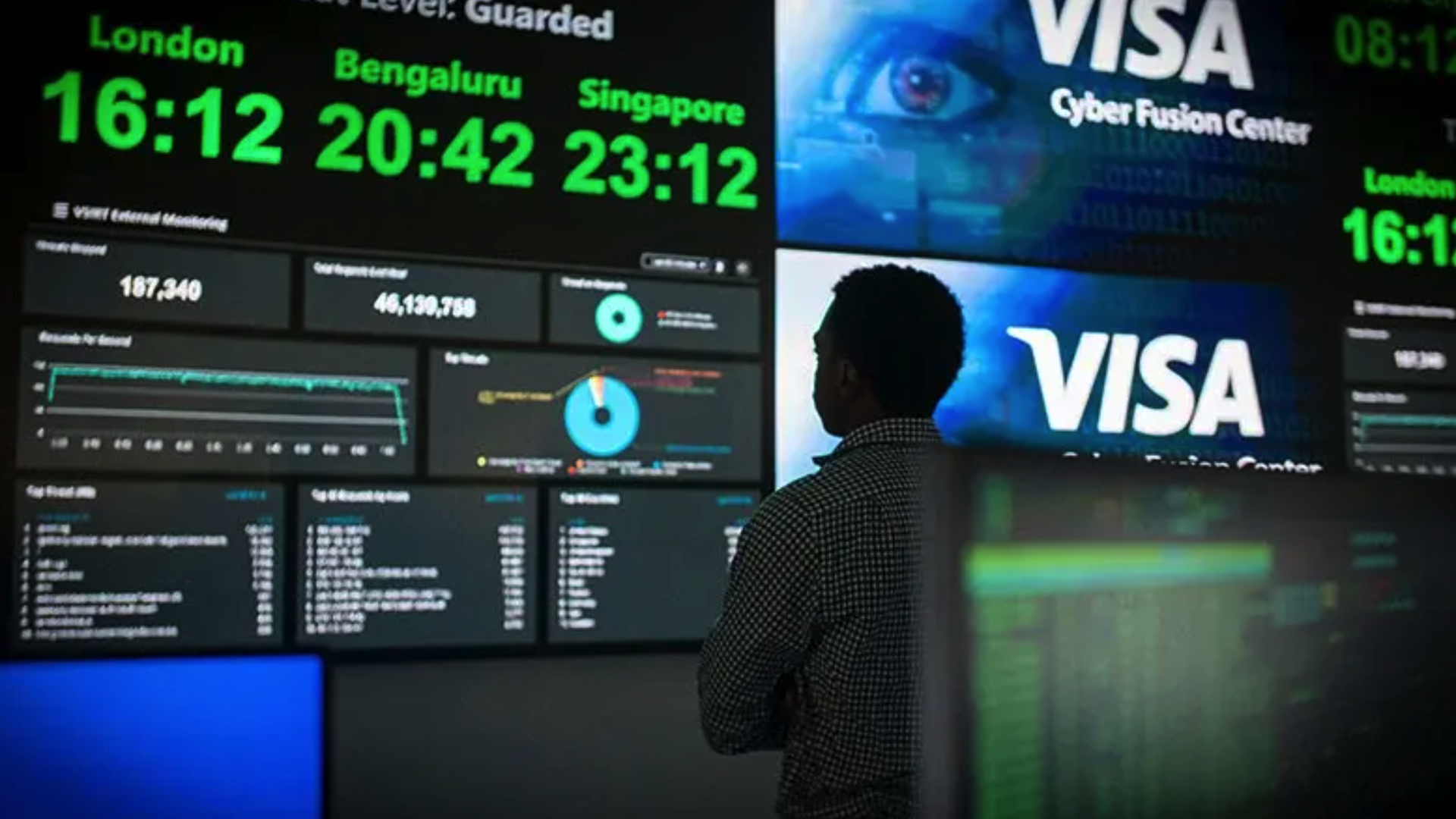
As holiday spending surges, so do fraud attempts.
Why it's important: Advances in AI allow for faster, smarter and more scalable fraud — but Visa's teams and technologies are working just as quickly to block it.
In 2024, on Cyber Monday alone, Visa blocked nearly 85% more suspected fraudulent transactions globally compared to 2023.
- In fact, the entire 2024 holiday shopping season saw a spike in attempted fraud worldwide.
The positive news: Visa has invested more than $13 billion in technology and security over the last five years to ensure that, even as threats evolve, they're stopped in minutes — not hours.
On the front line: How Visa neutralizes the most complex threats
Fraud unfolds in split seconds. Visa's Risk Operations Center (ROC) serves as Visa's front line against fraud. Employees monitor 24/7/365 to block more than 500,000 fraudulent transactions each day — most in less than one second.
- The on-the-ground team leverages their expertise and AI-powered tools to quickly analyze data, identify patterns, assess risk and shut down threats.
How it's done: The center has multiple layers of defenses that constantly work to identify and block a whole host of fraudulent transactions.
- More complex attacks — the ones that require further investigation and refinement — are handled by a team of experts and the latest in AI tech.
The goal: To reduce fraud and false declines. False declines are legitimate transactions that get rejected by banks or payment processors.
- For cardholders, these rejected transactions are a nuisance. Roughly 27% don't return to a retailer after a false decline.
- For merchants, one false decline can cost a retailer $25,000 or more in lost lifetime revenue from a single customer.
It takes just 17 minutes for Visa's ROC team to carefully identify, assess and resolve even the most complex potential threats.
A closer look: Using AI to outsmart fraudsters
Visa's human experts are backed by powerful AI tools.
Take note: For Visa, AI isn't a new phenomenon; the company pioneered AI payments back in 1993.
- Today at Visa, 80% of cyber incidents are AI-investigated, and AI-powered systems prevent billions of dollars in fraud each year.
An example: Enumeration attacks make up a significant share of global fraud, accounting for $1.1 billion in fraud losses each year. These attacks often spike around the holidays, when online shopping surges.
- The details: Fraudsters use automated tools to test stolen or guessed account information. Once identified, valid account numbers can be used to conduct unauthorized purchases.
- As technology becomes more sophisticated, attackers can test ever larger volumes of information at high speeds — amplifying the damage.
A solution: To combat these attacks, Visa built Visa Account Attack Intelligence (VAAI). The AI-powered tool, trained on more than 15 billion VisaNet transactions, identifies and scores transactions.
- Transactions processed through Visa and Visa's issuers receive a real-time risk score in just 20 milliseconds, helping flag potential attacks or approve legitimate transactions without delay.
The impact: The two-digit VAAI Score has cut false declines by 85%, ensuring the network stays safe while minimizing disruptions for cardholders, merchants and banks.
The takeaway: This holiday season, millions of people around the world will swipe, tap and click to pay. Behind every transaction, Visa's ROC — backed by AI-powered technologies — will be working around the clock to detect and contain threats within minutes.
- 17 minutes, to be exact.