How AI is increasing readiness in aerospace and defense industry

A message from: GE Aerospace
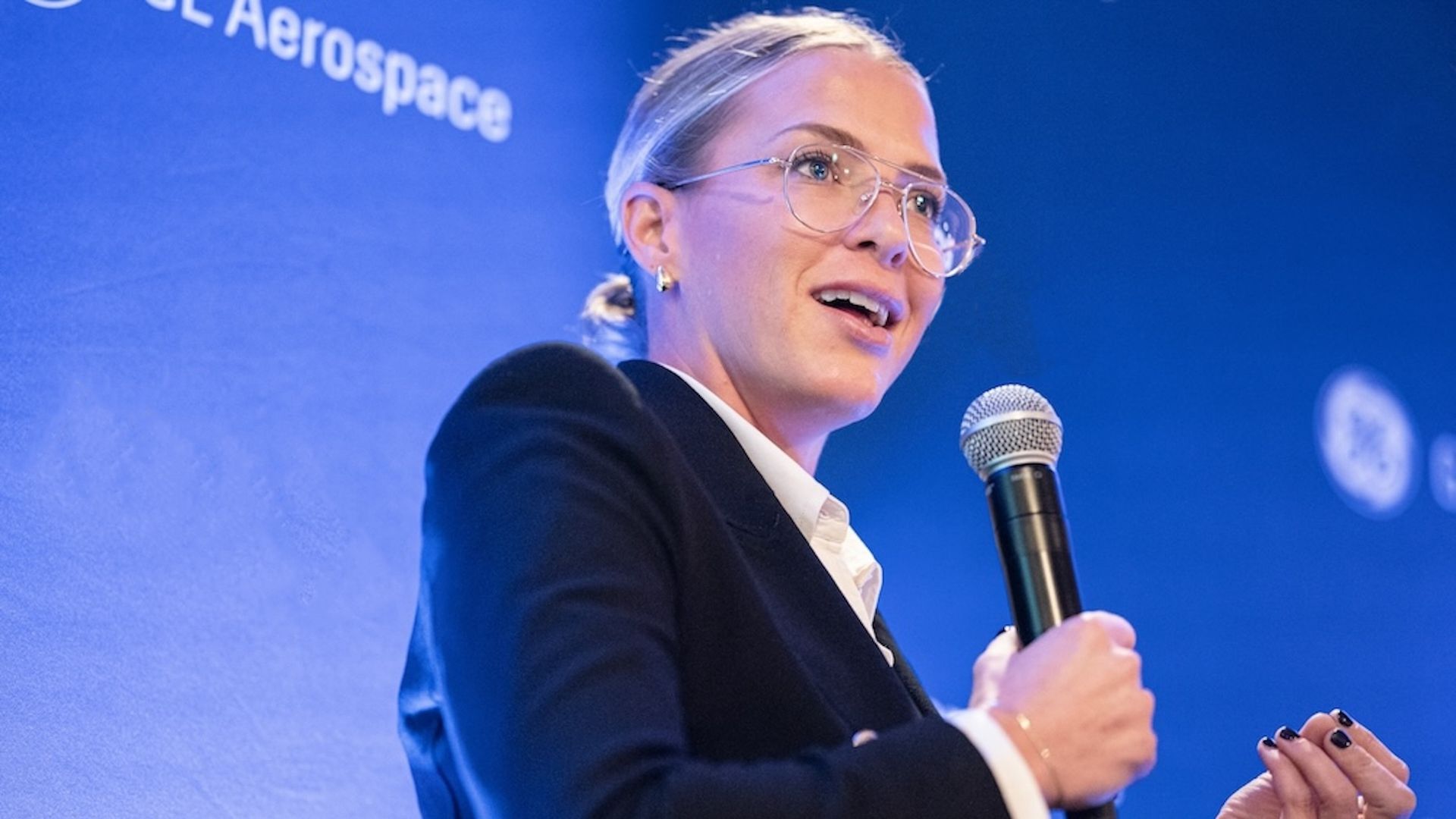
Artificial intelligence (AI) and software are rapidly transforming the defense sector, and GE Aerospace is laser-focused on helping its defense customers use AI to increase readiness, life-cycle costs and make critical decisions.
GE Aerospace's Chief Information Officer of Defense & System Jess Salzbrun highlights how the company's use of AI is enhancing its capabilities — from improving predictive maintenance to developing innovative solutions for the U.S. military.
1. First things first: GE Aerospace is now a standalone company. Tell us a bit more about what you plan to achieve with this recent change.
Salzbrun: As of April 2nd of this year, GE Aerospace is now a fully focused, fit-for-purpose aerospace and defense company.
This has allowed us a new level of focus to support both our commercial and defense customers.
- The background: We've been in the aerospace industry for over 100 years now, and innovation has been at our core since we were founded by Thomas Edison.
GE Aerospace powers two out of every three U.S. military aircraft. It's a responsibility we take seriously.
So it's important that we are using innovation to drive breakthrough capabilities for the warfighter to help our country meet the pace of national security threats. And we're using AI as one way to do that.
- Us being a standalone, fit-for-purpose aerospace and defense company really affords us the focus and the resources to do that.
2. What to expect: What are some of the AI-focused projects that GE Aerospace is working on?
Salzbrun: We got our start in AI a long time ago. Chat GPT and GenAI hitting the mainstream a couple of years ago makes AI feel like it's new but we have been working in AI for over a decade.
GE started using AI with physics-based machine learning algorithms to analyze the performance of our commercial engine fleet.
We have over 44,000 commercial engines deployed today that we monitor in near real-time for key engine performance trends.
Over those 10 years, we've been able to use that technology to drive 60% earlier lead time in identifying predictive maintenance actions. So really, really powerful.
3. The impact: Can you talk more about the real-world impacts or implications of some of those innovations in defense?
Salzbrun: We have taken our commercial foundation in AI and we're now starting to port that over to supporting the defense customer.
We have a couple of applications:
For starters, we hear from our defense customers all the time that from a sustainment perspective, there are two important things: increasing readiness and reducing lifecycle costs.
GE Aerospace, in partnership with Palantir, is undergoing a pilot program with the Air Force to support exactly that mission.
GE Aerospace's J85 engine powers the T-38 trainer aircraft used to train Air Force pilots.
When trying to combat this pilot shortage, you can't train pilots if you don't have planes available for them to fly.
- One of the big challenges that exists in this J85 program is that in the aftermarket —maintenance and repair operations — if you don't have a single part available to repair an engine then that engine sits there in waiting and you're not getting back to flying and training pilots.
The J85 has six thousand separate parts managed by different acquisition agencies.
- It's impossible to try and identify when a single part might not be there when you need it to repair an engine and get it back flying.
We're using AI in partnership with Palantir to not only identify a part constraint that may be happening today, but also to look into the future and say: "Hey, four weeks from now, this is going to be a problem."
- But we're not just identifying the constraint. We're also using AI and large language models to make recommendations to say: "Hey, here's how we recommend that you go solve it."
It has been a pretty impactful pilot that we've been running for the last couple of months and it's been really well received.
4. The strategy: How can the U.S. stay ahead and remain competitive given everything happening in the air space right now?
Salzbrun: In the same way that AI isn't new, software is also not new to our industry.
- You can take it all the way back to the '60s when you had the first ever on-board computer on the Gemini Spacecraft.
- Then that started advancing rapidly into digital fly-by-wire capabilities in the '70s.
- In the '80s, you have flight management systems and it goes on with integrated sensors, modular avionics and predictive maintenance capabilities in the '90s and 2000s.
Hardware/software integration has been this sort of slow burn over the last 60 years, but it's suddenly picking up speed because of the pace that software and AI are coming in to disrupt the industry and change the very nature of warfare.
It's our noble mission to consider how we create a partnership between software and hardware moving into the future. Because it's not an either/or. It's certainly both. We have to lean into that, we have to aggressively move in that direction.
- Otherwise, we're not going to be able to meet the demands of the warfighter. We're not going to be able to deliver affordable mass at the speed that our customers need.
GE Aerospace is really uniquely positioned because we have that hardware history, but we've also been leaders in the software space for a long time. So we're excited to be a part of creating this future together.