Innovation is key to maintaining U.S. air superiority

A message from GE Aerospace
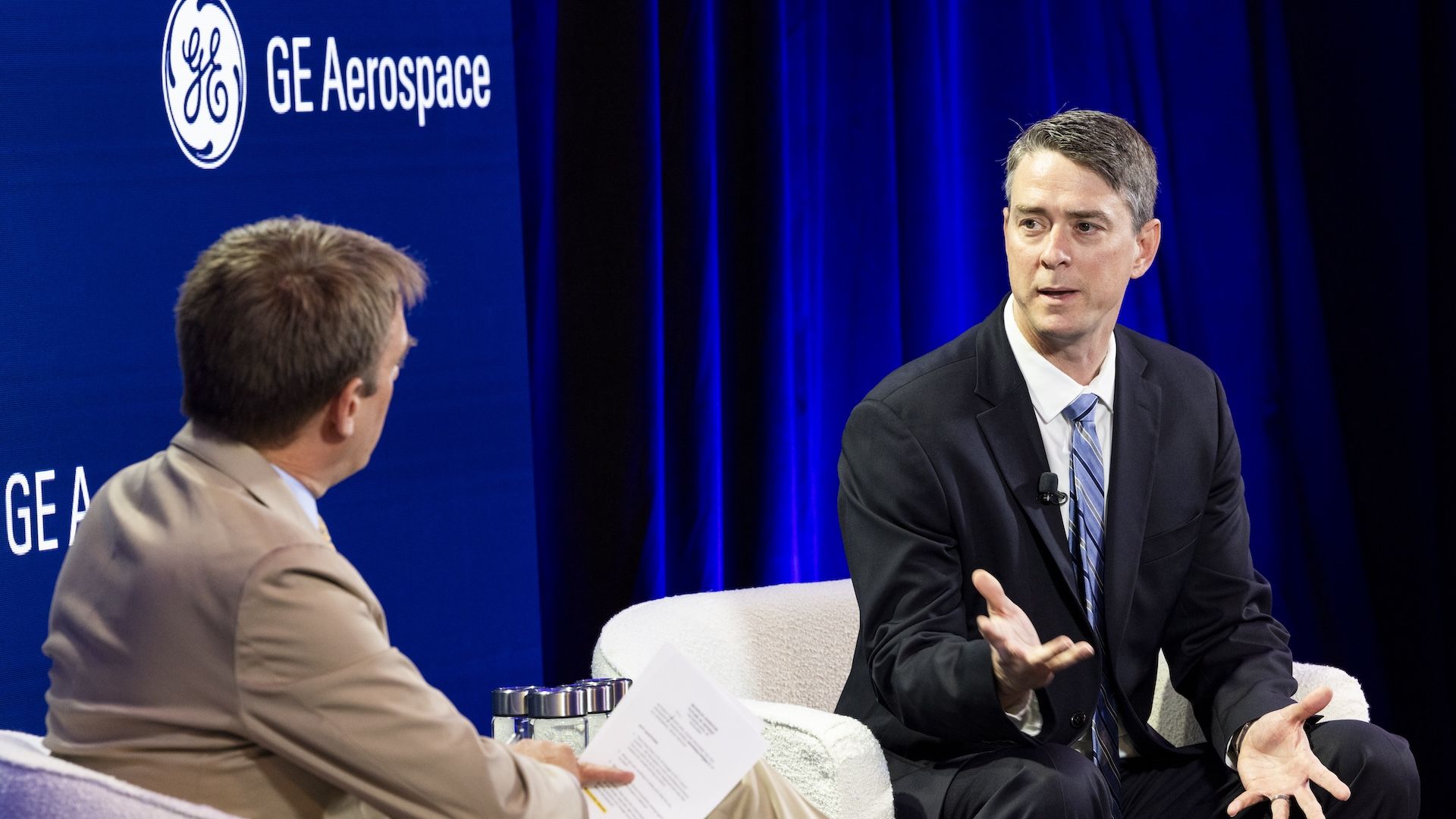
GE Aerospace is continuing its 100-plus-year tradition of innovation to provide new capabilities to the U.S. military.
In a recent interview, GE Aerospace vice president of Edison Works advanced products David Tweedie talked about the company's cutting-edge technologies, ongoing projects and future plans.
1. First things first: GE Aerospace is now a standalone company. Tell us a bit more about that and why it matters.
Tweedie: GE has been in the aerospace business for over 100 years now, delivering superchargers for piston engines and inventing the first U.S. jet engine during World War II.
But on April 2, 2024, we transitioned from being in the aerospace business to being an aerospace business.
Today, we stand as GE Aerospace, a focused aerospace and defense company.
- We're proud that two-thirds of today's aircraft in the United States Department of Defense fleet, rotorcraft and fixed wing, are powered by GE Aerospace products.
- The company is focused on continuing to support and deliver for today's warfighter, as well as thinking through tomorrow.
Why it's important: We live in an evolving world. Our adversaries are investing in and continuing to accelerate their capabilities.
As an aerospace company, we've got to understand this reality, work with our military and defense customers, and invest in the right solutions at the right time to meet the emerging threats.
2. What to expect: What's some of the exciting stuff that GE Aerospace is working on currently?
Tweedie: We really are at an inflection point.
One of the things I really get passionate about is how I get to show up to work every day in a place where technology and innovation really matter to us and our customers.
We're currently working on things like:
New materials.
Our jet engines operate at extremely high temperatures, and we historically have used nickel-based metal alloys in those parts of the engine.
We are now transitioning to ceramic-based material systems that can operate 500 degrees hotter than our current material systems.
- Engines can operate with more power, more efficiency, with more durability.
- It's a generational change, and we're the first company to industrialize those material systems for fielded aerospace use.
New manufacturing techniques, like 3D printing.
We have a whole generation of people who had to constrain their design solutions to what is possible in traditional manufacturing.
We've pioneered 3D printing, and industrialized it for aerospace-grade tolerances and quality requirements.
- Now that unlocks the design engineer to think totally differently about how to bring innovation, technology and capability to our products.
Hypersonics.
We've been a gas turbine engine company for a long time now, since World War II.
We recently announced we're demonstrating hypersonic propulsion systems.
- Today, we have a full-scale, hypersonic propulsion system — a dual motor ramjet on test, that could directly transition into single-use hypersonic applications.
- When you take that hypersonic propulsion system and combine it with our historic state-of-the-art gas turbine engines, you can come up with a turbine-based combined cycle engine that can enable reusable hypersonic vehicles.
That's science fiction today, but what we are working on and demonstrating are the building blocks so that we can turn that science fiction into reality.
3. The results: When can we expect to see these changes actually happen?
Tweedie: I can't tell you the exact date, but we're working on it so that it's in the time frame of relevance.
Let's use today as an example, looking at the Apache and Black Hawk fleet.
- GE Aerospace is proud to have a robust, reliable power plant that's been powering those applications for decades.
- Okay, but: The Army realized that future mission demands will require more.
We are harnessing these technologies I was just mentioning by using ceramic-based material systems and additive technologies in our new T901 engine.
The impact: When you put that together, in the same weight and physical size of today's power plant on the platforms, you can have an engine that is 25% more fuel efficient, with 50% more power.
- The fuel efficiency gives you more range and persistence.
- The power, more payload.
And it's not just for our warfighters that are serving overseas and protecting our interests. It's here at home.
- The Air National Guard, when it comes to disaster relief, disaster recovery and firefighting out west, uses those exact same platforms here to serve our citizens.
Next steps: A few weeks ago, we delivered our first T901 flight test engines to the U.S. Army for the Black Hawk.
- We've been encouraged recently as we saw bipartisan support in the House for restoring full funding for the T901 program.
- We would certainly encourage the Senate to do the same and see this through. That way we can get this capability out of the flight test arena and into the hands of the warfighter, not just those serving overseas, but those serving closer to home with disaster relief.
4. The software: Where does AI fit into your thinking? How is that upending the aerospace industry?
Tweedie: It permeates everything.
The digital transformation allows us to move from analog paper-based design systems to model-based engineering.
- A model-based supply chain linked through a digital thread helps us go at a faster cadence for our customers.
We're using AI to assess the health of jet engines, much like the medical space couples it with radiologists to improve the accuracy of cancer screenings.
- Coupling and supplementing that with AI allows us to do a more accurate job of assessing the health of an engine.
Plus, plus, plus: We're proud to announce that we're doing a pilot program with Palantir to use AI for better fleet management and predictive maintenance to really help our customers with the logistics and readiness.
5. The strategy: How can the U.S. Military keep the lead with new technologies in aerospace?
Tweedie: It's a team sport. It's industry, DoD and Congress coming together to deliver these capabilities.
History has shown that when in conflict, technology and capability overmatch can be decisive.
- Today's issue in Ukraine is the counterfactual of what ends up happening when you don't have that overmatch.
As an aerospace company, we think every day about things like air superiority and how can we, collectively as a team:
- Understand the threat, the technologies and capabilities needed to overcome the threat.
- Harness them into actual products and capabilities.
- Get them across the goal line into the hands of warfighters.