4 ideas from the Skoll World Forum on expanding economic opportunity

A message from: Skoll Foundation
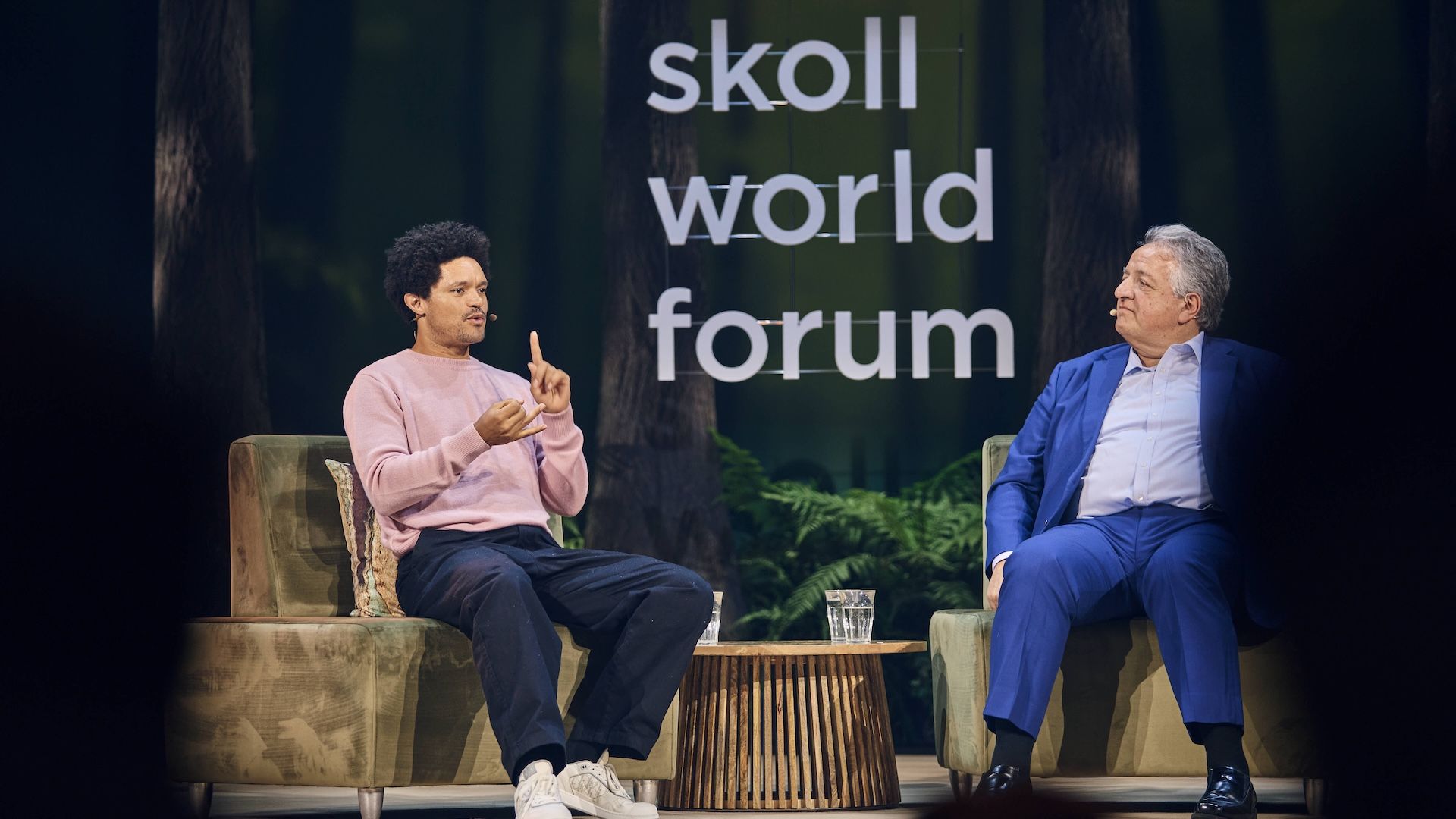
Economic mobility feels out of reach both in the U.S. and around the world, as people struggle to translate education into employment and find jobs that are safe from climate and technology pressures.
At the Skoll World Forum on April 21-24 in Oxford, England, changemakers, social innovators and investors made one point clear: Real economic progress at the individual level requires cohesive systems working in tandem, from workforce training to climate resilience, capital flows to women's access to opportunities.
1. An education isn't enough — we need to invest in connecting students, especially girls, to high-quality careers
The challenge: Education systems are often failing to convert learning into steady income, employment growth and leadership down the line.
Across global regions, leaders described the same pattern: Millions are educated, but remain excluded from meaningful work, stuck in informal jobs or unable to translate credentials into economic mobility.
An example: Angeline Murimirwa, CEO of CAMFED, a grassroots movement that provides scholarships to girls in Africa and a 2005 Skoll Awardee, was once in the CAMFED program herself.
- At the forum, she told a powerful story about her own experience. After completing school, one of the first cohorts of scholarship recipients gathered and realized that despite their academic success, they were returning to the same poverty they came from, with no access to jobs, networks or next steps.
- "We ran 100 meters. Can you imagine getting to the finishing line and realizing there is no income at the end of it?" said Murimirwa.
That experience led CAMFED to build its alumni network, now 355,000 members strong, where each woman commits to supporting at least three other girls through school while also providing graduates access to a growing network of mentors and professionals after graduation.
Worth a mention: Skoll Awardees SmartStart, based in South Africa, and ChildLife Foundation, in Pakistan, also provide novel career opportunities for women.
SmartStart is expanding economic opportunity from two angles: by connecting disadvantaged kids to early childhood education that improves their future prospects, while creating dignified jobs for thousands of unemployed women.
- Instead of relying on capital-intensive early learning centers, SmartStart trains women to turn their homes and community spaces into licensed early education businesses, reaching 160,000 children each week while creating income for more than 15,000 practitioners.
ChildLife Foundation strengthens pediatric emergency care through public-private partnerships with government hospitals.
- The organization rehabilitates and manages pediatric emergency rooms inside public hospitals, combining modern facilities, specialist training, telemedicine and AI-supported systems to deliver affordable, life-saving care to children across the country.
Plus: The organization also creates high-quality, safe employment opportunities for women in Pakistan.
- While the country has many highly educated female physicians, cultural barriers and limited local opportunities often prevent them from practicing medicine.
- ChildLife's telemedicine and hospital network enables more women doctors to remain in the workforce while expanding access to pediatric care nationwide.
The takeaway: Across regions, the most effective approaches are those that close the gap between learning and earning, turning individual success into scalable, community-wide economic growth.
2. Sustainability solutions must be tied to economic success for people
The background: The forum discussion highlighted a broader takeaway about the green transition: Solutions are most effective when they align environmentally friendly growth with economic opportunity for local communities.
- Panelists emphasized that sustainability efforts gain traction when they are scalable and designed around the people most directly impacted.
An example: One Acre Fund began in 2006 serving 38 farmers in western Kenya. Today, the organization supports 5.9 million smallholder farmers across 10 African countries, most farming less than one acre of land, with women making up 55% of participants.
Its model combines financing, access to seeds and supplies, farmer training and market access to help increase harvests and incomes.
- About a decade ago, the organization expanded its work to include tree distribution after realizing traditional farming interventions had plateaued at roughly 40% annual income gains per household.
- The program proved highly effective: One Acre Fund found it could distribute a tree to farmers for about 20 cents while generating roughly $15 for the farmers over 10 to 15 years.
The impact: Through an extensive network of local, farmer-run nurseries, One Acre Fund now distributes 100 million trees annually, strengthening livelihoods while reversing deforestation and climate change.
- They aim to reach 1 billion trees by the end of the decade, creating $1 billion in new net assets for farmers.
What you need to know: When capital supports decentralized, community-led models, it can lead to stronger economic and environmental outcomes. That is sustainable impact at scale.
3. Why women farmers are critical to resilient food systems
The challenge: Women are the backbone of many food systems globally, but they lack access to markets, capital and decision-making power.
At the forum, Reema Nanavaty, director of Economic & Rural Development at SEWA, described a stark reality:
- In India, the person feeding the community is often an invisible woman — waking before sunrise, working land she may not own, producing food she may never consume, all while navigating low wages, limited market access and a climate shifting "faster than the farming calendar."
- Despite long hours of labor, many still cannot secure even one reliable meal a day, because the systems are set up for them to fail.
The solution: SEWA organizes women into collectives, cooperatives and farmer-owned enterprises, connecting them to financing, seed banks, tools and markets.
The lesson: With the right infrastructure, essential services like farming and food production can function better for everyone while offering a pathway to greater economic stability for those who put in the work.
4. Rethinking how the flow of money can help communities
The challenge: Funding for projects that aim to have positive societal impact remains challenging for many to access, with funding concentrated in the wrong places and risk perceptions limiting investment.
Okay, but: Leaders are unlocking new capital sources and redesigning how money flows into large-scale investments.
Skoll Awardee Indus Action reflects a growing shift in how organizations are approaching poverty alleviation: Rather than creating entirely new aid systems, this organization improves how existing public funding reaches the people it was designed to support.
- India already spends roughly $150 billion annually on social protection programs, but complex systems prevent millions from accessing benefits they are legally entitled to receive.
- Indus Action works to change that flow of money by helping governments improve delivery systems through technology, research and administrative support.
Another model to try: Supported by the World Bank Group and its lending arm, the IBRD, a debt-for-development swap in the Ivory Coast illustrates how rethinking capital structures can unlock large-scale economic opportunity without new funding.
- Instead of simply repaying debt externally, roughly €300 million was redirected into domestic investment, funding the construction of schools and expanding access to education for tens of thousands of students.
The story: The capital didn't come from a new multilateral investment; it came from restructuring existing obligations, showing that the barrier isn't always a lack of money, but how financial systems are designed and where capital is allowed to flow.
🔮 Looking ahead
A world that enables prosperity for all is within reach.
How we get there: It requires sustained effort from people willing to rethink how systems work, redirect power and resources and build new pathways where old ones have failed.
Learn more about the Skoll-supported social entrepreneurs who are shifting economic systems.