May 09, 2024

Good afternoon ... The speaker lineup for our AI+ Summit in partnership with Tech:NYC is now live! Featured guests include Robin Hood CEO Richard R. Buery Jr. and Allen Institute for AI CEO Ali Farhadi.
- Request an invite to attend in person here.
1 big thing: Lawmakers keep up the TikTok pressure

Illustration: Lindsey Bailey/Axios
TikTok's suit against the government is drawing a sharp response from lawmakers and critics who say it will do little to convince them the app isn't a threat, Ashley and Maria report.
Why it matters: Getting the law thrown out of court is TikTok's whole game. But even if its bid is successful, lawmakers won't ease up the pressure.
What they're saying: "It is telling that TikTok would rather spend its time, money and effort fighting in court than solving the problem by breaking up with the CCP," new House Select China Committee Chair John Moolenaar said this week. "I'm confident that our legislation will be upheld."
- Sen. Mark Warner told Ashley he wasn't surprised by the lawsuit: "I think the legal standing is strong, and I'd love to see those American investors in ByteDance actually support a transaction."
TikTok has a strong First Amendment case when it argues that the speech of app users would be restricted, according to Saurabh Vishnubhakat, a law professor at Cardozo Law School.
- Vishnubhakat also said the bill's authors did not provide sufficient evidence of a national security threat outweighing First Amendment rights, making the government's argument in court tougher.
Friction point: TikTok's own lawsuit states that "the Chinese government has made clear that it would not permit a divestment of the recommendation engine that is a key to the success of TikTok in the United States."
- Some analysts view this as evidence that TikTok is too entwined with the Chinese government and therefore poses a national security threat.
- TikTok has argued that this does not mean the Chinese government asks it for data.
The big picture: Both countries are increasingly looking at software regulation in the name of protecting national security, and some analysts worry it will lead to a tit-for-tat confrontation that hurts U.S. companies.
- The U.S. has its own export controls on American companies' algorithms to China, particularly those the government deems crucial to national security.
- The Biden administration is now looking to limit China's access to AI software like ChatGPT's.
- "It just feeds into this overall narrative that we're closing off our country to China. We're being the confrontational ones. We're the ones separating ourselves from the world," said Mercatus Center's Matt Mittelsteadt.
Organizations that pushed for the ban behind the scenes, like the Hill and Valley Forum and Palantir, think U.S. firms should be more concerned about national security and that that should drive their business decisions.
- Former Rep. Mike Gallagher, who co-wrote the House bill with Rep. Raja Krishnamoorthi and plans to work for Palantir, told Ashley: "The genesis of the bill was [lawmakers] wanting to tackle a serious national security threat posed by TikTok. It wasn't subject to any outside influence."
2. The House turns up the heat on China
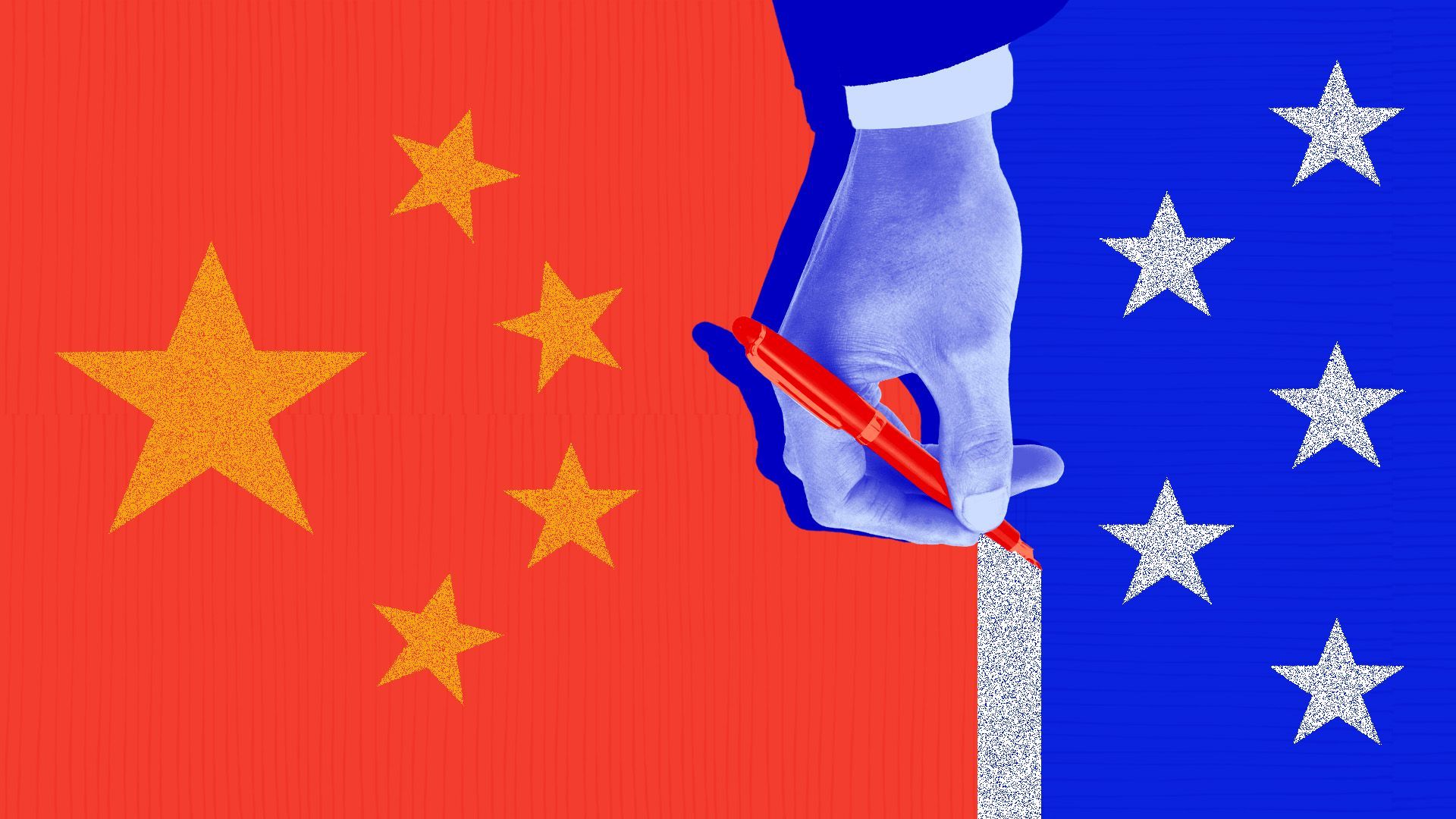
Illustration: Sarah Grillo/Axios
Lawmakers are gearing up to advance bills aimed at boosting U.S. competitiveness against Beijing, Maria reports.
Why it matters: Countering China is one of the few areas Democrats and Republicans agree on.
- As Axios Pro Health Care Policy has reported, the House is planning a "China week," which Rep. Darin LaHood said will enable lawmakers to highlight how Beijing plays by a different set of rules.
Driving the news: A report released late last year by the House China Select Committee — which included the TikTok divestiture recommendation — will continue to guide lawmakers, House Majority Leader Steve Scalise told Maria.
- Scalise: "[Moolenaar's] got a very aggressive plan to continue moving bills forward that have come from suggestions out of the task force to ultimately go through the authorizing committees."
What's inside: The report has nearly 150 policy recommendations. Those focused on economic competitiveness include:
- Authorizing the president to ban AI, quantum and other technology critical to national security that is owned by a foreign adversary.
- Funding NSF, NIST and DOE research for AI.
- Developing international standards with allies on AI.
Behind the scenes: Jacob Helberg, a policy adviser for Palantir behind a push to connect Silicon Valley and D.C., told Maria he's planning on carrying out a series of briefings and roundtables with elected officials on Capitol Hill soon that will focus on securing the U.S. AI supply chain.
3. Catch me up: Preemption, AI and more
Illustration: Tiffany Herring/Axios
⚡️ DOE meets AI: The Department of Energy announced the Frontiers in Artificial Intelligence for Science, Security and Technology initiative this week, our Axios Science colleague Alison Snyder reports.
- FASST focuses on how the department can leverage its supercomputing resources, data it collects from scientific work at its facilities and the know-how of scientists at the 17 national labs for AI.
- "Imagine we had a basic science AI foundational model like ChatGPT for English — but it speaks physics and chemistry," deputy Energy secretary David Turk said in announcing the initiative.
✍️ Preemption plea: 15 state attorneys general sent a letter to congressional leaders urging them to remove preemption language in the American Privacy Rights Act draft.
✔️ Chip check-in: The Semiconductor Industry Association released a report with the Boston Consulting Group that projects the U.S. will triple its domestic semiconductor manufacturing capacity by 2032, fueled by the CHIPS and Science Act.
🤖 Senate AI report update: Senate Majority Leader Chuck Schumer said yesterday at the AI Expo for National Competitiveness that the long-awaited Senate AI working group report "will come out within a few weeks."
- Later that day, Sen. Todd Young told Ashley that "we will be producing our work product in fairly short order" but said he wouldn't "elaborate on Sen. Schumer's timeline."
- Young: "We'll have clarity soon enough. There won't be a whole lot of legislation moving prior to that."
✅ Thank you for reading Axios Pro Policy, and thanks to editors Mackenzie Weinger and David Nather and copy editor Brad Bonhall.
- Do you know someone who needs this newsletter? Have them sign up here.
View archive