August 03, 2023

1 big thing: The future of NSF

Illustration: Tiffany Herring/Axios
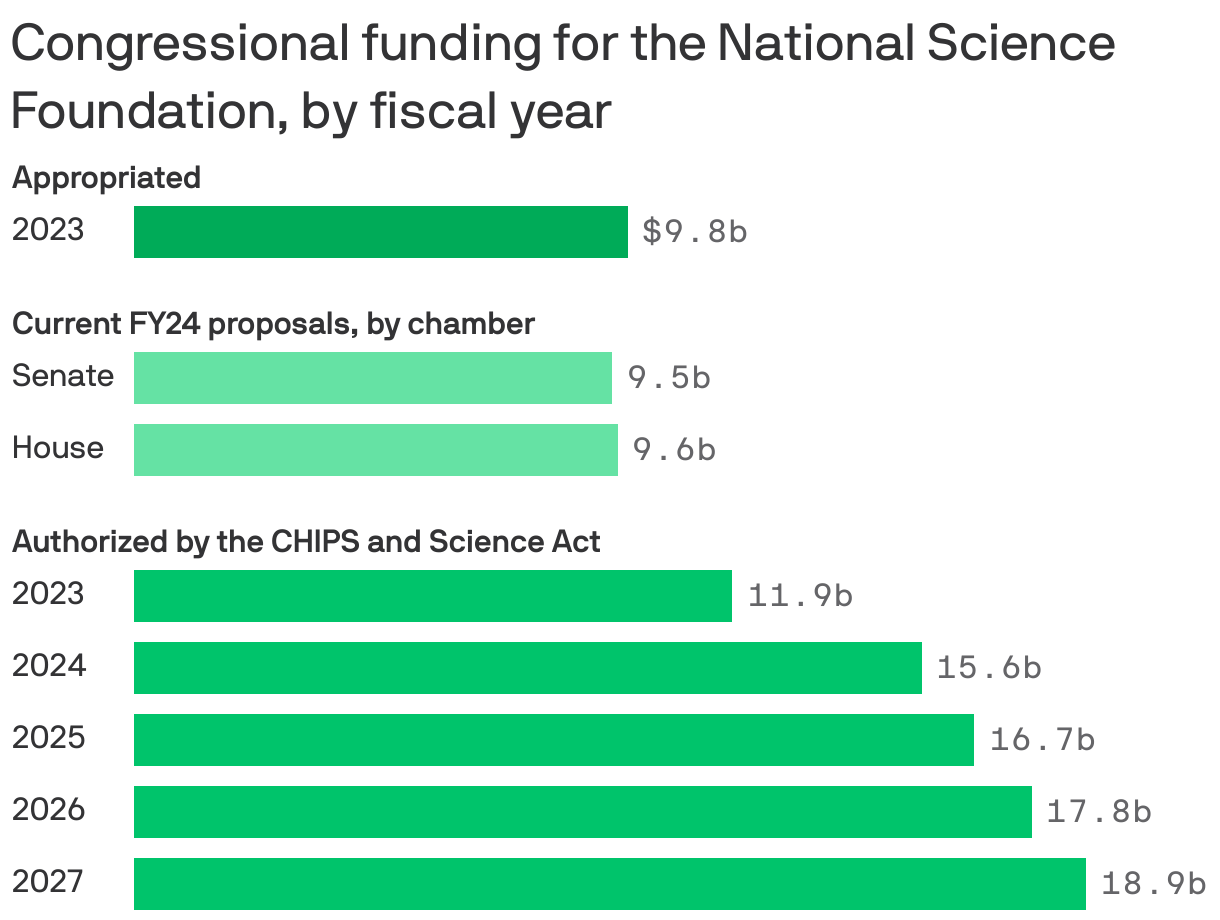
Lawmakers this year are unlikely to meet CHIPS and Science Act ambitions for the National Science Foundation, the agency at the heart of technology research and STEM workforce development, Maria reports.
Why it matters: Funding long-term basic research in key technologies, such as artificial intelligence and quantum computing, falls squarely on the government because a lack of immediate use-cases makes it less attractive for the private sector.
- NSF has partnerships with companies and philanthropies but by and large depends on the government.
Catch up fast: NSF is regarded as the agency around which the science part of the CHIPS and Science Act was built.
- The law authorizes a doubling of the agency's budget over five years, funneling money into early stage research, research infrastructure, international collaborations, new and existing STEM education programs, and a research security office.
- It dedicates $20 billion to the Technology, Innovation and Partnerships Directorate, including the flagship Regional Innovation Engines program.
- That program will bring together researchers, companies and nonprofits in regions across the country to come up with solutions for society's biggest problems and, in that process, train and develop the local workforce.
- "In North Dakota, they're looking at autonomous systems and wireless connected drones. We have projects in the South that are looking at energy approaches and solar," TIP assistant director Erwin Gianchandani told Axios in his office at NSF's Virginia headquarters.
- "We expect these engines over time to really be the harbingers, the seedlings of new jobs that will be coming down the pike."
Yes, but: That's going to require money.
Meanwhile, China leads the world in 37 of 44 technologies in various fields, including AI and quantum computing, according to an Australian Strategic Policy Institute report published in March.
What they're saying: Sen. Todd Young plans to keep advocating for additional funds for TIP and the regional engines program through the regular appropriations process, his communications director Matt Lahr said.
- Those two initiatives deserve priority "when it comes to the difficult funding decisions Congress will need to make in the fall," Lahr added.
- NSF Graduate Education Division Program director Vinod Lohani: "We know that so many, very creative ideas are still left on the table because of the constraints we have with funding."
Of note: NSF has been moving into a model where it's supporting more use-inspired fundamental research, said Pascal Van Hentenryck, whose program has a partnership with Intel and other private sector players.
- Van Hentenryck is the director of the NSF AI Institute for Advances in Optimization, which is tackling challenges in energy, supply chains, sustainability, and chip design and manufacturing.
- "There's a direct impact on the bottom line of some of these companies, and I can tell you they have massive problems to solve," he said, adding additional funding is needed.
- Crucially, Van Hentenryck said, the program allows professionals to break out of their silos and work together in a diverse team with a variety of expertise from AI to optimization to manufacturing.
Threat level: Congress is in for a fight when lawmakers get back from recess in September, and it could lead to a government shutdown.
- There's relative bipartisanship on funding tech and science research, but House Republicans' mission to cut government spending overall is bound to affect an agency like NSF.
- The House appropriations bill would prohibit funding for the NSF's Global Change Research Program, Clean Energy Technology program, Advancing Informal STEM Learning Program, Alliances for Graduate Education and the Professoriate Program, and the Office of Equity and Civil Rights.
- A provision in the House bill prohibiting funding to carry out an Office of Science and Technology Policy memorandum to ensure free, immediate and equitable access to federally funded research would also hit NSF.
What we're watching: While there's a long way to go, some senators are exploring supplemental legislation to bolster Defense Department spending, which could include a second China competition package with additional funds for an agency like NSF or the National Artificial Intelligence Research Resource, one source told Axios.
- A bipartisan, bicameral group of lawmakers recently introduced the CREATE AI Act to establish NAIRR, which would boost the research community and has NSF backing.
- NSF is working on reports required by the CHIPS and Science Act detailing the need for AI workers and the capacity of U.S. institutions to educate those workers.
- The results of those studies could lead to a recommendation to Congress to fund a new program.
2. Worthy of your time: Diversifying STEM
Illustration: Tiffany Herring/Axios
Businesses and government alike are mobilizing to fix the STEM workforce shortage — and that means amping up efforts to bring in historically underrepresented groups, Maria reports.
Why it matters: Technology is developing at breakneck speed and not having the people in place to meet the moment poses an existential threat to U.S. goals of remaining globally competitive.
- As the country builds its workforce, it has an opportunity to attract more women, people of color and people with disabilities, whose unique perspectives will be crucial for ensuring technology is developed and deployed responsibly.
What's happening: The CHIPS and Science Act built on existing NSF diversity programs focused on minority-serving institutions, emerging research institutions and rural communities.
- It also established a chief diversity officer at the agency.
- "Science is great, but it's done by scientists, and then it's usually done for people," said Jacqueline Huntoon, the director of the Division of Graduate Education in the Directorate for STEM Education.
- "So it's really important to keep those people and their perspectives and lived experiences in mind as we start to develop solutions."
Zoom in: José-Marie Griffiths told Axios in an interview that she's always been fascinated by making discoveries through research — her dad was a high school math teacher, her school headmistress in the U.K. was a chemist, and growing up, her hero was Marie Curie.
- But Griffiths, president of Dakota State University, noted that many girls don't have similar role models from an early age helping them engage in STEM.
- "What I've observed is young girls have tended to be encouraged to go into what are called the softer fields. Boys have been encouraged to go into the harder sort of engineering fields. And that has an impact on young girls. We lose them by the time they come out of eighth grade."
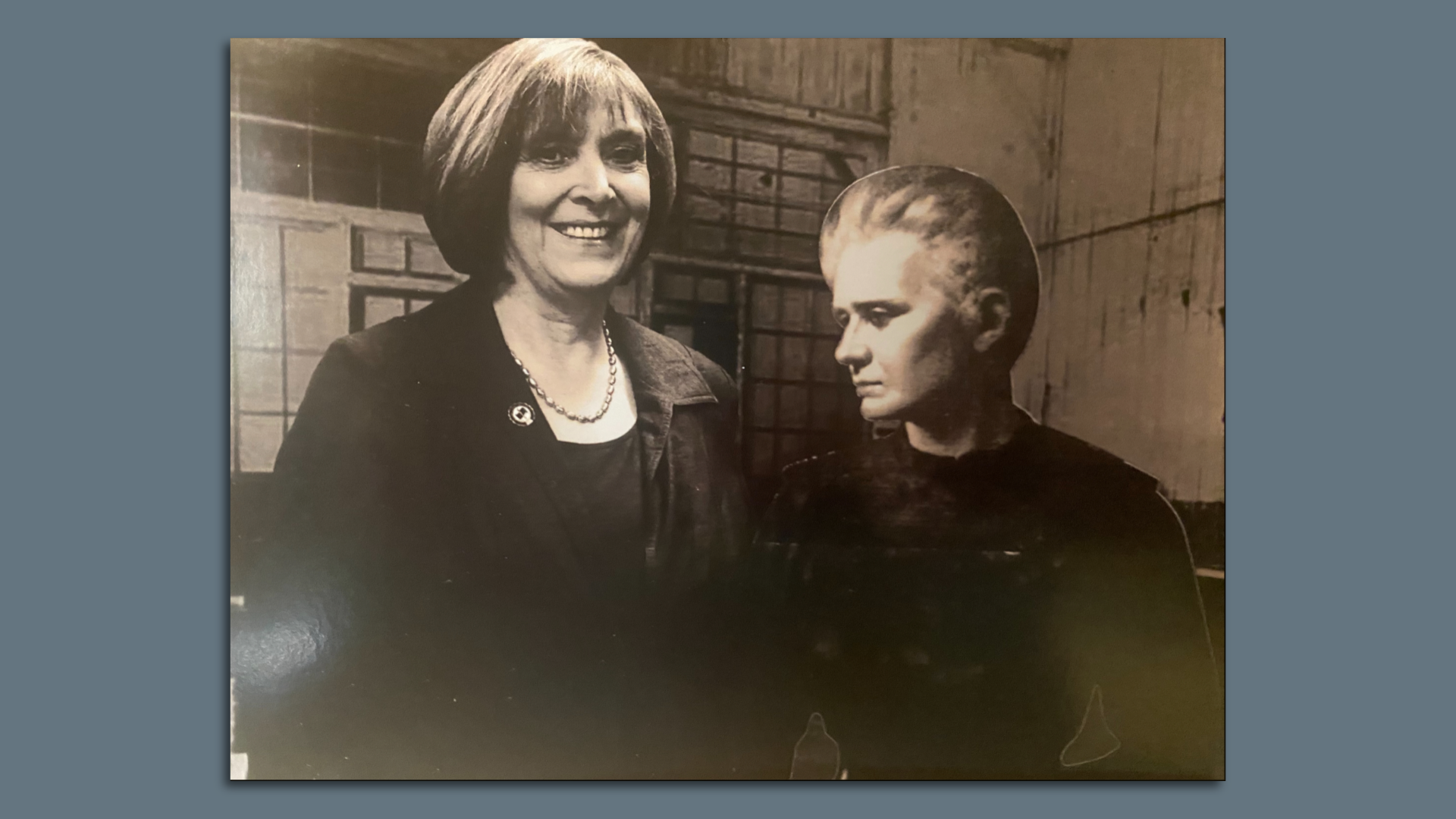
- Griffiths has been involved in recruiting women into STEM fields from the beginning of her career. She's been appointed as lead or key personnel for more than 28 federal agencies, including NSF.
- Dakota State has various STEM workforce development initiatives, including the Governors Cyber Academy, the CybHER Security Institute and GenCyber camps for middle schoolers, high school students and teachers. Some have received NSF funding.
Yes, but: At a July 26 AI briefing on Capitol Hill, Griffiths told senators domestic workforce development will not be enough.
- "We have to have better immigration policies. We're going to have to have both domestic and international talent in cybersecurity, in artificial intelligence, and probably in quantum as we go forward."
- "Let's face it, our post-war contingent of researchers, particularly researchers that have stayed and done well, are heavily international. I'm one example. And I think half of our National Security Commission on AI were people who are immigrants into the country."
Zoom out: Men and white people continue to make up the largest share of the STEM workforce, but it has gradually been diversifying, according to a 2023 NSF report.
- Women are being employed at a faster rate than men. Between 2011-2021, the number of women in STEM increased 31% while employment among men increased by 15%.
- Underrepresented minorities made up 24% of the STEM workforce in 2021. In 2011, they made up 11%.
- In 2021, 21% of workers with at least one disability worked in STEM; people with disabilities account for 3% of the total STEM workforce.
View archive