
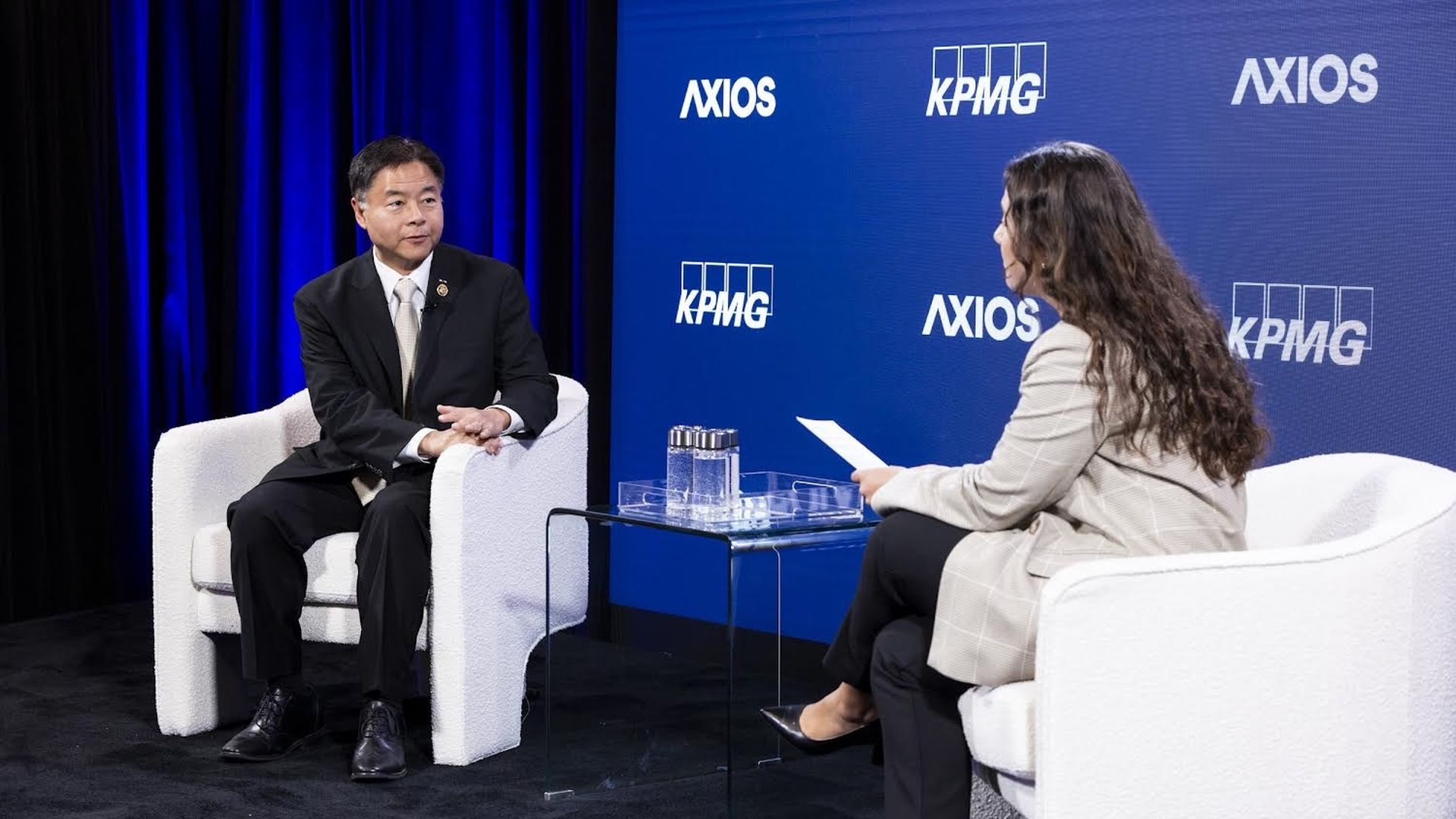
Rep. Ted Lieu and Maria on Sept. 10. Photo: Kristoffer Tripplaar on behalf of Axios
Rep. Ted Lieu laid out his AI policymaking outlook for the remainder of this year and next during an Axios event on Tuesday, suggesting it'll be an uphill climb.
Why it matters: As co-chair of the bipartisan House AI working group, Lieu is helping lay the groundwork for legislative action in the lower chamber.
Below is an excerpt from the conversation, which has been edited and condensed for clarity.
The House task force has been around for about seven months now. What have been some of its accomplishments?
We've had a number of hearings that were very bipartisan. The members are very engaged and asking very insightful questions. The witnesses have been fantastic.
- Overall, there's just a lot of chaos — and I'm just being descriptive here — in a Republican-controlled Congress, right? Some of them are now threatening yet another government shutdown.
- So just keeping the lights on in a Republican-controlled Congress has been hard.
GOP leadership has poured cold water on pretty much all AI related legislation. What are the areas where the House and the Senate can come together to regulate AI?
One person in GOP leadership made some statements and it's not clear where the other folks are.
- My view of politics is everything seems impossible until it happens. And so we're just going to be doing our work and then we'll see what happens at the end of this year.
At this juncture, do you see the government playing a role in ensuring that the transition with AI in the workforce runs smoothly?
I think the fundamentals haven't changed, which is that the most impact we can have on a human being's life is ages 0 through 5.
- And so we continue to invest in education, invest in teaching people how to think, and then they can use all these tools to benefit their family and their employees and themselves.
One way that AI can impact work for people is in the hiring process. Do you believe that Congress needs to pass new laws to prevent AI-based discrimination, or is it a matter of enforcing existing laws?
You can say, we have a whole body of law built up over many years in employment law and what we can do is simply fit AI into that body of law.
- Another approach would be there's harm if AI has bias. ... We could also have [new] laws that say you cannot deploy this system if it doesn't meet certain checks or balances.
- I think it remains to be seen how different states or the federal government approach that.
How are you thinking about the ways AI can benefit workers?
If you're going to buy a product as a company, some of the things you do is just think about questions you may want to ask the folks who try and sell you that product, such as what kind of testing do they do on this or what happens if things go wrong?
- Sen. [Ed] Markey and I introduced the Cyber Shield Act that allows companies to put on this designation that says there's some cybersecurity production in our products.
- The White House ran with that idea and that's gonna be rolling out pretty soon.
Congress is working on funding the government — can you speak to funding research and development when it comes to AI and the likelihood that will happen, given the dynamics in the House?
There's so much of AI that needs to be done in a way that the private sector simply cannot do.
- I'll give you an example: If you want to do a lot on AI safety, not a lot of private sector companies are going to do that because that just doesn't make a lot of money, right?
- Let's say you're a physicist working on cutting edge physics and it turns out that every particle accelerator is owned by one of five private sector companies.
- Would we have a problem with that? I think we probably will, but that's what we have right now. If you want to do cutting edge AI to get that compute power, it's owned by just a handful of private sector companies.
What's next: Lieu said he and other lawmakers are thinking through this month which bills and areas of AI will make it into the task force report.
- Lieu added the report is on track to be finalized by the end of this year and that list of priorities will inform next year's work.
