
Illustration: Aïda Amer/Axios
Those who watch debate over Section 230 closely were expecting a consequential Supreme Court ruling this month and were surprised when the court ruled firmly in favor of not changing the law in May.
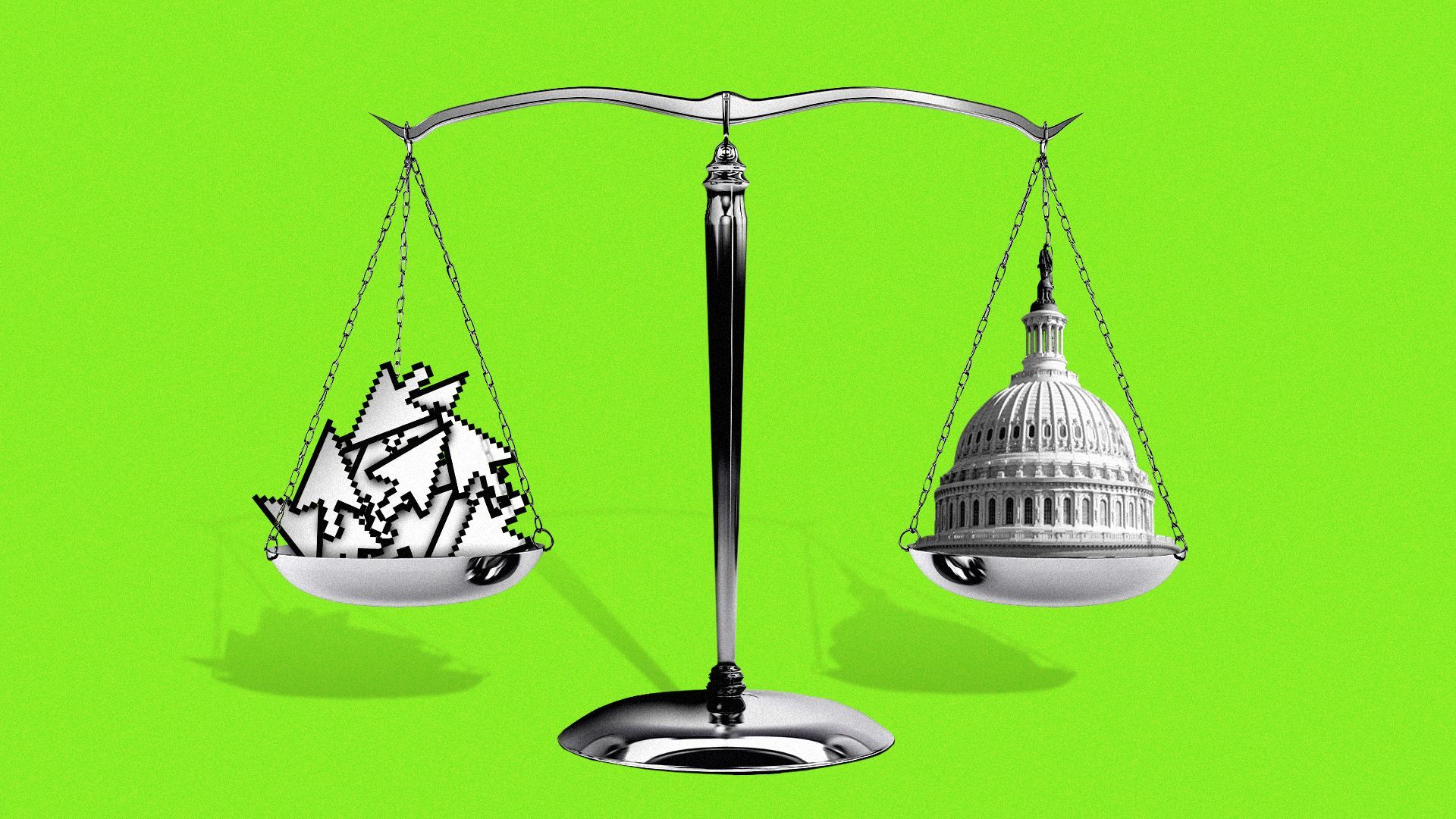
Why it matters: Waiting for the Supreme Court to possibly alter the internet's fundamental law has led to nothing but status quo. It's still up to Congress, which has struggled for years to grapple with the law in the modern internet age, to change or amend it.
Between the lines: The Supreme Court had the option of narrowing the definition of Section 230 and what it covers, faced with two cases that asked how far the immunity goes when it comes to algorithmic sorting and hosting terroristic content.
- Justices punted on making a call, sending the issue back to lawmakers.
- Congress came up with Section 230. Lawmakers repeatedly talk about how it needs to amend Section 230, a law conceived in 1996 that couldn't have envisioned today's social media and internet landscape.
- They haven't done it, short of a very small revision in 2018 that some say hasn't done what it intended to do.
Tech platforms big and small have dogs in this fight, but it's always been more existential for those outside Big Tech.
Axios caught up with Rebecca MacKinnon, vice president for global advocacy at the Wikimedia Foundation, last month in Washington about what's next for places like Wikipedia, which rely on Section 230 to exist.
What they're saying: MacKinnon said the Wikimedia Foundation was briefing Hill staffers last month, reminding them that smaller sites rely on 230 to edit and share content.
- "It's just all about reminding people that we exist ... and how [Section 230] protects the right of communities to self-govern information."
- In the wake of the Supreme Court's decision, "we understand there are concerns, and we don't disagree with some of the concerns," she said. "But just because you see a cockroach in your kitchen doesn't mean you blowtorch the kitchen."
- What the court's decision shows, MacKinnon said, is that "you don't [change] Section 230 lightly, and you have to be very clear about what you're doing."
State of play: There's still great interest in Congress in amending Section 230, and there's momentum around bills having to do with children's safety online — something that unites both parties and is why SESTA-FOSTA passed in 2018 — but progress is plodding.
- A number of child safety bills have made it out of the Senate Judiciary committee; only one, the EARN IT Act, directly touches Section 230. That bill would amend 230 to "remove blanket immunity for violations of laws related to online child sexual abuse material," per bill sponsors Sens. Marsha Blackburn, Lindsey Graham and Richard Blumenthal.
- "If these bills die, we need to change the game," Graham said at a Judiciary markup last week. "So I will be introducing an elimination of Section 230 in two years. I need your help because they’ll never come to this committee or this body, the social media companies, until they believe their liability's in jeopardy."
Flashback: Senate Majority Leader Chuck Schumer said he wanted to bring several bills focused on kids' online safety to the Senate floor "in the coming months," Axios reported in April.
Be smart: Congress has been mad at social media companies over a long list of grievances for years now, and changing Section 230 has been the threat that keeps tech lobbyists on their toes.
- But the chatter in tech policy circles is increasingly around AI policy and how the U.S. will govern it. That distraction could allow for even more time to pass with Section 230 reform languishing.
What's next: NetChoice, a tech trade group, is waiting for the Supreme Court's decision on whether it will hear its cases against Florida and Texas laws that would make it illegal for websites of a certain size to kick off or otherwise punish users for certain viewpoints.
The bottom line: "Whether there's going to be impetus to do something that leads to anything around which there's enough consensus ... I have no great insight," MacKinnon said.
