
July 31, 2025
Recess is so, so close! But first, we have an updated bill tracker to keep you abreast of what's still in play after August.
1 big thing: Axios Pro tracker: Health care bills to watch
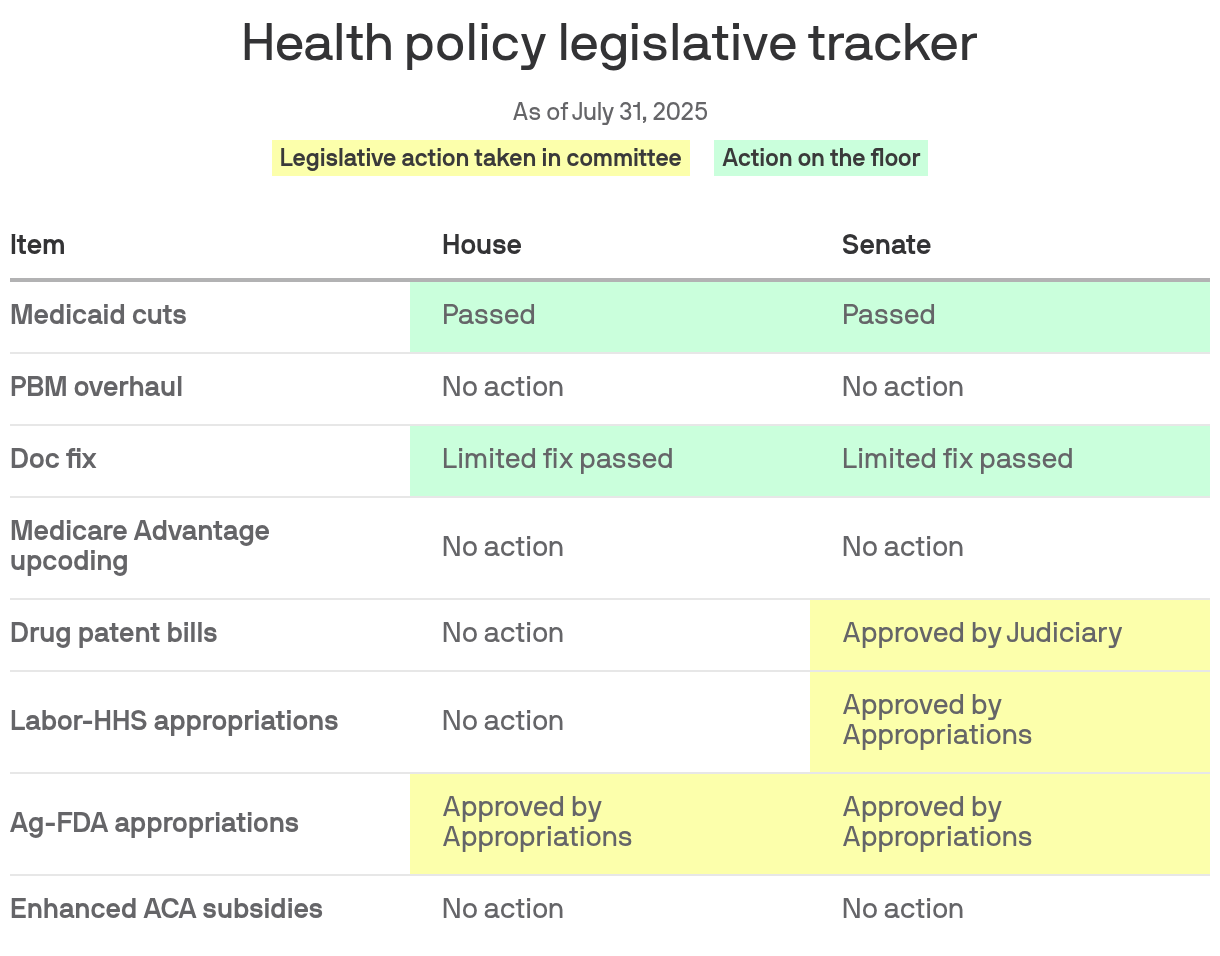
Before Congress heads off to August recess, we're back with an update to our tracker showing where bills stand.
Why it matters: Reconciliation took care of the GOP's priorities, but a lot of unfinished business remains — including holdovers from the health package that was dropped from the year-end funding deal.
Medicaid cuts
The issue: The tax-and-spending law included a range of Medicaid measures, including new work requirements, limits on provider taxes that states use to finance their share of costs in the program, and new cost-sharing for enrollees.
Status: Signed into law.
Cost estimate: Almost $1 trillion in savings over 10 years.
What's next: The changes are law, but Democrats are ramping up their attacks for the midterms. And some Republicans, like Sen. Josh Hawley, want to delay certain cuts.
PBM overhaul
The issue: A slew of measures are on the table, including "delinking" PBM compensation from the price of a drug in Medicare Part D, transparency measures and banning spread pricing in Medicaid.
Status: The proposals have been debated many times and could have bipartisan support if a new health package comes together. Some measures were originally included in reconciliation but ran afoul of Senate rules.
Cost estimate: A range, some in the ballpark of $1 billion in savings over 10 years.
What's next: Assessing whether the broader environment is conducive to a significant year-end health package.
Doc fix
The issue: The reconciliation law included a 2.5% Medicare payment boost for physicians through 2026.
Status: Signed into law.
Cost estimate: $1.9 billion over 10 years.
What's next: Efforts toward a broader, longer-term overhaul of Medicare physician payments are likely to continue.
Medicare Advantage upcoding
The issue: A bill from Sens. Bill Cassidy and Jeff Merkley would crack down on "upcoding," a practice in which Medicare Advantage insurers classify patients as sicker to secure higher government payouts.
Status: No formal committee action, but it was considered for the reconciliation bill and could be an enticing payfor for other health measures in the future.
Cost estimate: $200 billion to $270 billion in savings over 10 years, per Cassidy's office.
What's next: We're watching how successful insurers are in mounting opposition and whether a major health package comes together that could be a vehicle for the bill.

2. More bills to watch
Drug patent bills
The issue: Bipartisan measures to lower drug prices by cracking down on ways drug companies can game the patent system to delay competition from generics.
- One prominent effort would prohibit "patent thickets," or an array of patents that manufacturers take out on the same product.
- Another bill targets "product hopping," small changes that manufacturers can make to a drug with the intent of delaying competition.
Status: Both advanced out of Senate Judiciary Committee on a bipartisan vote.
Cost estimate: About $3 billion in savings over 10 years, CBO found last year.
What's next: The patent thicket measure was in the December health package that collapsed, and could be revived if there is another package.
Labor-HHS Appropriations
The issue: FY26 government funding levels for health agencies, including HHS, NIH, CMS and CDC.
Status: Advanced out of Senate Appropriations on a bipartisan vote. House Appropriations hasn't acted on the bill yet.
Cost estimate: Total funding levels weren't immediately available, but the NIH received a $400 million budget increase.
What's next: House Appropriations is expected to take up the Labor-HHS bill in September. Senate appropriators have said they want to send the Labor-HHS bill to the floor in September.
- But disputes over this and other spending bills could prompt a shutdown and will likely necessitate a short-term continuing resolution at the end of September.
Ag-FDA Appropriations
The issue: FY26 government funding level for the FDA.
Status: Advanced out of Senate Appropriations on a bipartisan vote. Advanced out of House Appropriations on a party-line vote.
Cost estimate: The Senate funded the FDA at $7 billion. The House funded the FDA at $6.8 billion.
What's next: The Senate may bundle the Ag-FDA bill into a minibus with other funding bills and put it on the Senate floor as soon as this week, or in September. The House will likely put appropriations bills on the floor in September. A short-term CR is still likely.
Enhanced ACA subsidies
The issue: More generous subsidies that help people on the ACA marketplaces afford their premiums expire at the end of this year.
Status: No formal committee action, but some Republicans have expressed openness to a year-end deal that continues the subsidies in some form.
Cost estimate: $335 billion over 10 years, per CBO last year.
What's next: Democrats will try to ramp up political pressure over August recess about fears of premium increases to try to get enough Republicans to the table.
3. Senate appropriators approve Labor-HHS bill
Senate appropriators today approved an FY26 Labor-HHS bill that included a slight bump in funding for the NIH with a strong, 26–3 bipartisan vote.
Why it matters: The vote and some lawmaker comments signaled that most of the senators aren't going along with the Trump administration's proposed 40% budget cut for the agency, instead adding $400 million to NIH accounts.
What's inside: Senate Appropriations customarily approves spending bills before releasing the full text, so final numbers weren't available at deadline.
- Full text will be posted on the committee's webpage later today.
- Senate Appropriations Ranking Member Patty Murray said the bill rejected Trump's proposed cuts to efforts to fight substance use disorders, HIV and prepare for future pandemics.
- Subcommittee Chair Shelley Moore Capito said the bill had "targeted increases" for research at the NIH to specific areas including Alzheimer's, diabetes, Parkinson's, women's health and cancer.
Between the lines: OMB had abruptly paused already approved NIH grant spending Tuesday, but then quickly reinstated it.
- "As we've said, this is a programmatic review of NIH funding. The funds were released," Rachel Cauley, communications director at OMB, said in a statement yesterday.
The temporary pause ratcheted up tensions with appropriators. Democrats questioned whether it was even worth cooperating in a bipartisan manner when the administration could resort to more rescissions packages or just opt to pause approved spending.
- Subcommittee Ranking Member Tammy Baldwin also pointed to a provision in the manager's package for Labor-HHS that would prevent OMB from "forward funding" NIH grants, which she said would result in many fewer grants being received.
- "What OMB tried to do this week … through a footnote in a budget document should be an eye-opener to all of us," Baldwin said.
4. Catch me up: 340B rebates, direct primary care

- 340B discounts: HRSA today announced a pilot program to test a rebate model for selected drugs within the 340B program, as an alternative to providers getting an upfront discount.
- Direct primary care: The concierge-like providers are poised to benefit from a provision in the tax-and-spending law extending uses of health savings accounts, Axios' Maya Goldman reports.
- HHS counsel: The Senate Finance Committee held confirmation hearings today for Gustav Chiarello III to be assistant secretary of health and Michael Stuart to be general counsel of HHS.
✅ Thank you for reading Axios Pro Policy, and thanks to editors Adriel Bettelheim and David Nather and copy editor Brad Bonhall. Do you know someone who needs this newsletter? Have them sign up here.
View archive