Axios Pro tracker: Health care bills to watch


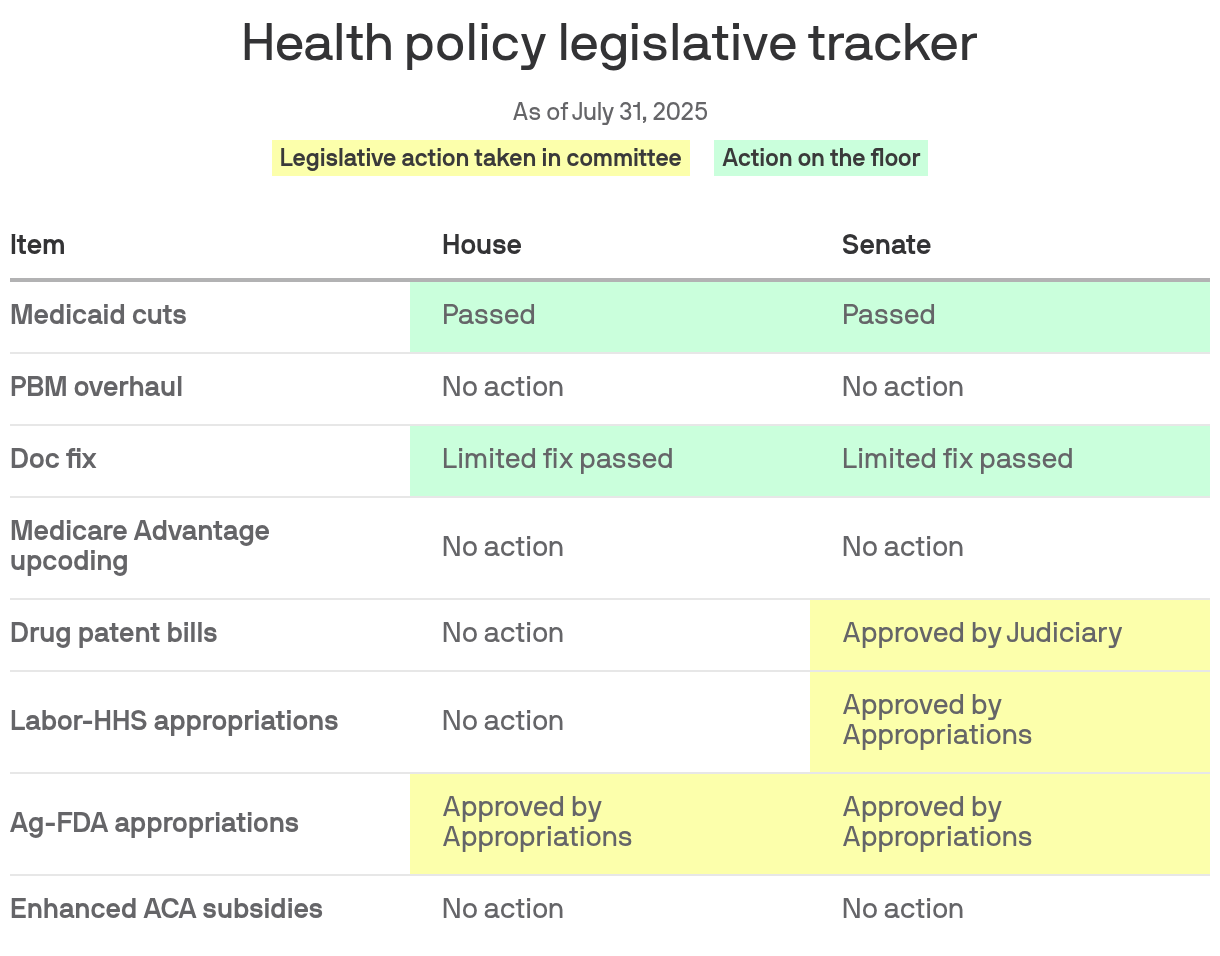
Before Congress heads off to August recess, we're back with an update to our tracker showing where bills stand.
Why it matters: Reconciliation took care of the GOP's priorities, but much unfinished business remains — including holdovers from the health package that was dropped from the year-end funding deal.
Medicaid cuts
The issue: The tax-and-spending law included a range of Medicaid measures, including new work requirements, limits on provider taxes that states use to finance their share of costs in the program, and new cost-sharing for enrollees.
Status: Signed into law.
Cost estimate: Almost $1 trillion in savings over 10 years.
What's next: The changes are law, but Democrats are ramping up their attacks for the midterms. And some Republicans, like Sen. Josh Hawley, want to delay certain cuts.
PBM overhaul
The issue: A slew of measures are on the table, including "delinking" PBM compensation from the price of a drug in Medicare Part D, transparency measures and banning spread pricing in Medicaid.
Status: The proposals have been debated many times and could have bipartisan support if a new health package comes together. Some measures were originally included in reconciliation but ran afoul of Senate rules.
Cost estimate: A range, some in the ballpark of $1 billion in savings over 10 years.
What's next: Assessing whether the broader environment is conducive to a significant year-end health package.
Doc fix
The issue: The reconciliation law included a 2.5% Medicare payment boost for physicians through 2026.
Status: Signed into law.
Cost estimate: $1.9 billion over 10 years.
What's next: Efforts toward a broader, longer-term overhaul of Medicare physician payments are likely to continue.
Medicare Advantage upcoding
The issue: A bill from Sens. Bill Cassidy and Jeff Merkley would crack down on "upcoding," a practice in which Medicare Advantage insurers classify patients as sicker to secure higher government payouts.
Status: No formal committee action, but it was considered for the reconciliation bill and could be an enticing payfor for other health measures in the future.
Cost estimate: $200 billion to $270 billion in savings over 10 years, per Cassidy's office.
What's next: We're watching how successful insurers are in mounting opposition and whether a major health package comes together that could be a vehicle for the bill.
Drug patent bills
The issue: Bipartisan measures to lower drug prices by cracking down on ways drug companies can game the patent system to delay competition from generics.
- One prominent effort would prohibit "patent thickets," or an array of patents that manufacturers take out on the same product.
- Another bill targets "product hopping," small changes that manufacturers can make to a drug with the intent of delaying competition.
Status: Both advanced out of Senate Judiciary Committee on a bipartisan vote.
Cost estimate: About $3 billion in savings over 10 years, CBO found last year.
What's next: The patent thicket measure was in the December health package that collapsed, and could be revived if there is another package.
Labor-HHS Appropriations
The issue: FY26 government funding levels for health agencies, including HHS, NIH, CMS and CDC.
Status: Advanced out of Senate Appropriations on a bipartisan vote. House Appropriations hasn't acted on the bill yet.
Cost estimate: Total funding levels weren't immediately available, but the NIH received a $400 million budget increase.
What's next: House Appropriations is expected to take up the Labor-HHS bill in September. Senate appropriators have said they want to send the Labor-HHS bill to the floor in September.
- But disputes over this and other spending bills could prompt a shutdown and will likely necessitate a short-term continuing resolution at the end of September.
Ag-FDA Appropriations
The issue: FY26 government funding level for the FDA.
Status: Advanced out of Senate Appropriations on a bipartisan vote. Advanced out of House Appropriations on a party-line vote.
Cost estimate: The Senate funded the FDA at $7 billion. The House funded the FDA at $6.8 billion.
What's next: The Senate may bundle the Ag-FDA bill into a minibus with other funding bills and put it on the Senate floor as soon as this week, or in September. The House will likely put appropriations bills on the floor in September. A short-term CR is still likely.
Enhanced ACA subsidies
The issue: More generous subsidies that help people on the ACA marketplaces afford their premiums expire at the end of this year.
Status: No formal committee action, but some Republicans have expressed openness to a year-end deal that continues the subsidies in some form.
Cost estimate: $335 billion over 10 years, per CBO last year.
What's next: Democrats will try to ramp up political pressure over August recess about fears of premium increases to try to get enough Republicans to the table.
