
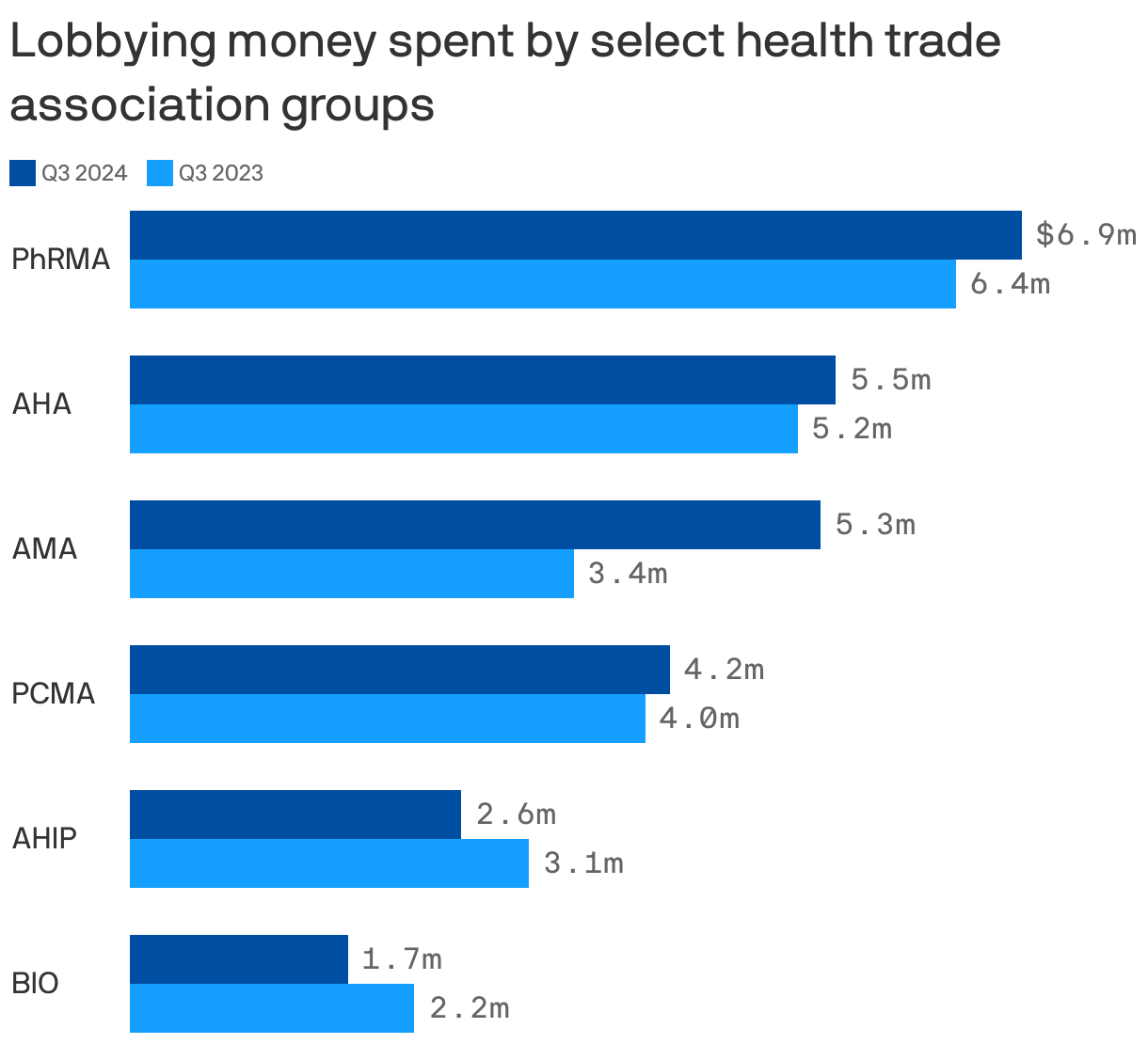
Efforts to stabilize Medicare physician payments and reform PBM business practices helped drive health industry lobbying during the quarter ending Sept. 30, according to the new federal disclosure reports.
Why it matters: The influence efforts picked up with Congress largely gridlocked and lawmakers weighing prospective policy changes that could be included in a post-election deal.
By the numbers: The American Medical Association spent $5.3 million in Q3 2024, up from $3.4 million in the same quarter last year.
- Physician groups are hoping Congress can at least partially offset a nearly 3% cut in their Medicare payments for 2025. The House Ways and Means Committee had scheduled a markup of a prospective "doc fix" in September but postponed it.
- AMA has long pushed for a permanent fix that would include annual payment updates that better account for inflation, and there appears to be growing sentiment for a long-term remedy, especially with several GOP doctors retiring at the end of this Congress.
The PBM trade group PCMA also upped its spending, putting forward $4.2 million in Q3 2024 compared with about $4 million in Q3 of 2023.
- The group's spending increased compared with Q2 of this year, when it spent $3.6 million.
- There's a range of PBM bills for lawmakers to choose from (see our breakdown from last week) that could generate savings to pay for health programs in an end-of-year funding package.
The American Hospital Association spent $5.5 million in Q3, which was slightly higher than this time last year but lower than the previous two quarters of 2024.
- Hospitals still are facing possible site-neutral Medicare payment reforms, though the effort appears to have less momentum than some others.
The intrigue: The Biosecure Act remained a priority for drugmakers, biotechs and other groups to lobby on in Q3, just as it was in Q2 2024, even though it wasn't included in the annual defense authorization bill.
- Pharmaceutical companies that listed Biosecure as an issue in their latest lobbying disclosures included Amgen ($2.8 million), GlaxoSmithKline ($1.5 million), Takeda Pharmaceuticals ($970,000) and Biogen ($710,000).
- WuXi AppTec, which is one of the targeted companies in Biosecure, spent $140,000 in Q3 2024. That's compared with $260,000 in Q2 2024. WuXi Biologics, an affiliated company, also spent $100,000 in Q3 2024.
- Other groups who listed Biosecure Act as an issue this quarter include Thermo Fisher Scientific, Heritage Action for America, the University of Michigan and Vanderbilt University.
- The trade group BIO, which now supports Biosecure after opposing it earlier this year, spent $1.7 million in Q3 2024.
Between the lines: Novo Nordisk has upped its spending over last year as it faces scrutiny from the Senate HELP Committee over the price of its blockbuster GLP-1 drugs.
- The company spent $780,000 in Q3 2024 compared with $600,000 in Q3 2023.
- The latest filings cover the period during which HELP Chair Bernie Sanders hauled in the Novo Nordisk CEO Lars Jørgensen to testify about Ozempic's and Wegovy's price tags.
- But this most recent quarter's spending was lower than what the company spent in the previous two quarters.
PhRMA, consistently one of the biggest spenders among health care lobbying interests, spent $6.9 million in Q3 2024.
- That's slightly less than what was spent in the two previous quarters this year but is a jump from the amount spent in Q3 of 2023, which was $6.4 million.
