

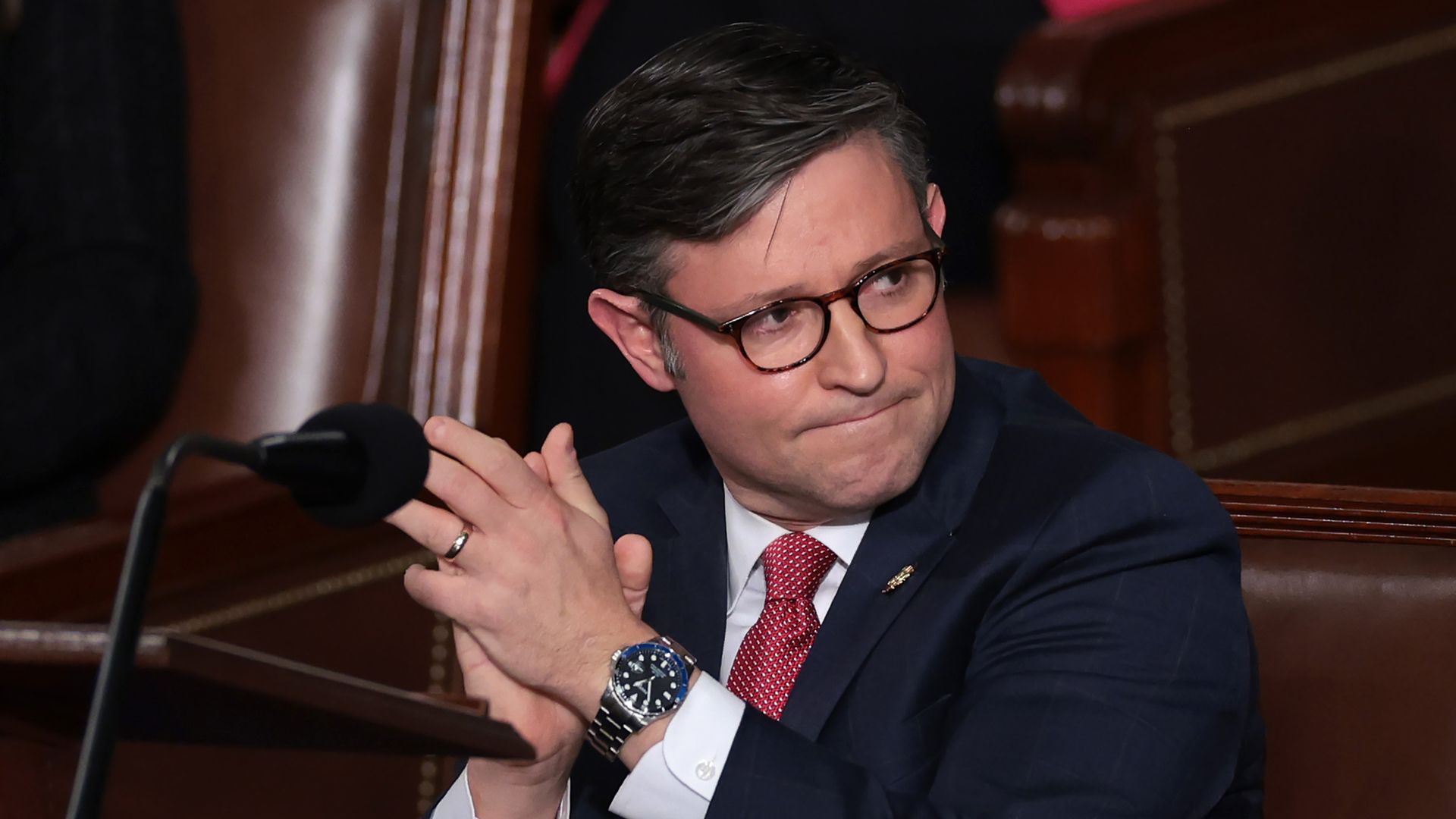
Johnson applauds in the House chamber during Wednesday's speaker election. Photo: Win McNamee/Getty Images
New Speaker Mike Johnson is not known as a health care specialist. But he is a former Republican Study Committee chair, which means he put out some plans and a budget, and as a strong social conservative he is very anti-abortion.
Let's dive in.
Abortion and gender-affirming care
Johnson is a hard-line conservative on abortion issues. For the 117th Congress, he has an A+ rating for Susan B. Anthony's Pro-Life Scorecard, with the organization noting his many actions to support anti-abortion measures, including making the Hyde amendment permanent.
- In this Congress, Johnson has also co-sponsored prominent anti-abortion legislation. He's an original co-sponsor on the "Life at Conception" bill, which would essentially ban all abortions.
- He's also a co-sponsor of the "No Taxpayer Funding for Abortion" act, which would codify the Hyde Amendment, and signed on to multiple bills that would restrict federal funding from Planned Parenthood and Title X grantees who perform abortions.
- Johnson led the introduction of a resolution that passed the House in January that condemned violent activities against "pro-life" organizations.
- He's also a co-sponsor of anti-gender affirming care bills, including Rep. Marjorie Taylor Greene's, which we wrote about previously.
- That bill would effectively ban Medicare, Medicaid and Affordable Care Act health plans from providing gender-affirming care and prohibit medical schools from training providers to offer gender-affirming care.
Our thought bubble: As the House appropriations bills have been packed with anti-abortion and anti-gender affirming care poison pills, Johnson's record suggests he would likely be a supporter of such measures, even with the reality of the Senate being against them.
Appropriations
Johnson was also circulating an appropriations plan to members during the GOP conference meeting on Tuesday where he had specific timelines and plans for the two health-related spending bills.
- He recommended that the Appropriations Committee first work on reporting out favorably the Labor-HHS bill, which has only been passed out of the subcommittee so far.
- Johnson then suggested that members create a new working group to address concerns with the Ag-FDA appropriations bill. The bill previously failed on the House floor in part due to a controversial provision that would reverse current FDA policy around the abortion pill mifepristone.
- According to the appropriations schedule that Johnson was proposing, he would send both health appropriations bills, Labor-H and Ag-FDA, to the House floor the week of Nov. 13 — just before the government funding deadline expires Nov. 17.
- As these are the traditionally harder-to-pass bills with more controversial measures, this could be a way to put pressure on members to pass them before the deadline and Thanksgiving holiday.
- Johnson did suggest that another continuing resolution could be passed if needed — with possible dates of either Jan. 15 or April 15, depending on what the conference can agree on — "to ensure that the Senate cannot jam the House with a Christmas omnibus."
Medicaid and ACA
As RSC chair in 2019, Johnson put out a 57-page health care plan along with other members of the group.
- It would have repealed many of the ACA's protections for people with pre-existing conditions, including "community rating," which prevents charging sicker people much higher premiums.
- As an alternative, it would have funded high-risk pools, leaving the details up to states.
- It would have limited Medicaid spending through per-capita caps, as well as ended the enhanced federal funding that eases the way for Medicaid expansion, seeking to stop what it called the "runaway trajectory" of spending on the program.
- It also would have expanded Health Savings Accounts.
Medicare
Separately, the RSC budget for 2020, under Johnson's chairmanship, called for major Medicare changes like a "premium support" system of private plans competing alongside traditional Medicare.
- It also would have raised the Medicare eligibility age to 67.
- Attention hospitals: The budget also endorsed site-neutral payments "throughout the Medicare program."
