June 12, 2024

🐪 The GEICO camel commercials first aired more than 10 years ago. Where did the time go?
🎶 Today's last song is from Boundary Stone's Emily Domenech: "Ready 24" by J. Cole.
- Nick's thought bubble: More of you should be listening to J. Cole.
1 big thing: D.C. games out Trump 2.0
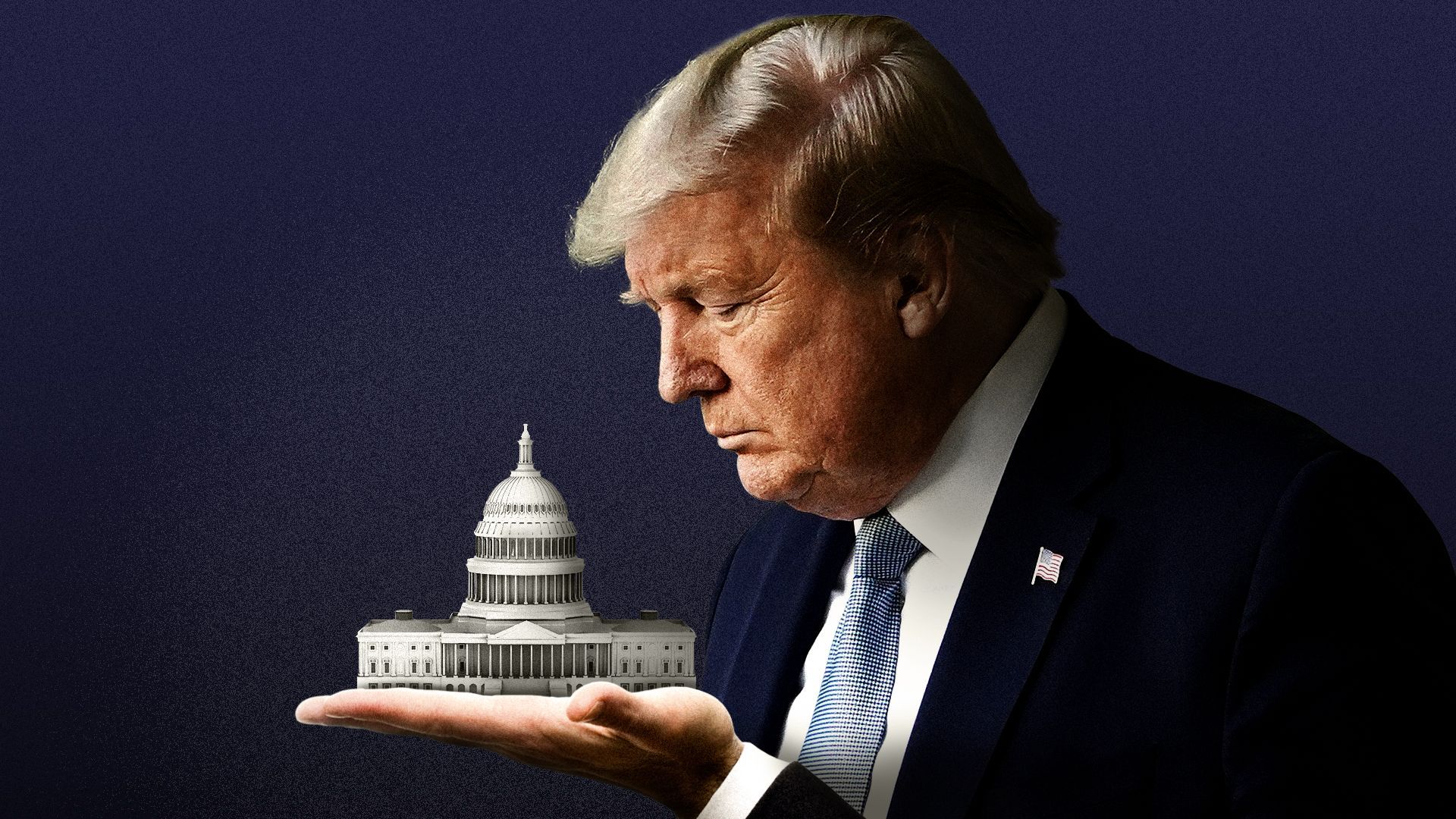
Photo illustration: Lindsey Bailey/Axios. Photo: MANDEL NGAN/AFP via Getty Images
Energy companies and lobbying firms are starting to game out scenarios for an election that could upend generational changes to climate and environmental policy, Nick writes.
Why it matters: Another Donald Trump administration would mean vast regulatory rollbacks and big changes to how IRA funds get doled out.
- House Speaker Mike Johnson's staff is already prepping for a possible reconciliation bill next Congress.
The big picture: Top of mind for everyone is the coming tax debate in 2025, when parts of the 2017 Trump tax cuts will expire.
- The IRA isn't getting fully repealed. But even with divided government, lobbyists think parts of the climate law would be in play as pay-fors and negotiating wedges.
- If Republicans get unified control, expect a reconciliation bill that could severely curtail its subsidies and uncapped tax credits.
- "We're trying to be as proactive as possible" about protecting the IRA, said Brandon Hurlbut, a former Obama administration official and co-founder of Boundary Stone Partners.
Zoom in: The EV tax credit is most vulnerable to outright repeal, or a reversion to its pre-IRA caps, according to half a dozen lobbyists and industry sources.
- The offshore wind provisions are vulnerable too, given that they have "been harshly criticized by Trump on the campaign trail," said Colin Hayes, a founding partner of Lot Sixteen.
- The investment and production tax credits — the centerpiece of the law's projected emissions reduction — are seen as safe, but they could be in for caps or changes in a GOP sweep scenario.
Meanwhile, there's a long list of federal rules Trump — who's planning to be on the Hill tomorrow — would likely scale back: auto emissions standards, power plant greenhouse gas rules, NEPA implementing regulations and more.
Between the lines: Many of the IRA's incentives and subsidies will be tough to claw back, given corporate support and burgeoning manufacturing in GOP areas of the Southeast.
- "There's a scenario where policies focused on reshoring domestic manufacturing capacity, like 45X for example, could appeal to the populist wing of the Republican Party and have staying power," said Emily Domenech, a senior vice president at Boundary Stone and a former GOP leadership aide.
What they're saying: "Industry covets certainty. One of the major problems with the Biden administration has been the lack of certainty because of his political tightrope walk," said Bracewell's Frank Maisano.
- But Trump 2.0 would raise similar concerns because of his "scattershot approach" to policy, Maisano said. "Pick your poison."
2. Senate confirms two FERC nominees
Illustration: Tiffany Herring/Axios
The Senate confirmed Democrat David Rosner and Republican Lindsay See to serve at FERC, sending two of the three nominees to the commission, Nick reports.
Why it matters: The nominees will ensure FERC keeps a quorum and lock in a Democratic majority on the commission.
Driving the news: Rosner was confirmed in a 68-26 vote this afternoon.
- A few progressives — including Bernie Sanders and Ed Markey — voted "no" alongside Republicans.
- Some green groups had been urging them to oppose Rosner over his statements about LNG and work for the Bipartisan Policy Center.
- See was confirmed 83-12, with Josh Hawley and Eric Schmitt joining Democrats in opposition.
What's next: The Senate now moves to a procedural vote on Judy Chang, the other Democratic nominee.
- She's likely to be confirmed with support from both Energy Chair Joe Manchin and Ranking Member John Barrasso.
3. Bill of the week: Geothermal, so hot right now
A crescent moon over the Capitol. Photo: Brett Davis
House Science Chair Frank Lucas is out with new bipartisan legislation to research a new wave of geothermal power systems, Nick writes.
Why it matters: It adds to the wave of interest on the Hill in geothermal that could juice the private sector cash flowing into the low-carbon technology.
Zoom in: Lucas' bill, introduced last week with Rep. Andrea Salinas, would create a new DOE program to research and test "supercritical" geothermal tech.
- These systems seek to inject water deep underground and use the heat of the Earth to generate power.
- Lucas' committee will mark up the legislation tomorrow.
Between the lines: There are already companies experimenting with supercritical systems.
- Quaise Energy, for instance, wants to use a new drilling technology to tap into super-hot rocks miles beneath the Earth's surface.
- Geothermal, generally, is an old technology, but Quaise is part of a new group of companies trying to find unconventional ways to tap into the Earth's heat and generate climate-friendly baseload power.
Yes, but: Supercritical success is likely far in the future, and it's going to take quite a bit of R&D to make it a cost-effective reality.
- "Economic production of supercritical resources will require the development of entirely new classes of drilling technologies and methods," DOE said in a 2019 report.
4. Catch me up: NDAA amendment watch

Illustration: Tiffany Herring/Axios
👀 1. NDAA amendments: The House Rules Committee yesterday approved a long list of amendments to the defense bill for floor consideration.
- That doesn't include the semiconductor or CFATS proposals we discussed yesterday, but those are by no means dead.
- The House will consider several amendments on advanced nuclear, a proposal to block DOD from buying Chinese-made solar panels, and a whole bunch of partisan ideas on EVs and climate executive orders.
🚜 2. Farm climate revolt: Senate Republicans are out with their own farm bill proposal that would repurpose IRA conservation money.
- It adds to the ongoing fight over that money that's derailed farm bill debate for months.
💵 3. No riders, please: Nearly the entire Senate Democratic caucus signed onto a letter asking Approps Committee leaders to cut "controversial" climate and environmental riders out of the spending bills.
🗣️ 4. Quote for the road: Senate Majority Leader Chuck Schumer said Joe Manchin has complained to him that the IRA's climate provisions have ballooned beyond the $369 billion cost they originally envisioned.
- "I said, 'Joe, we were in the room together. You had the ability to ask me for a cap, and I was fearful that you would, but I wasn't going to tell you to do it. And you didn't.' So now it's even bigger than we ever thought," Schumer said during a roundtable with LCV today.
✅ Thank you for reading Axios Pro Policy, and thanks to editors Chuck McCutcheon and David Nather and copy editor Amy Stern.
View archive