January 17, 2024

🐪 Who is the nomad's favorite basketball player? Camel-o Anthony, of course.
🎶 Today's last tune is from the World Resources Institute's Dan Lashof, who enjoyed the score to "Of Whales," an exhibition at the San Francisco MOMA.
🚨 Situational awareness: E&C energy subcommittee chair Jeff Duncan announced today he won't seek re-election. He joins Rep. Bill Johnson, another E&C subcommittee chair, who is soon to enter academia.
1 big thing: The Hill's latest climate fight
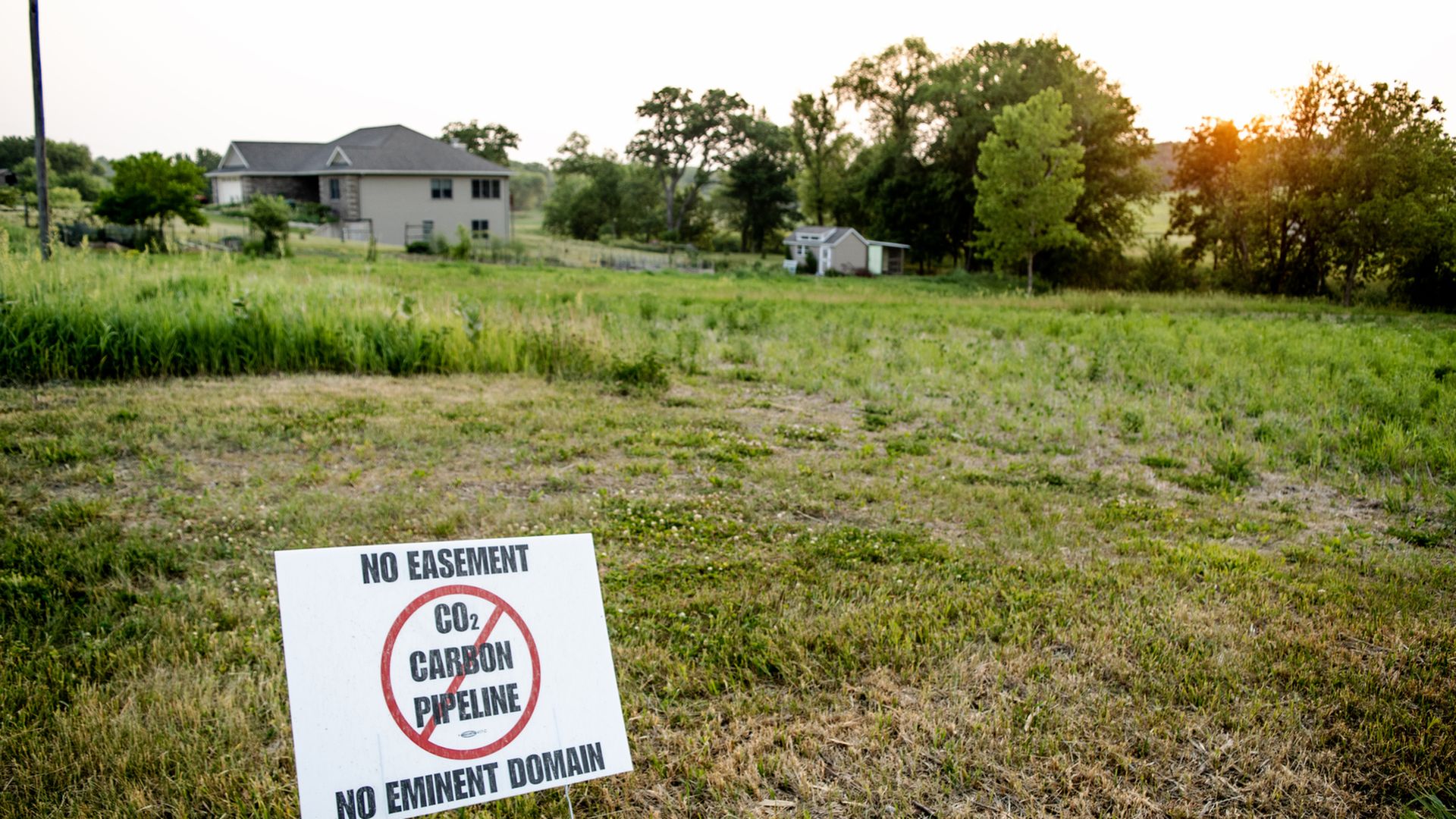
A sign against a proposed carbon dioxide pipeline in New Liberty, Iowa. Photo: Miriam Alarcon Avila/Bloomberg via Getty Images
Carbon dioxide pipelines are a new frontier shaping the Hill's debate about the energy transition, Nick and Jael write.
Why it matters: Carbon capture has always been divisive. Now there are billions more federal dollars on the table from the IRA and infrastructure law to build out new grids of pipes for moving CO2 underground.
- The potential boom is fracturing the left and creating tricky political problems in traditionally Republican areas.
- "There's massive ignorance within the Democratic Party about this," Rep. Jared Huffman told Nick. "People have no idea what's really going on."
What's happening: Concerns about these pipelines — underground tools for transporting and storing CO2 sucked from smokestacks or the air — have been coloring work on reauthorizing the Pipeline and Hazardous Materials Safety Administration.
- House T&I's bipartisan reauthorization bill, the PIPES Act, would clarify the agency's authority over CO2 pipes and move toward new minimum safety standards.
- During debate on House legislation to renew the safety regulator, Huffman and Republican Scott Perry contemplated adding language that would make the government scrutinize safety more closely. (It didn't happen amid concerns that it would upend the bill's delicate support.)
- PHMSA is also working on a safety rulemaking after a 2020 CO2 pipeline rupture in Mississippi led to evacuations and hospitalizations, while the Forest Service proposed last year to potentially allow carbon to be stored under national forests.
Between the lines: We expect CO2 pipelines to also get wrapped up in the broader Hill conversation about permitting and "clean" energy infrastructure.
- Climate hawks and the energy industry expect to massively expand the CO2 pipeline network, juiced by an expanded 45Q tax credit for carbon capture in the IRA and billions for demonstration projects in the IIJA.
- Sen. Sheldon Whitehouse told Nick that CO2 pipelines and hydrogen should be part of the permitting conversation, alongside grid infrastructure and offshore wind.
- Republicans have also long sought to overhaul section 401 of the Clean Water Act to prevent states from blocking pipeline infrastructure that moves across their waterways.
What they're saying: Rep. Garret Graves told Nick that he gives the Biden administration credit for being "very clear that carbon capture is reality."
- "There's no question that carbon capture plays a role," he said.
- While local concerns need to be addressed, "the more pipelines are used for hydrogen and to properly dispose of CO2 and not for further fossil fuel, there's a different aspect to that," Whitehouse said.
The intrigue: Many climate experts see these projects as essential to an effective, comprehensive decarbonization effort. But local opposition is growing.
- CO2 pipes already run thousands of miles around the country. Right now they're mostly used by oil companies to extract more fossil fuel from the ground, not for decarbonization.
- After the fracking boom and some headline-grabbing pipe failures like the one in Mississippi, the ethanol industry is facing massive local pushback in the Midwest on building pipe networks to sequester carbon.
- That bubbled up in the Iowa primary, where Vivek Ramaswamy made it a signature campaign issue.
The other side: Hill progressives are gearing up for a fight, too.
- Huffman and other lawmakers wrote Biden in October calling for a moratorium on all new CO2 pipelines until PHMSA finishes its safety regs. (The White House didn't immediately respond to a request for comment.)
- Environmental groups have also raised concerns about a provision of the PIPES Act that would allow PHMSA some discretion in what safety information it discloses to the public.
2. Last-ditch transmission tax push
Illustration: Annelise Capossela/Axios
The new Ron Wyden–Jason Smith tax package is getting injected with climate politics as leading renewables groups push to add a transmission tax credit, Jael writes.
Why it matters: Boosting transmission has proved a tough sell for Republicans this Congress. It's unlikely this will work, but it could keep talk about the idea alive.
Catch up quick: The Senate Finance chair and House Ways & Means leader yesterday unveiled a package of tax proposals on immediate R&D expensing, the child tax credit, and aid to disaster-hit areas.
- Notably, though, energy-specific proposals weren't in the mix.
Driving the news: Major renewables groups, including American Clean Power, joined leading energy firms, unions and environmentalists in sending a letter today that was reviewed by Axios urging tax negotiators to include a transmission investment tax credit.
- "A transmission tax credit, narrowly tailored to apply to high-capacity, long-distance lines, would provide developers long-term investment certainty when building regionally-significant transmission lines," the letter said.
Between the lines: Lawmakers have been trying to no avail to pass a transmission credit. Most recently, the idea was nixed when the Build Back Better Act went defunct.
But, but, but: The Wyden-Smith package still doesn't have buy-in from Finance ranking member Mike Crapo, whose approval would be crucial. It's hard to believe he'd accept something from Build Back Better.
3. Catch me up: Lead limits, climate conservatives
The Capitol during this week's snowstorm. Photo: Brett Davis
☀️ 1. This just in, solar edition: The Interior Department just released its draft analysis of the utility-scale solar energy programmatic EIS. The agency believes its preferred path under the analysis would leave roughly 22 million acres open for solar siting.
👀 2. EPA's lead fight: The EPA said it is formally lowering the allowable level of lead contamination in soil at sites where children are known to be present.
💵 3. Big DOE dollars: The Energy Department has announced at least $138 million for projects promoting grid resilience and cutting emissions from federal sites.
🌞 4. Conservative climate crew: We have new vice chairs of the Conservative Climate Caucus: Reps. Lori Chavez-DeRemer, Buddy Carter, Jen Kiggans, Greg Murphy and Tim Walberg. They all join Mariannette Miller-Meeks.
⛰️ 5. New Nevada lands bill: Sen. Jacky Rosen, who is up for re-election this cycle, introduced a bill that would designate certain federal lands in the state to be sold for affordable housing.
- It would also convey lands to Reno and outlying towns while designating more than 170,000 acres eligible for "withdrawal" from mining activities in the state's resource-rich northern section.
✅ Thank you for reading Axios Pro Policy, and thanks to editors Chuck McCutcheon and David Nather and copy editor Brad Bonhall.
View archive