January 10, 2024

🐪 Happy hump day. Have you ever seen a concert at The Camel in Richmond?
🎶 Today's last tune is from Princeton climate policy wizard Jesse Jenkins: "We Could Forever" by Bonobo (because who doesn't love a sick beat).
1 big thing: Zooming in on the uranium ban
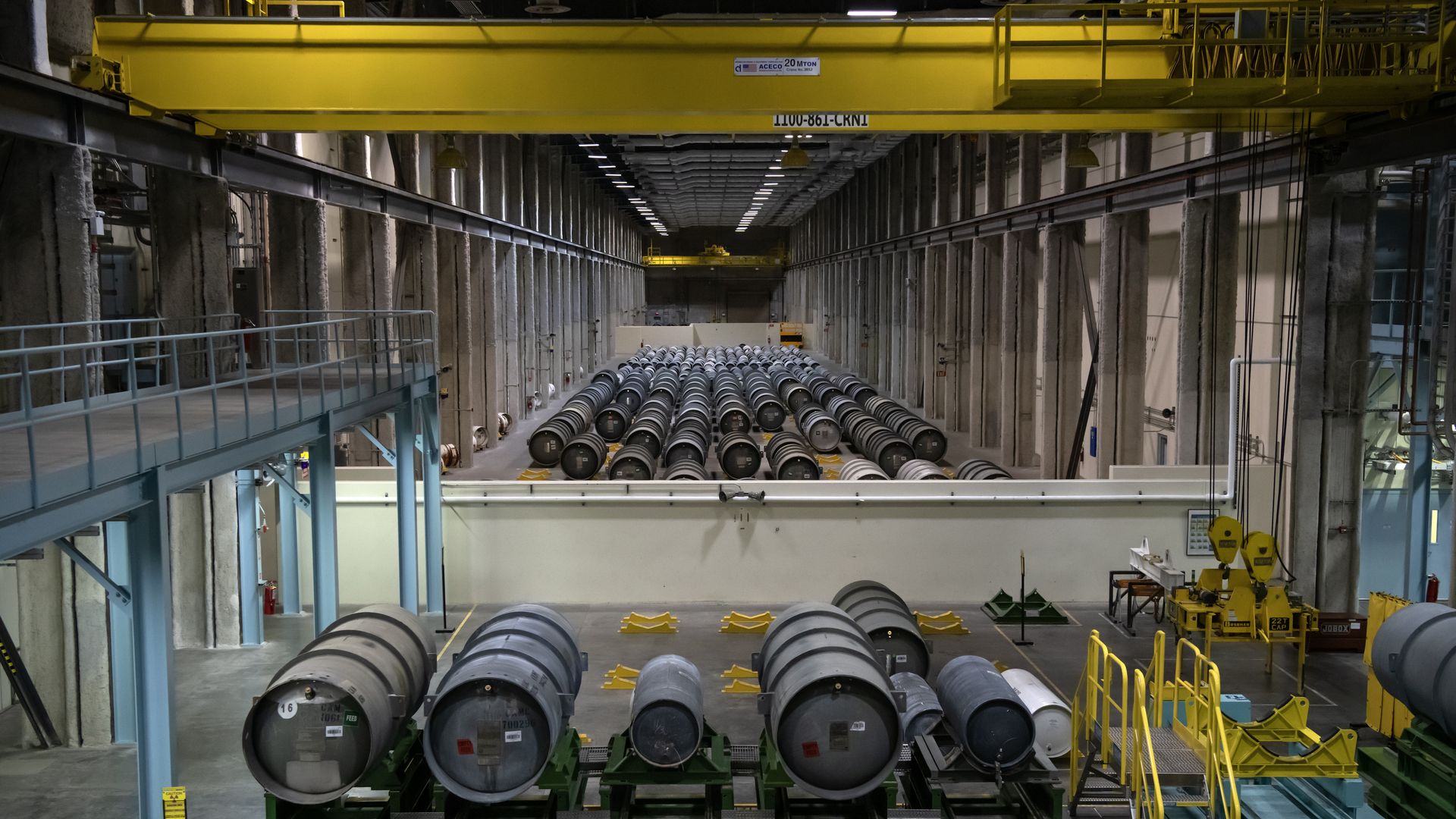
Canisters filled with enriched uranium at the Urenco USA uranium enrichment facility near Eunice, N.M. Photo: Mark Felix/Bloomberg via Getty Images
The Russian uranium ban bill moving on the Hill could both increase operating costs for U.S. nuclear plants and alleviate what experts say is a big long-term security risk, Nick writes.
Why it matters: Russia is the world's largest supplier of enriched uranium, and U.S. nuclear power plants source about one-quarter of their enrichment services from the country.
- That's a big gap to fill — but lawmakers want the import ban to complement an influx of federal resources intended to bolster domestic production.
How it works: The Prohibiting Russian Uranium Imports Act would ban low-enriched uranium, used in conventional commercial reactors, that comes from Russia.
- It includes a waiver for energy companies with no "viable" alternative to continue sourcing LEU from Russia through the end of 2027.
- That doesn't give companies much time in the slow-moving nuclear world. For that reason, some lawmakers have emphasized that the legislation has to be one in a sequence of policies to find new enriched uranium sources.
- Energy and Commerce ranking member Frank Pallone has said the bill must be paired with efforts to shore up domestic enrichment.
- It passed the House by voice vote in December after the lawmakers agreed to include the Nuclear Fuel Security Act — which would create a new DOE program for domestic uranium — in the defense authorization.
State of play: Sen. John Barrasso told Nick yesterday that he's still working with Ted Cruz, who's been blocking unanimous passage because of a political dispute with the House.
- "Not this week," he said. "We haven't figured out how we're going to do that."
What they're saying: "It's really about a holistic, multi-pronged approach to standing up domestic fuel supply," said Rowen Price, a policy advisor on nuclear energy at Third Way.
- Relying on Russia for nuclear fuel is a "looming instability that we need to take care of," said Jeremy Harrell, chief strategy officer at ClearPath.
Zoom in: The CBO estimates the legislation would increase the price of nuclear fuel by 13% and reduce average operating margins for U.S. reactors.
- That in turn could increase federal spending under the IIJA's Civil Nuclear Credit Program, per CBO, because more companies would be expected to seek federal financial support.
- Meanwhile, industry observers expect lawmakers to include nearly $3 billion more for enriched uranium in a national security supplemental — if they can overcome political hurdles on border and foreign aid provisions.
Between the lines: Many of the impacts here are TBD.
- There are questions about whether Russia might decide to unilaterally stop exports to the U.S. before the waiver period ends.
- And there are concerns among power companies about whether the Biden administration can stand up programs at DOE quickly enough to boost domestic production by 2028, said one industry source, granted anonymity to speak candidly about the bill.
Since the Russian invasion of Ukraine, "the market has anticipated, or at least acknowledged, the supply chain risk," said Timothy Fox, a managing director at ClearView Energy Partners.
- Constellation, the biggest U.S. nuclear operator, told lawmakers it has fuel supply secured through 2028.
- Urenco, which operates the only U.S. enrichment plant, has also said it will increase capacity 15% at its New Mexico facility.
- "We are committed to meeting increased demand," a company spokesperson said in an email.
2. A deep dive into geothermal tax issues

Illustration: Gabriella Turrisi/Axios
The geothermal heat pump sector is pressuring regulators to grant an exemption to a long-standing tax policy, Jael writes.
Why it matters: Geothermal players have valid grievances — but getting what they want will require Biden officials to provide what critics might see as an industry carveout.
Driving the news: A flotilla of Senate Democrats wrote the Treasury Department before New Year's with a wonky request: Release guidance declaring geothermal heat pumps, or GHPs, as exempt from something called the "limited use property" doctrine.
- Under this regulatory doctrine, equipment must be recoverable in order to be leasable, according to the letter.
- The Democrats say this makes sense for some renewable energy projects, like solar, in which panels are removed. But geothermal projects are dug into the Earth and aren't easily transplanted.
A company leasing these systems to keep ownership of property for tax reasons would need an exemption from the government, the lawmakers say.
- That's why industry and its allies in Congress are getting involved: They fear that companies could be denied IRA benefits because of this technical issue.
Between the lines: A significant barrier to getting this done will be the perception that it's a carveout to help favored businesses, according to Ryan Dougherty, president of the Geothermal Exchange Organization.
- But the group believes it's worth getting this done for the potential greenhouse gas emission reductions, energy grid resilience and potential consumer savings.
- "Limited use property doctrine has a longstanding basis which has merit, and if the geothermal industry is asking for just a carte-blanche exemption, does that make policy sense.… We would argue that indeed it does."
Of note: Dougherty said support for expanding geothermal's use is quite bipartisan. The reason the letter has only Democrats on it, he said, was simply that it referenced the benefits of the IRA.
- It wasn't long ago that one of geothermal's biggest backers in Congress was Sen. Jim Inhofe, a noted skeptic of climate science.
3. PROVE IT gets chance to prove it

Cramer in May. Photo: Bill Clark/CQ-Roll Call Inc. via Getty Images
The Senate Environment and Public Works Committee plans to mark up the PROVE IT Act next week, Nick writes.
Why it matters: The bill would direct the government to study emissions from heavy industrial products, potentially an important step for trade talks with the EU or a broader carbon tariff regime.
Details: Cosponsor Kevin Cramer confirmed that EPW plans to consider the bill.
- Ranking member Shelley Moore Capito has raised concerns about the bill, Cramer said, but he plans to start talking to GOP members of the panel ahead of the markup.
- "If we're successful next week, it'll be a pretty significant step that obviously presents the opportunity for final passage at some point," Cramer said.
Of note: Cramer said he wants the final version of PROVE IT to include language that says it is not intended to be a precursor to a carbon tariff or domestic carbon tax — a sticking point for many Republicans.
4. Catch me up: Goffman, mining

Illustration: Shoshana Gordon/Axios
🗣️ 1. Nominee struggles: The Senate canceled a scheduled vote on EPA's Joe Goffman yesterday. His nomination is controversial, and Democrats have had some absences this week.
⛏️ 2. Remining reminder: Multiple environmental groups dropped a report yesterday outlining policy recommendations on recovering minerals from waste.
🗿 3. Mining a response: House Republicans in a letter this week said Interior is stonewalling their investigation into the Biden administration canceling leases for Twin Metals in Minnesota.
✅ Thank you for reading Axios Pro Policy, and thanks to editors Chuck McCutcheon and David Nather and copy editor Brad Bonhall.
View archive