November 29, 2023

🐪 Do we need to tell you why we're starting this one with a camel?
🍻 Join Axios Pro on Tuesday for the final Happenings on the Hill Happy Hour of 2023.
- Meet, network and drink with Pro Policy reporters and leaders within the policy space. And the first person to ask Nick about Phish will win a prize!
📻 Today's last tune is actually the top 100 Beatles songs playlist that Senate EPW Chair Tom Carper told Jael he listened to with his wife on a Thanksgiving road trip. In classic politician fashion, he said his favorite was "Come Together."
1 big thing: Advanced nuclear's tough road

Illustration: Aïda Amer/Axios
The advanced nuclear industry is facing new challenges on the Hill that compound the private sector's woes, Nick writes.
Why it matters: Don't expect the recent high-profile setbacks (see NuScale) to dampen congressional enthusiasm for the technology, but there are real roadblocks to commercialization right now.
Driving the news: The ADVANCE Act — one of the main nuclear bills moving this year — appears to have fallen out of the defense authorization bill, as we reported yesterday.
- There's also some question about whether another key provision — John Barrasso's Nuclear Fuel Security Act — will make the final NDAA. His legislation aims to boost domestic production of high-assay, low-enriched uranium for advanced reactors.
- Meanwhile, Senate Energy and Natural Resources will hold a hearing tomorrow on advanced nuclear commercialization — the industry's most significant Hill scrutiny since the NuScale debacle early this month.
- It'll feature testimony from John Wagner, director of the Idaho National Lab, where NuScale's project was to be sited.
What they're saying: ENR Chair Joe Manchin told Nick he has "a lot of concerns" about recent struggles in the private sector that he plans to raise at the hearing. But he added that Congress shouldn't stop trying on advanced nuclear.
- "The bottom line is, it's a technology that we must mature," he said. "It gives us dispatchable, 24/7 [power], and I think it's imperative that we are leaders in that."
- Sen. Martin Heinrich said he still sees a prominent role for federal dollars to commercialize small modular reactors and other emerging low-carbon technologies.
- "What we're trying to figure out is what are the most appropriate technologies to decarbonize the last 20% of the grid," he said.
Context: NuScale's small modular reactor is the only technology of its kind that has received Nuclear Regulatory Commission approval.
- The company and its partner on the Idaho project, Utah Associated Municipal Power Systems, said they didn't have enough buyers for the power as they faced rising costs — despite a cost-share agreement with the Energy Department.
- In a statement, the Nuclear Energy Institute said it has "no doubt that NuScale has a design that will deploy and bring clean and reliable energy in the future."
- Heinrich, too, dismissed the idea that NuScale would bring bigger consequences for the industry: "I don't see that as an indictment of small modular so much as a marketing failure."
Yes, but: It takes a long time to get these designs approved at the NRC, and advocates on both sides of nuclear see a bleak outlook for SMRs in the near term.
- Even the ADVANCE Act — which would cut licensing fees and attempt to staff up the NRC — wouldn't move the needle much, said Breakthrough Institute executive director Ted Nordhaus.
- Nordhaus thinks Congress needs to more directly force the NRC to speed up its licensing process for advanced reactors.
- "Congress is going to ultimately have to decide how committed this bipartisan coalition is to actually getting these reactors commercialized," he told Nick. "At times it sort of verges on being a kind of Potemkin nuclear commercialization strategy."
What we're watching: Barrasso told Nick he's still working to make sure his nuclear fuel bill makes the final NDAA.
- Sen. Tom Carper, meanwhile, said he'll try again next year if he can't find a vehicle for the ADVANCE Act before lawmakers head home for the holidays.
- "I don't know that we're going to be able to do that this year, but we can certainly continue to lay the groundwork," he said.
2. Mark Kelly's bleak optimism on CHIPS rider
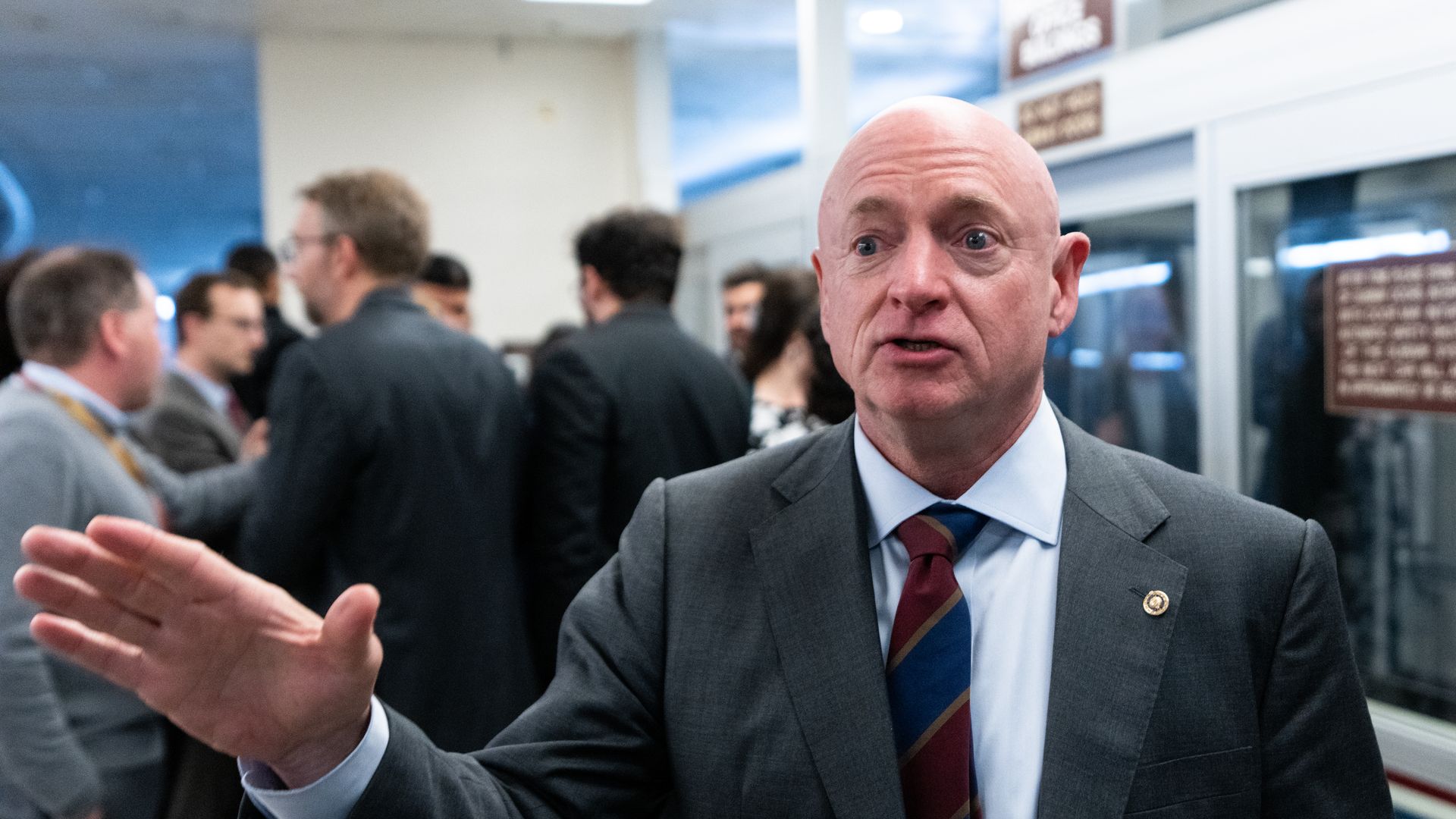
Kelly in May. Photo: Bill Clark/CQ-Roll Call Inc. via Getty Images
The Senate's CHIPS permitting rider may be the next shoe to drop in defense bill conference talks, Jael writes.
Why it matters: Semiconductor manufacturers want faster permits for federally backed projects. Per one key lawmaker, members usually hungry for "permitting reform" appear to be in the way.
The backstory: Sens. Mark Kelly and Ted Cruz got language attached to their chamber's version of the NDAA to let federal agencies determine some projects funded under CHIPS are not "major federal actions" for comprehensive review under the National Environmental Policy Act.
Driving the news: Kelly told Jael this afternoon that hurdles remain to including his language in the final conference report, which is expected to be filed as soon as tomorrow.
- "A couple things" were holding up the language, Kelly told Jael in a Senate elevator, including "folks that generally like reforms of environmental reviews" — a not-so-subtle shot at Republicans who've opposed its being included in the final bill.
- "I've been working on this every day for two weeks," said Kelly, who said he's still pressing to get the language into the conference. "You know I used to fly a spaceship built by the lowest bidder, so you have to be an optimist."
State of play: Kelly's remarks were eerily similar to those offered by supporters of the ADVANCE Act before it was tossed out of talks.
- Yet there is still the chance something like this can make it into the final package, given the NDAA's high likelihood of becoming a Christmas tree.
3. Catch me up: Big outdoors, Connecticut cars

Illustration: Shoshana Gordon/Axios
🐍 1. Lower Snake saga: House E&C Chair Cathy McMorris Rodgers has a fresh oversight letter to the Biden administration on talks with tribes and localities regarding Columbia River System Operations.
⛰️ 2. Outdoors package: Top House Natural Resources lawmakers unveiled a bipartisan legislative package to expand recreation on public lands.
- The Senate has its own version that it has voted out of committee.
🚛 3. Connecticut's car trouble: Legislators in Connecticut have forced the state's Democratic governor, Ned Lamont, to toss out proposed regulations to phase out the sale of new gas-powered cars by 2035.
🛢️ 4. New pipeline bill: Democratic Rep. Salud Carbajal has a new bill to create new pipeline safety standards, including automatic shut-off valves in case of spills.
Thank you for reading Axios Pro Policy, and thanks to editors Chuck McCutcheon and David Nather and copy editor Brad Bonhall.
View archive