April 18, 2023

🏛️ Congress is back, and we're returning to regular newsletters. Let's dig in!
🌎 Mark your calendars for an Earth Day virtual event Friday featuring Democratic Reps. Steny Hoyer and Jared Huffman. They'll talk to us about implementation of the IRA and IIJA. Register here.
🎧 Today's last song comes from Jael, who was listening to "Broadripple Is Burning" by Margot & the Nuclear So & So’s as we put together the newsletter. Check it out.
1 big thing: Congress loves nuclear power

Illustration: Megan Robinson/Axios
Nuclear energy has growing bipartisan appeal, and that popularity could shepherd new legislation through a particularly divided Congress.
Why it matters: Nuclear’s role has risen beyond the shadow of past global plant mishaps, as Congress rallies behind it as a low-carbon source of baseload power.
- Lawmakers and industry watchers expect nuclear policy to become part of talks on a bipartisan permitting overhaul over the next few months.
- The road ahead could still be bumpy: Nuclear's critics remain troubled by cost concerns and the lack of a permanent waste storage solution.
What they’re saying: Both Democrats and Republicans are interested in speeding the licensing process at the Nuclear Regulatory Commission, particularly for small modular reactors and advanced nuclear technologies that could come online over the next decade.
- "With small modular reactors, you could literally have a lot more inherent safety built into the design," Sen. Martin Heinrich told Nick last month. "And if you get through the regulatory process once, you're really only going to make an exact copy of that, so it needs a different regulatory structure than permitting a new light-water reactor from 10 years ago."
- Before the House jetted off for recess, Rep. Byron Donalds told Nick, "We have to find ways at the NRC to get to ‘yes’ as opposed to everything being ‘no,’ especially when the technology is changing and other countries are light years ahead of us."
Zoom in: NRC reform is particularly important to the industry because the agency might face a flurry of new requests in the next decade, juiced by subsidies from the IRA and IIJA.
- "You will see more design certification applications in the near term," John Kotek, the Nuclear Energy Institute’s senior vice president of policy development and public affairs, told us.
- "But as you get into the middle of the decade, that handful of companies trying to get a technology license, we think, is going to turn into dozens of applications to actually license a particular site."
- That’ll make for a busy NRC and could create potential roadblocks for new development, Kotek said.
What we’re watching: Atop the bipartisan list is the ADVANCE Act, introduced this month by Sens. Shelley Moore Capito and Tom Carper, leaders of the Environment and Public Works Committee.
- That bill would cut down licensing fees for advanced technologies and aim to make it easier to hire new highly specialized staff to get through the paperwork.
- It includes a hook that might appeal to progressives: new funding authorizations to clean up legacy mining pollution on tribal lands, which have historically borne the brunt of uranium supply chains.
- Donalds, meanwhile, has bills to let the government ease fee requirements for small businesses and require an anonymous internal survey at NRC to learn what staff think about agency operations.
- And Rep. Buddy Carter has legislation that would set up a DOE training program for “foreign nuclear energy expert[s]” and allow agencies to restrict China-linked nuclear fuel.
What’s next: A pair of hearings this week could shed light on where this conversation is going.
- A House Energy and Commerce subcommittee will meet this afternoon to hear from experts and advocacy groups on how to expand the industry.
- Senate EPW, meanwhile, plans a deep dive on the NRC’s budget tomorrow.
- Sen. Mike Crapo will attend a separate EESI briefing on the Hill tomorrow.
2. Between the lines on nuclear policy
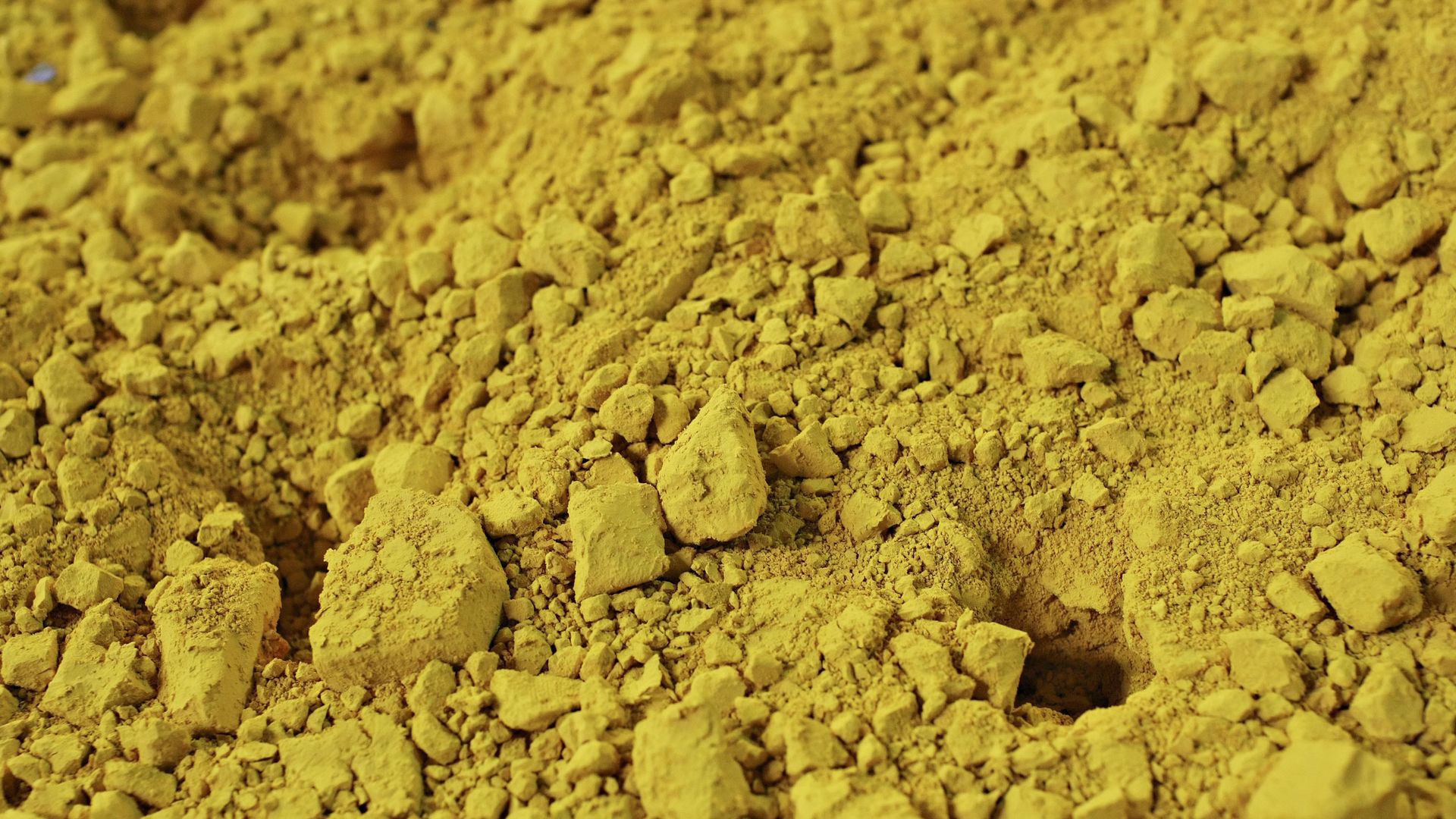
Uranium concentrate, known as yellowcake, at a processing facility in Kyzemshek, Kazakhstan. Photo: Daniel Acker/Bloomberg via Getty Images
At least one bipartisan priority has gotten a lukewarm reception in the U.S. nuclear space: banning Russian enriched uranium used in reactor fuel.
Why it matters: Russia is home to a large portion of the world’s uranium enrichment business. Few allies could ever offer any comparable amount of supply in the near term.
Zoom in: So far, the nuclear sector has avoided U.S. sanctions on Russian enriched uranium despite other commodity import restrictions over the invasion of Ukraine.
- The industry argues it's moving at a brisk pace to decouple its supply lines from Russia over the longer term, but sanctions could disrupt regular fueling operations.
Insert the Prohibiting Russian Uranium Imports Act, a proposed ban on Russian enriched uranium backed by Sen. Joe Manchin, Rep. Cathy McMorris Rogers and a raft of other Democrats and Republicans.
- It’s unclear whether enough support exists to pass the ban in the Senate, and hearings on the bill haven’t been held yet in either chamber.
- But we expect chatter about the ban to increase in the coming months, given that many of the same lawmakers support the push to boost U.S. nuclear generation capacity and reform the NRC.
- The industry is "very much committed to moving away from Russian uranium enrichment and conversion services," said the NEI's Kotek. "This is something that takes years."
Go deeper: The industry and its backers also think Congress might move legislation to boost nuclear exports and spur collaboration with U.S. allies on advanced technologies.
- That could resemble the International Nuclear Energy Act, introduced by Manchin and Sen. Jim Risch, which would create new federal programs to develop a civil nuclear exports strategy.
The big picture: The politics remain tricky for an industry plagued by cost overruns (see: Plant Vogtle), waste controversies and long-standing opposition from the environmental left, but the NEI and its allies see a changing landscape.
- During the 2020 campaign, progressive presidential candidates — namely Bernie Sanders and Elizabeth Warren — were promising to halt nuclear in its tracks.
- Yet Democrats passed in the IRA a tax credit to specifically subsidize existing nuclear reactors, plus billions more through the IIJA to keep the fleet alive and fund advanced tech demonstrations.
- Even as Germany closes its remaining nuclear plants, plenty of experts say nuclear needs to be part of long-term net zero scenarios to limit the use of natural gas and coal going forward.
- "We don't yet have a strong social policy for nuclear that detangles the waste issue, that brings communities into the decision-making process, that addresses historical legacy contamination issues from uranium mining and milling," said Jackie Toth, deputy director of Good Energy Collective, a progressive pro-nuclear group.
- "These are the kinds of issues that we hope Congress turns its attention to this session."
✅ Thank you for reading Axios Pro Policy, and thanks to editors Chuck McCutcheon and David Nather and copy editor Brad Bonhall.
View archive