
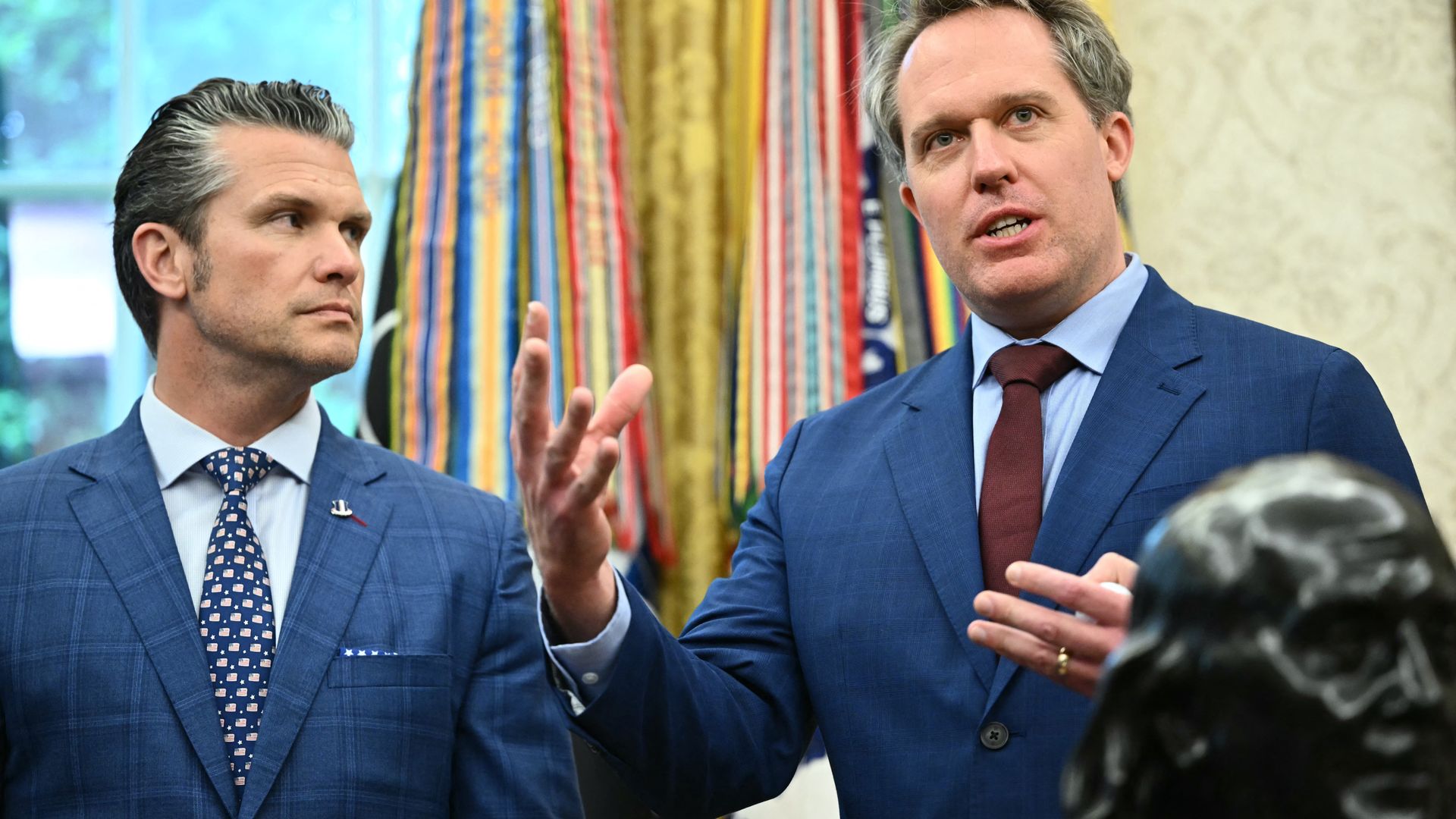
Defense Secretary Pete Hegseth and DeWitte at May's executive order signing. Photo: Mandel Ngan / AFP via Getty Images
President Trump's aggressive nuclear goals have helped break the decades-long logjam for new projects, a leading figure in advanced reactor development says.
Why it matters: Oklo CEO Jacob DeWitte's bullishness comes as the White House's executive orders and AI demand boost prospects for nuclear's long-promised renaissance.
Driving the news: The Energy Department announced last week it would speed testing of 11 advanced reactor projects — including three from Oklo —as part of a pilot program spurred by May's executive orders.
- The orders set up a DOE-DOD partnership for at least three test reactors to achieve self-sufficiency by July 4, 2026. They also envision reactors on military sites by 2028.
- The actions are "opening up sort of a different pathway and unleashing government in a more constructive way," DeWitte told Axios. "We have this moment to rethink what's possible."
The big picture: Oklo — a Sam Altman-backed venture developing a compact reactor — is positioned to reap the benefits of deploying reactors to feed military bases and data centers.
- Oklo aims to commission a commercial-scale reactor at Idaho National Laboratory by late 2027.
- DeWitte dismissed concerns about the White House infringing on NRC's independence, arguing that the commission has been resistant to change.
- The NRC in 2022 denied Oklo's application to build and operate the company's reactor in Idaho, though the company is trying again.
The other side: The NRC has defended its ability to license reactors and said it's carrying out the ADVANCE Act and Trump's executive orders.
- Sen. Sheldon Whitehouse and other Democrats have expressed growing alarm at the firing of a Democratic NRC commissioner and installation of a DOGE representative at the agency.
- The administration is "listening to the startup guys who want to say that the regulator is the problem, when most of the mature players in the industry are not saying that," a source familiar with the situation — who spoke on condition of anonymity — told Axios.
Zoom in: DeWitte contrasted Oklo's eagerness to take on first-of-a-kind projects with the caution of electric utilities.
- Oklo doesn't need federal backstops for reactor projects — as envisioned in Sen. James Risch's ARC Act — to bring down reactor costs, DeWitte said. It just needs quicker licensing and permitting.
- "The view in D.C. and Capitol Hill and the policy space is still so heavily biased towards utilities being the ones who are going to drive everything in this industry forward," DeWitte said.
The executive orders' biggest timeline accelerant? Speeding up nuclear fuel enrichment, he said.
- The executive orders tap existing DOE fuel stockpiles to supply the first batch of reactors, creating a bridge to the point when enough advanced reactor demand can support fuel producers.
What's next: DeWitte isn't worried about nuclear's fortunes being too tethered to AI demand, which is making power-consumption forecasts hard to predict.
- "The AI side can just move faster and more efficiently than anyone else can, and has a lot of capital as well," he said.
- "The simple fact is, as we see things moving, we feel pretty comfortable that those kind of dynamics" will last.
