
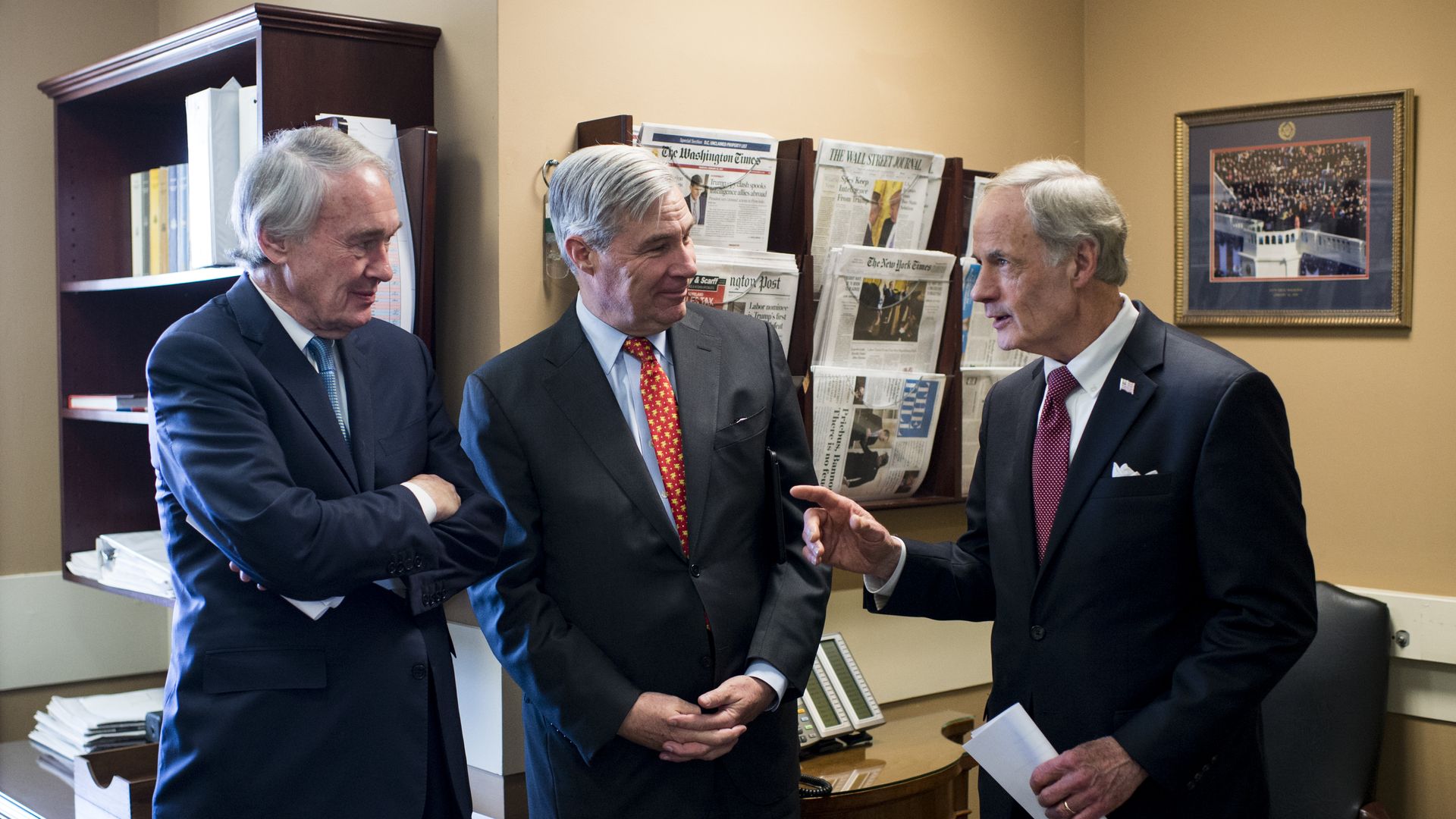
COP Senate delegation members Ed Markey, Sheldon Whitehouse and Tom Carper in 2017. Photo: Bill Clark/CQ Roll Call
The Senate delegation is now officially in Dubai. It brings mixed views on the fossil fuel question that has dogged COP28.
Why it matters: Whether countries can agree to "phase out" or "phase down" oil, gas and coal is a huge flashpoint at this year's conference.
- It's a conundrum that's consistently trickled into U.S. domestic politics.
The delegation spoke to reporters shortly after landing. Here's what they said ...
Sen. Ben Cardin said he expects "more predictable, and I think more aggressive" results on fossil fuels than during past conferences.
- In Glasgow in 2o21, countries agreed to reduce coal use — but didn't touch oil and gas. Last year's conference didn't produce a decisive outcome on the issue, either.
- "This COP seems to be better organized ... The UAE seems to have a grip on making sure that this is a productive outcome," he said.
Sen. Tom Carper likened the phase out-vs.-phase down debate to U.S. actions on hydrofluorocarbons, or HFCs, potent greenhouse gases used for years in refrigeration.
- After a lengthy deliberation in 2020, Congress agreed to legislation to phase down HFCs by 85 percent.
- "I think it's good to aim high ... It's also important for us to set goals and then go out and get them and achieve them," Carper said.
Sen. Lisa Murkowski, the delegation's lone Republican, said "it's okay to be aggressive," but she added that the outcome at COP28 needs to be realistic about the energy transition.
- "There's a big difference between phase out and phase down. And the term that we use is transition because you cannot go from A to Z with a flip of a switch."
Sen. Ed Markey, unsurprisingly, offered more direct support for a total elimination of fossil fuels.
- "We have to turn that rising tide of fossil fuel production and exports before it sweeps the entire planet away. That's why I support a negotiated outcome for a fossil fuel phase out."
The bottom line: COP28's outcome could make a big difference in how Congress views international climate commitments.
