WindBorne closes $15M for weather balloons & AI

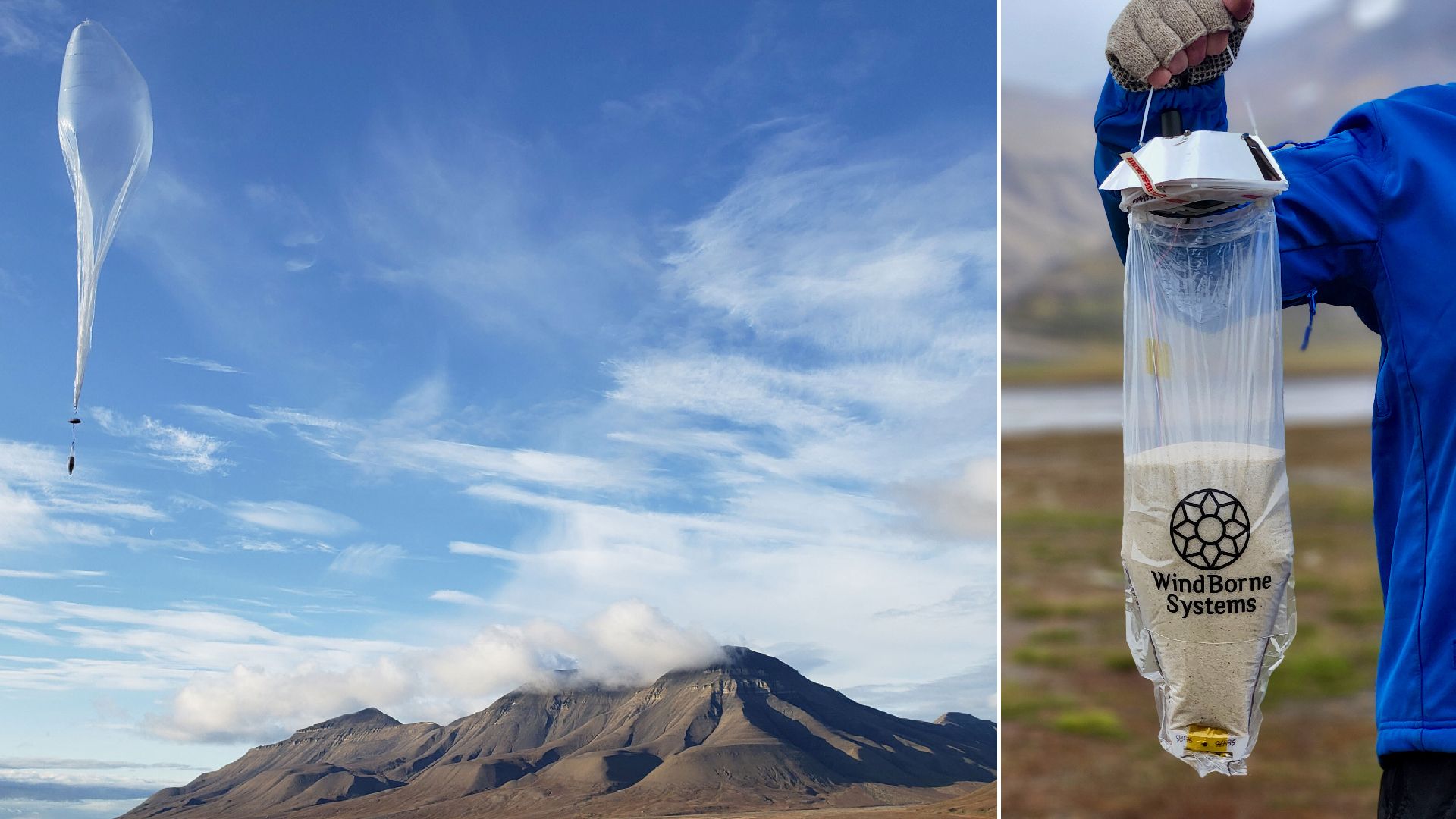
A WindBorne Global Sounding Balloon. Photo: Courtesy of WindBorne Systems
Smart weather balloon startup WindBorne Systems has closed $15 million led by Khosla Ventures.
Why it matters: AI weather prediction is a hot sector, with deep-pocketed players like Nvidia and Google involved in the technology.
Zoom in: WindBorne's round was listed in a recent SEC document.
- Prior investors in the company in addition to Khosla include Footwork, Pear VC, Ubiquity Ventures, Harvest Ventures, Humba Ventures, Jetstream, and Convective Capital.
- The company, founded by a team of Stanford graduates, raised a seed round of $6 million last year.
How it works: WindBorne has developed a low-cost weather balloon that can be controlled remotely using lifting gas, enabling the balloon to move up and down in the atmosphere.
- Governments and organizations commonly use low-cost balloons to collect weather data but traditionally those balloons float uncontrolled in the atmosphere for a couple of hours before they pop.
- WindBorne's balloons use various weather sensors to collect temperature, wind pressure and direction data, and use satellite networks to communicate the data. They also use a solar panel for power.
- In February the company announced an AI weather forecasting model called WeatherMesh, which it says broke accuracy records previously held by Google DeepMind's AI weather model.
Catch up quick: Better forecasting using AI will be an important tool as weather becomes more extreme with climate change.
- Weather AI models are trained on historical data to learn complex systems and generate projections.
- The traditional approach relies on numerical models that use physics equations and weather observations to produce simulations of future conditions.
- There's some skepticism in the weather and climate communities around AI-driven weather predictions.
The big picture: WindBorne is tapping into several emerging trends including low-cost hardware, ubiquitous communication networks, and the growing demand for better weather data.
What's next: The startup plans to increase the number of balloons in the atmosphere to 10,000.
