Traffic is back, but rush hour isn't the same

Add Axios as your preferred source to
see more of our stories on Google.


The pandemic didn't kill rush hour in America — it just spread traffic throughout the day.
What's happening: The rise of home offices and flexible work hours means there were fewer cars on the road last year during traditional peak times — particularly the morning commute, according to TomTom Traffic Index 2021.
- In some cities, there was a new "late morning peak" around 11am.
- In others, the evening rush started earlier — as early as 3 or 4pm.
Why it matters: The change in traffic patterns could be one of the lasting trends of the pandemic, but a lot will depend on whether remote work sticks around.
- Many companies have given up on their return-to-office plans because of all the unknowns. Nor have they figured out the concept of hybrid work, making new traffic patterns hard to predict.
Pandemic-driven traffic changes vary by city, often depending on the particular city's COVID restrictions and the nature of its workforce, TomTom data specialist Jeroen Brouwer tells Axios.
- While office employees stopped commuting in places like Silicon Valley, other workers still have to drive to their shifts at hospitals, factories and other workplaces.
The big picture: Traffic congestion isn't as bad as it was before COVID upended our weekday commute, but it's still stealing our time.
- In Minneapolis, drivers spent almost a full day — 23 hours — in traffic last year.
- In Atlanta, Tampa, Florida, and Washington, D.C., drivers lost two days to traffic.
- New Yorkers? More than three days.
How it works: TomTom collects hundreds of millions of anonymized GPS signals from cars and smartphones around the world to analyze traffic in more than 400 cities.
- It calculates a baseline for free-flowing traffic at midnight in each city, then compares traffic at other times of the day to determine congestion levels, including morning and evening peaks.
- New York, with a 35% congestion rate, is America's most congested city. That means a 30-minute trip will take 11 minutes longer when traffic is bad.
- But here's a surprise: Globally, New York is the only U.S. city ranked in the world's top 50 for congestion — it's No. 43. Istanbul has the worst traffic jams on the planet, with drivers losing 142 hours (six days) in traffic per year.
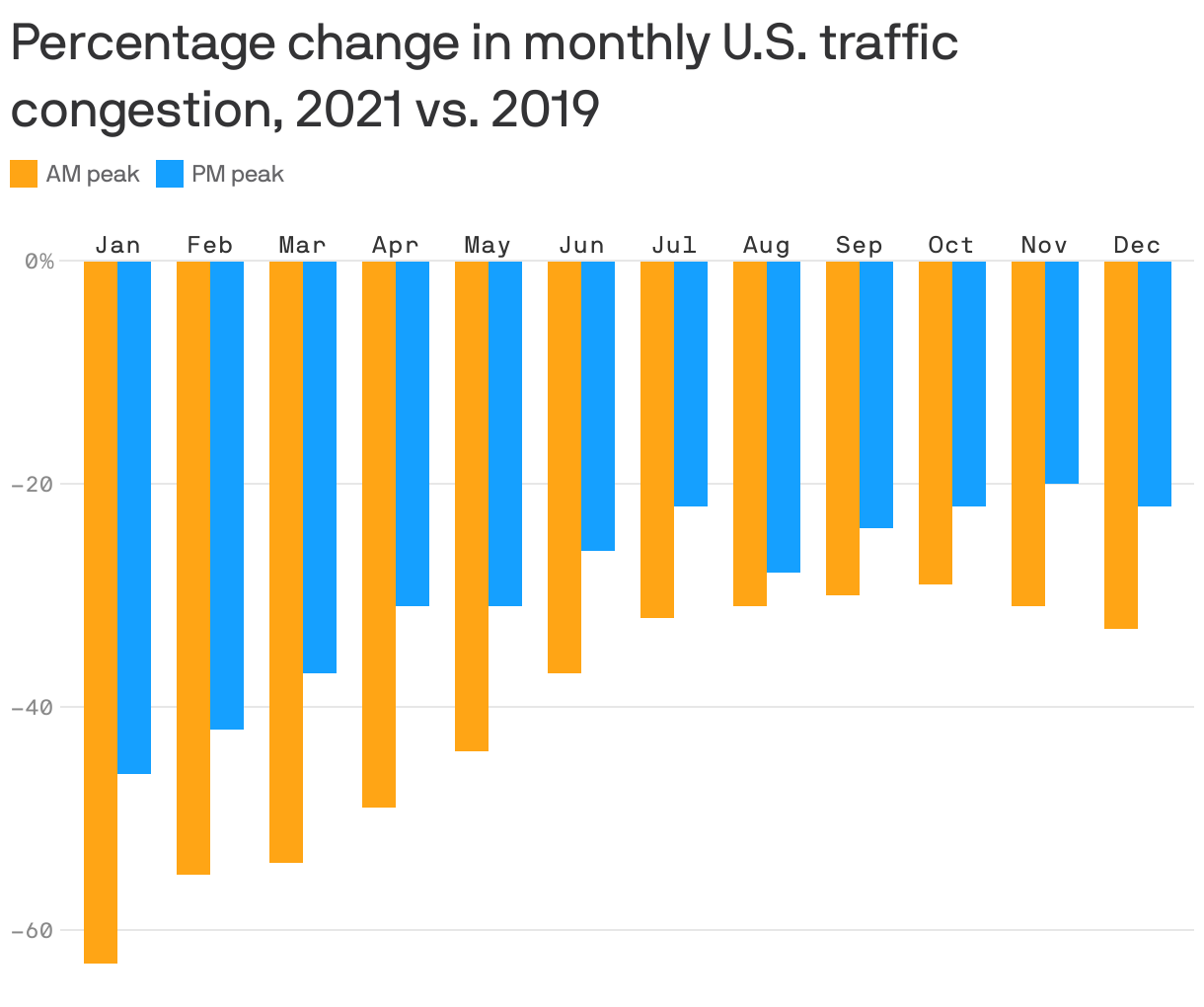
Between the lines: Overall congestion levels in North America were down 14% in 2021 compared with 2019. At traditional peak hours, the drop in traffic was 31%.
- In New York, Philadelphia, New Orleans and Las Vegas, congestion levels are almost back to normal — down just 1% or 2% compared with 2019.
- But in San Francisco, Los Angeles, Washington, D.C., and San José, California, congestion remains significantly below 2019 levels.
What to watch: Month by month, congestion has been building in the U.S.
- "Rush hour is coming back slowly," says TomTom's Brouwer. "The question is, what will the new normal look like?"