Axios What's Next

February 03, 2022

Several of you enjoyed the question a reader posed at the top of yesterday's newsletter, ""Why isn't there a Cabinet-level Secretary of the Future?”
- Jonathan Rein sent us a link to a white paper by his colleague Peter Scoblic on myopia in U.S. public policy.
- Zac Graves sent us a recommendation for a sci-fi book: "The Ministry for the Future" by Kim Stanley Robinson.
💡 Got a thought (or two) about today's stories? Email us at [email protected].
Today's Smart Brevity count: 1,167 words ... 4.5 minutes.
1 big thing: A "great resignation" silver lining for HR

Illustration: Sarah Grillo/Axios
It's not exactly the "great resignation," but more like the "great reorganization": Millions of Americans want to quit their jobs, but many would happily stay at their companies in different positions, Erica Pandey writes.
What's happening: 1 in 3 candidates who sought out a new job in the past year searched internally within their organization first, according to a new report from the consulting firm Gartner.
As workers in the era of COVID, “we’re more open to re-examination,” says Shonna Waters, a vice president at the career coaching company BetterUp.
- "For some people, that means moving somewhere new or pursuing a passion, but for a lot of people it could also just mean looking around and saying, 'I want a higher-level role,' or 'I want a different role at the same company.'"
- Many people want change at work but also want to retain the friendships and reputation they've built within a company, she says.
That's good news for stressed-out human resources departments: It means they might be able to fill some of those mounting job openings with applicants who've already gone through on-boarding and are familiar with the firm.
Yes, but: "Historically, that's been very hard to do," says Brian Kropp, head of Gartner's human resources practice.
- Applying for a new job at a new firm is a familiar exercise, says Waters. "But not every company has a clear process for making those changes internally."
- Hiring managers can be biased against people who already work for the company, Kropp says. "There's an emphasis on hiring a fresh face."
What to watch: To retain some of those "great resignation" workers who might want to stay on in new roles, companies will have to rethink their hiring practices and biases.
- One solution is to open up applications for a job a week early to internal candidates to encourage them to apply, says Kropp.
- Firms can also promote stories of workers who have made a successful transition from one role to another.
2. Where to encounter some of the first self-driving vehicles

Illustration: Shoshana Gordon/Axios
More driverless trucks and taxis are going to be on the roads in the near future — if you know where to look, Joann Muller writes.
- They're primarily in San Francisco and Phoenix.
Why it matters: Years of simulations and supervised, real-world testing with backup safety drivers are now giving way to fully driverless practice runs on some well-tested routes, which means we could finally be on the cusp of the autonomous revolution.
- Yes but: They’re only baby steps within tight geographic limits and under the fairest conditions.
Where it stands: To ride in an autonomous vehicle in the U.S. today, you'd have to head to suburban Phoenix, where Waymo One has been operating a limited service since 2018.
- It's also testing self-driving cars in San Francisco now, but only with a safety driver.
Starting this spring, autonomous truck developer TuSimple will begin driverless freight runs between Tucson and Phoenix for Union Pacific, America's largest railroad.
- TuSimple says it has conducted seven fully driverless runs over 550 miles since Dec. 22 "under various roadway conditions, including dense early-evening traffic," with plans to incorporate daytime runs and add new routes as it matures.
Meanwhile, Cruise, the GM-backed robotaxi developer, said it's beginning to offer rides in San Francisco to the public, starting with employee friends and family.
- GM CEO Mary Barra got her first driverless ride last week, calling it “surreal” and “a highlight of her career” as an engineer.
- Cruise is also opening up a public waitlist for what it calls the Cruise Rider Community program "for when we're ready to offer even more rides to San Franciscans."
Worth noting: The driverless trips by both Cruise and TuSimple have mostly been at night, when driving is less complicated.
3. Prepping for "Category 6" hurricanes

Illustration: Annelise Capossela/Axios
A trend toward rapidly intensifying, powerful hurricanes in recent years is spurring experts to examine more closely how to prepare communities to better withstand such violent weather, Andrew Freedman writes in Axios Generate.
Driving the news: The U.S. National Science Foundation (NSF) recently awarded about $13 million over four years to Florida International University's (FIU) Extreme Events Institute to support the design of what is essentially a "Category 6" storm simulator.
- The grant will allow FIU to create a testing facility capable of producing winds of up to 200 mph, complete with a water basin to simulate storm surge and wave activity.
Why it matters: Tropical cyclones, known in the tropical Atlantic and eastern Pacific as hurricanes, are intensifying as the oceans and atmosphere warm in response to human emissions of greenhouse gases.
- As storms get stronger, they are capable of inflicting more damage to homes and critical infrastructure along the coast, where the strongest winds and worst storm-surge flooding occurs, and also well inland through heavy rainfall.
Context: Currently, the Saffir-Simpson Hurricane Wind Scale goes from Category 1 through 5, maxing out when a storm’s top sustained winds go above 155 mph.
- Yet many storms have intensified so significantly that they might as well be called Category 6 storms, though the broad meteorological community has not rallied around a push to add another number.
4. The scent of a pandemic
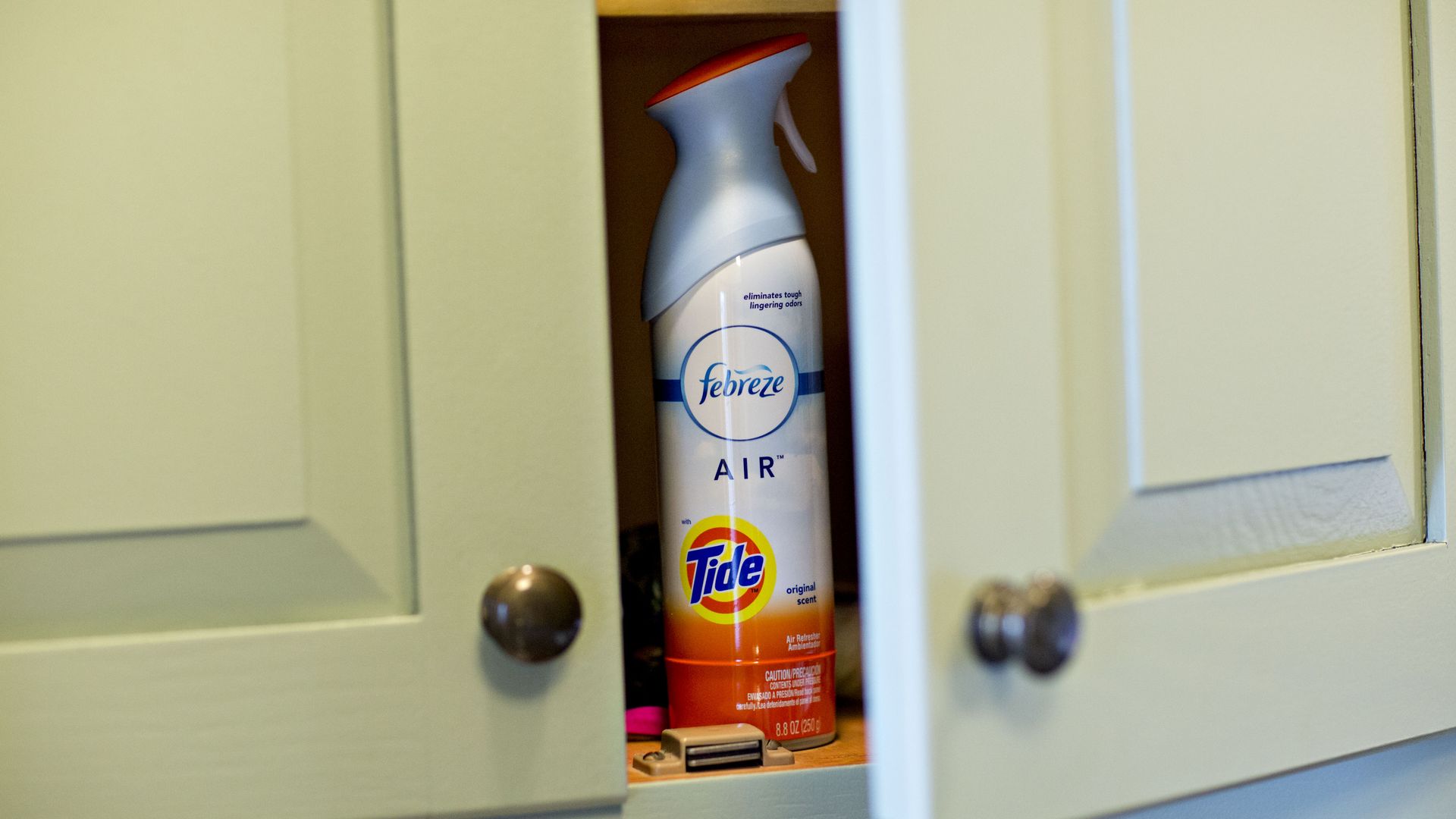
Photo: Daniel Acker/Bloomberg via Getty Images
We're buying more air fresheners, fragranced candles and other products to mask the stink of COVID-era living (sweat from your Peloton, your pandemic puppy's accident, etc.), Andrew Adam Newman writes in Retail Brew.
Why it matters: Purveyors of room fragrance products say that sales are up, and suppliers of scent to heavily perfumed retail stores (think: Abercrombie & Fitch) are optimistic as well.
- Prolitec, which supplies scent-circulating devices to stores like Skechers, L’Occitane and Haagen-Dazs, told Retail Brew it thinks it can be "part of retail’s rebound," helping to coax more shoppers back to stores.
- "Air freshener sales rose 10% in 2021 compared with 2019, while candle sales were up nearly 30% in the same period, according to IRI data."
Between the lines: A 2019 study found that "shoppers in stores with a pleasant scent spent 3% more on average than those who shopped in a store with no scent."
5. New fashion trend? "Balletcore"

Tweet image vis Axios Visuals
Remember "mumblecore" (an indie film genre with lots of mumbling) and "normcore" (a personal style that valued authenticity over edginess)? Well, the "-core" suffix seems to have staying power, judging from Vox's latest list of TikTok fashion trends — which is topped by "balletcore."
- Balletcore seems to be just what it sounds like: an airy, pink aesthetic that includes dressing in dance-inspired clothing (leotards, ballerina shoes, corsets) and wearing your hair in buns and wispy tendrils.
- "The latest aesthetic trend to reach social media It-girl status is balletcore," per The Cool Hour, a design collective that helps people discover new "looks."
- "Comprised of muted colors, wrap silhouettes, dainty skirts and ballet flats, you can expect it to be spring’s prettiest trend yet."
- To get the look: "Simply start with a circle skirt in a satin or tulle material, then layer on a light-colored faux fur coat and leg warmers. As for the shoes, either ballerina flats or Mary Jane pumps will pull it together."
Was this email forwarded to you? Get your daily dose of What's Next magic by signing up for our free newsletter here.
Sign up for Axios What's Next

The next decade of big, sweeping changes will unfold in cities and communities where new technologies like 5G, AI and drones are transforming how we work, live and play together. What’s Next will guide you through the revolution.