Axios What's Next

August 15, 2024
Some cities offer children born there more upward mobility than others, Alex reports today.
- 👋 Thank you so much for your support, ideas and feedback. Aug. 16 will be our last daily send of the What's Next newsletter — but coverage of all the ways we work, play and get around will continue to appear on Axios.com.
- We also hope to see you in person at What's Next events, and plan to share special coverage of those with you. Follow Axios Events to be the first to know about them.
Today's newsletter is 861 words ... a 3-minute read. Copy edited by Amy Stern.
1 big thing: Cities of opportunity, ranked

Americans born to low-income families are faring worse than the last generation in most major U.S. cities, a new analysis finds.
Why it matters: Intergenerational mobility — the idea that you'll do better than your parents, your children will do better than you, and so on — is core to the American dream, but is far from a guarantee.
What they did: A new analysis from the Census Bureau and Opportunity Insights, a research group at Harvard University, seeks to measure intergenerational mobility at the county level.
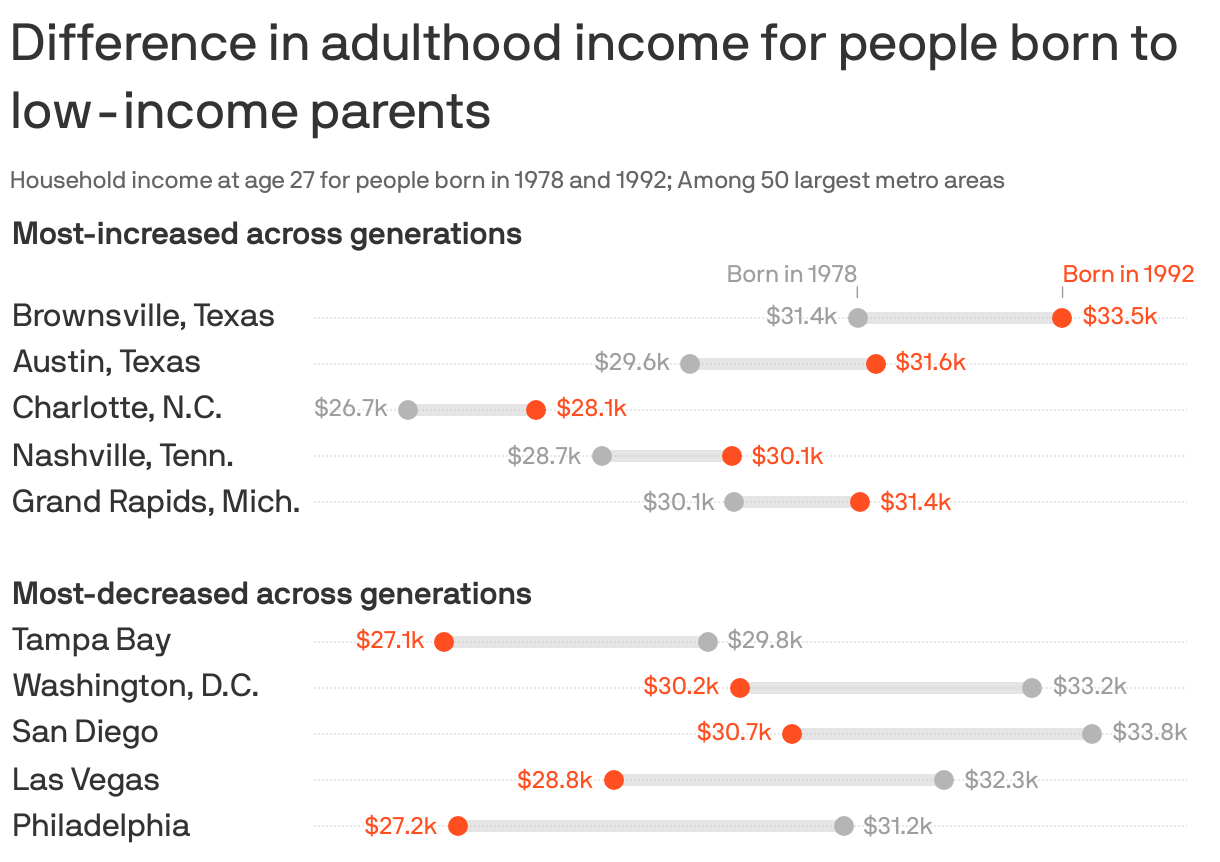
- Researchers compared the average household income at age 27 for Americans born to low-income families in both 1978 and 1992 to get a localized picture of changing opportunities over time.
What they found: In 38 of the 50 biggest U.S. metro areas, Americans born to low-income families in 1992 were doing worse at age 27 than those at that age born in 1978.
- Brownsville, Texas, had the biggest increase across generations: Those born in 1992 made $33,500 at age 27, compared to $31,400 for those born in 1978 (up 6.7%; adjusted to 2023 dollars).
- Philadelphia had the biggest drop, with those born in 1992 making just $27,200 at age 27, compared to $31,200 for those born in 1978 (down 12.8%).
Between the lines: The geography of mobility has shifted dramatically, especially when breaking down the data by race.
- "By 1992, upward mobility for low-income white children in the coasts and in the Southwest fell markedly to rates on par with those observed in Appalachia and other areas that historically offered the lowest chances of upward mobility," the researchers write.
- "Conversely, for Black children, upward mobility increased the most in the Southeast and the Midwest — areas where outcomes had historically been poorest for Black Americans."
Yes, but: "Black children born in 1992 still had poorer prospects of rising up than white children in virtually every county in America, because initial Black-white disparities were so large."
The bottom line: Changes affecting one generation quickly affect the next, the researchers say, and "thereby generate rapid changes in economic mobility."
- "While this carries hope for how opportunity can improve, it also comes with some caution, as communities can experience declining opportunity in a similar timeframe."
Go deeper: You can explore the researchers' work at the Opportunity Atlas, an interactive tool where the data can be sliced by income levels, gender, race and more.

2. Southwest board fight amps up
Activist investor group Elliott Management has ramped up its attack on Southwest Airlines, putting forward a slate of 10 directors and calling for a special board meeting to hold a vote on the candidates.
Why it matters: Southwest's leadership team now faces a tough and expensive challenge ahead.
Catch up quick: Elliott launched its campaign in June, calling for the airline's CEO and chairman to step down.
- Southwest's bylaws give Elliott the option of calling a special shareholders meeting to replace board directors — which it did yesterday.
The other side: "The Southwest Airlines board remains confident that the airline has the right leadership team in place to evolve the business and to lead Southwest Airlines forward," the company said in a statement.
What's next: The process to put a special meeting on the calendar can take months to sort out.
3. Safeguarding secrets from quantum spying
The National Institute of Standards and Technology has released its highly anticipated standards for protecting encrypted data from future quantum technologies.
Why it matters: China and other foreign foes are likely already collecting encrypted U.S. secrets with the hopes of breaking into them once quantum computing technology catches up.
What's happening: NIST this week formally approved three post-quantum cryptography standards, marking an important first step in protecting government and critical services from encryption-breaking quantum.
- IBM researchers developed two of the three standards in collaboration with industry and academic partners.
- The third standard was developed by a researcher who has since joined IBM.
- Apple, Meta, Google and some other companies are already implementing these standards.
What's next: These standards will serve as a blueprint for governments and private-sector organizations around the world.
4. No more Waymo honking
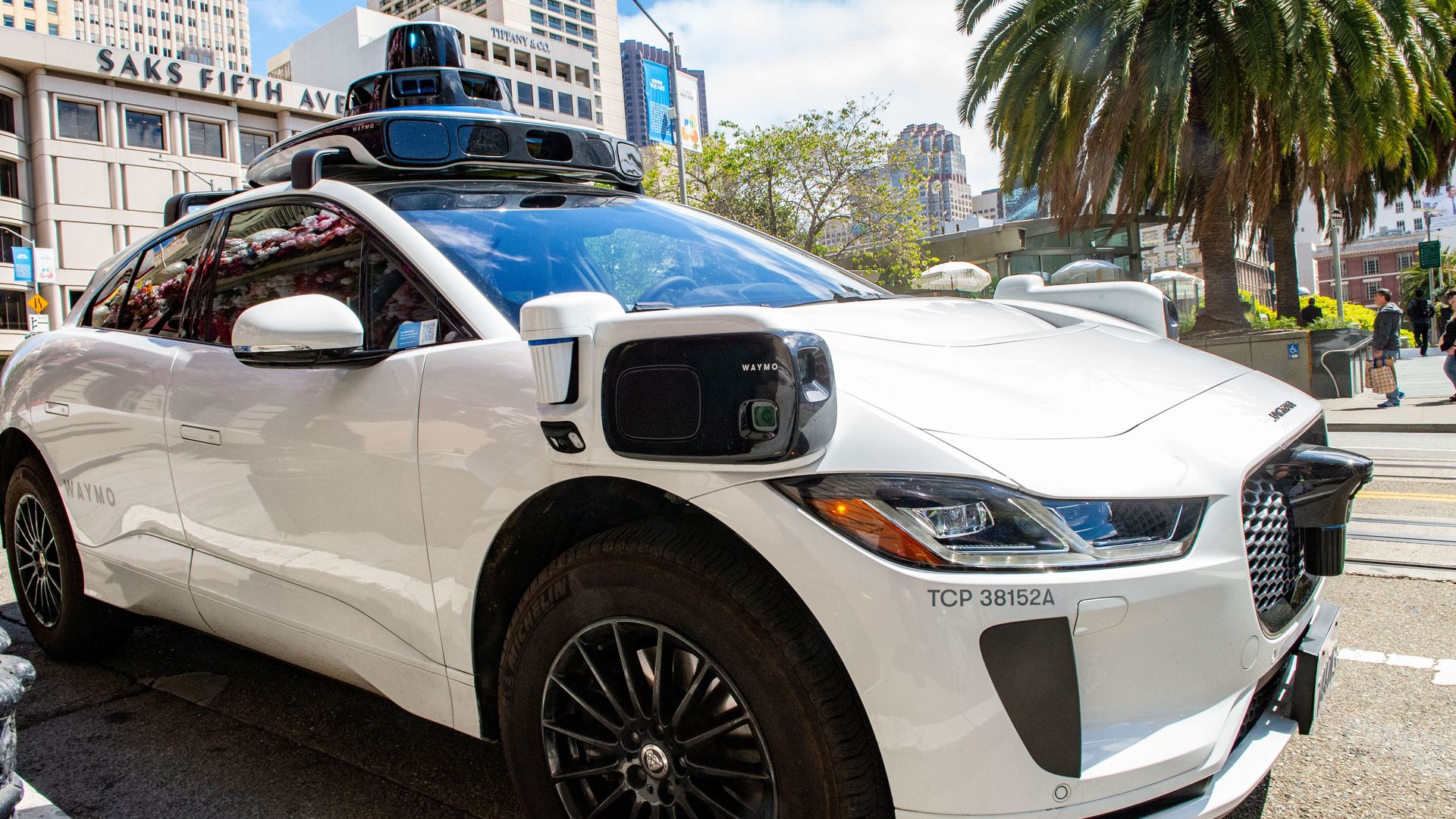
Waymo has fixed an issue causing incessant honking in a San Francisco neighborhood, the company tells Axios.
Driving the news: San Francisco resident Sophia Tung has been livestreaming a noisy parking lot that houses Waymo's driverless vehicles during downtime.
- Tung noticed the SoMa lot began filling with robotaxis in late July, and has since been disturbed by nightly honking — which "is mainly when they all come back from the charging depot at once, which is unfortunately at around 4 a.m.," she tells Axios.
What they're saying: The honking was tied to a feature the company recently introduced to avoid low-speed collisions, Waymo says.
- The "useful feature" makes the vehicles honk if other cars get "too close while reversing toward us," company spokesperson Chris Bonelli tells Axios.
- "It has been working great in the city, but we didn't quite anticipate it would happen so often in our own parking lots," he added.
The latest: "We've updated the software, so our electric vehicles should keep the noise down for our neighbors moving forward."
Axios' Claire Reilly and Joann Muller contributed to this story.
Sign up for Axios What's Next