
Axios What's Next

March 09, 2023
Alex here. For many of us in the Northeast, it felt like an unsettlingly warm winter — and the data backs up those bad vibes, as our colleague Andrew Freedman reports today.
Today's newsletter is 1,144 words ... 4 minutes.
1 big thing: Winter's warming faster than summer
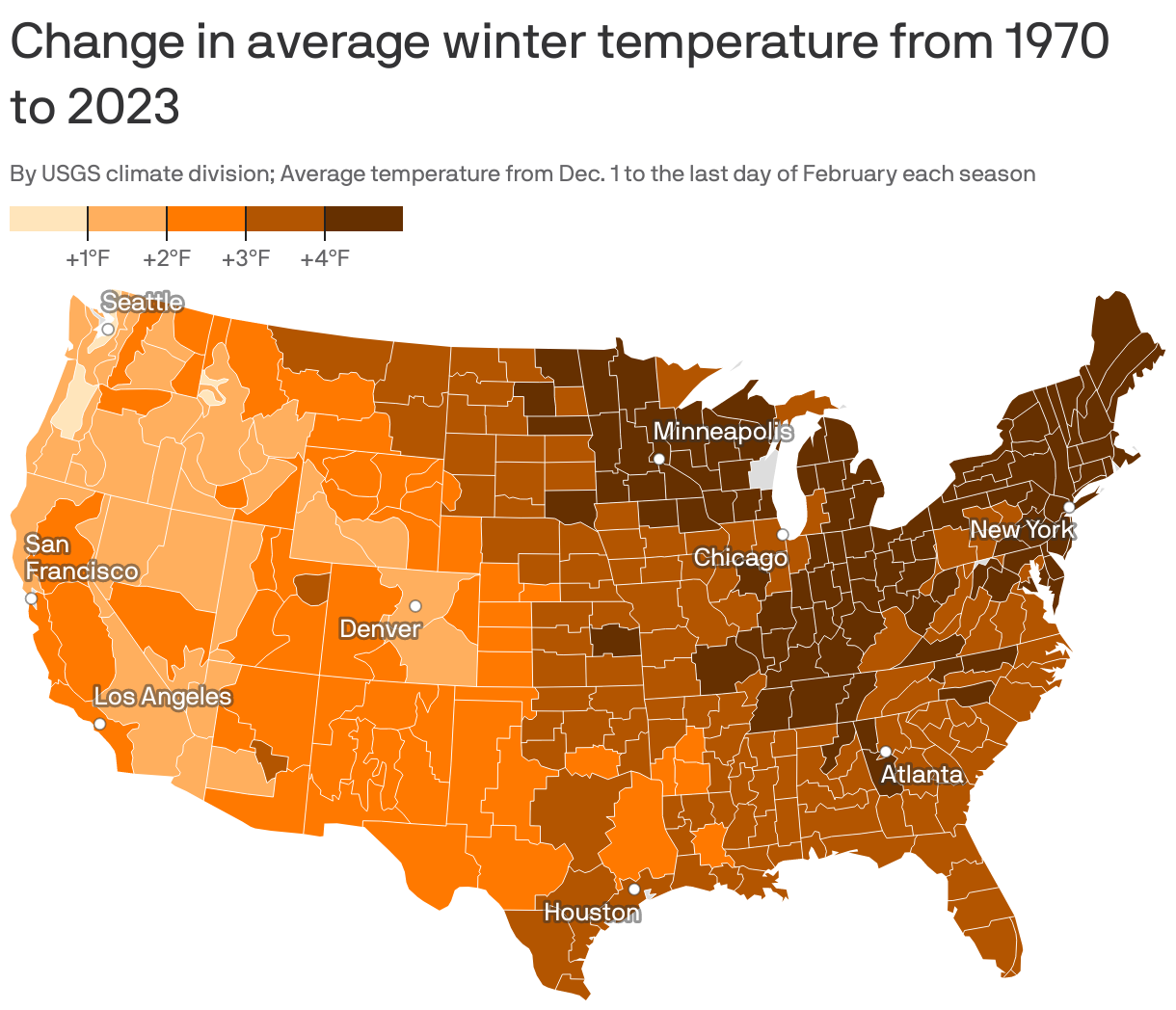
Average winter temperatures across the United States have increased by 3.2°F degrees since 1970, according to an analysis from Climate Central, a nonpartisan research and communications group, Axios' Andrew Freedman reports.
- By comparison, average summer temperatures have increased by 2.3°F in that time.
Why it matters: Warm winters can exacerbate drought (because there's less snowmelt in the spring), wreak havoc on crops and gardens, and spell disaster for towns built around skiing, snowboarding, and similar pursuits.
The big picture: Winter is the fastest-warming season for much of the continental U.S.
- About 80% of the country now has at least seven more winter days with above-normal temperatures compared to 1970, per Climate Central.
- Seasonal snowfall is declining in many cities — although heavy snowstorms can still happen when temperatures are cold enough.
- In fact, precipitation extremes are happening more frequently and getting more intense, which can lead to feast or famine snowfall.
Driving the news: Not only are winters warming overall, but cold snaps are becoming less severe and shorter in duration, the latest research shows.
- That's partly because the Arctic is warming at three to four times the rate of the rest of the world.
- In other words, our global refrigerator is warming up, making it harder to get record-breaking cold for days on end when weather patterns transport Arctic air southward.
Zoom out: This past winter was especially mild across areas east of the Mississippi River. But across the West, it was colder than average. This is reflected in the balance of daily record highs to daily record lows.
- Preliminary NOAA data processed by Climate Central shows there were 4,857 daily record highs set or tied in the lower 48 states this past winter, and 4,421 daily record lows set or tied.
- A combination of La Niña, a strong polar vortex, and a stubborn area of high pressure in the far western Atlantic Ocean favored a weather pattern that kept the East Coast on the warm side of winter storms, delivering snow across the Great Lakes northward into Ontario and Quebec.
- This was the 17th-warmest winter on record across the U.S. as a whole, as colder conditions in the West balanced out milder temperatures in the East.
The bottom line: Over the coming years, most of us can expect to feel climate change's effects more acutely during the winter months.
2. Airports get taxiway landing alerts

A plane prepares to take off from Denver International Airport on Sept. 7, 2016. Photo: Robert Alexander/Getty Images
New software that warns air traffic controllers if an inbound aircraft may be lining up to land on a taxiway rather than a runway has been installed at 43 major airports nationwide, the Federal Aviation Administration tells Alex Fitzpatrick.
Why it matters: Landing on a taxiway — essentially roads for aircraft that connect runways with terminals — can be a major safety hazard.
- There were 1,641 so-called "wrong surface events" between October 2016 and the end of last year, the FAA says — though the vast majority (83%) involved general aviation aircraft, not commercial planes.
How it works: The software, called ASDE-X Taxiway Arrival Prediction (ATAP), uses radar and other sensors to automatically tell if a plane appears to be lining up to land on a taxiway, rather than a runway.
- In such an event, the software alerts controllers to the potential problem. They can then communicate the issue to the incoming pilots.
Details: ATAP has been installed at Boston Logan International Airport, John F. Kennedy International Airport, and Chicago O'Hare International Airport among others.
- It has "helped prevent more than 50 wrong-surface taxiway landings since its first implementation at Seattle-Tacoma International Airport in 2018," the FAA said in a news release.
- There have been eight ATAP alerts so far this year.
Be smart: Runways have unique visual indicators — such as numbers, aiming points, and the "piano key" threshold markings — and they're lit differently from taxiways at night.
- Yet taxiways often run parallel to runways, and pilots — especially those unfamiliar with their destination airport — can sometimes mistake the two.
Backstory: There have been a handful of notable taxiway landings by commercial pilots in recent years.
- In 2006, a Continental Airlines 757 landed on a taxiway at Newark Liberty International Airport. In 2009, a Delta Air Lines 767 did the same at Hartsfield–Jackson Atlanta International Airport. And in 2015, an Alaska Airlines 737 landed on a taxiway at Seattle-Tacoma.
- None of those incidents resulted in injuries. Yet taxiways aren't built to be landing surfaces for heavy jets, and they're often dotted with aircraft about to depart.
- To that point: In 2017, an Air Canada A320 nearly landed on a taxiway at San Francisco International Airport where four other planes were waiting to take off.
Of note: One notable pilot who once accidentally landed on a taxiway? Harrison Ford.
Yes, but: None of the most recent headline-grabbing aviation safety incidents in recent months had to do with wrong-surface landings.
3. ChatGPT as therapist
Illustration: Sarah Grillo/Axios
People are using ChatGPT as their therapist, Axios' Peter Allen Clark reports, as the emergence of generative AI is raising new questions around tech's role in mental health.
Driving the news: Virtually no one is suggesting you replace a compassionate human professional with a probability-driven neural network — but plenty of users seeking info or help say they appreciate the platform's approachability (and low cost).
What’s happening: Users are filling online forums with accounts of their experiences casting ChatGPT as their personal therapist.
- In the ChatGPT subreddit, it's easy to find people offering examples of addressing trauma or attempting to improve their communication skills with the tech.
- Others are sharing advice on what kind of prompts to use and how to get the best responses in a ChatGPT therapy session.
What they’re saying: "As someone who has consumed a lot of mental health services in his life, I can say that I found [ChatGPT] to be incredibly helpful, much more than many of the humans I have interacted with," one Reddit user shared.
Yes, but: "You should never use our models to provide diagnostic or treatment services for serious medical conditions," per the policies governing ChatGPT's use.
4. Austin's 3D-printed pavilion
Rendering courtesy of ICON
3D printing company ICON is building a new performance pavilion at Austin's Long Center for the Performing Arts, Axios' Nicole Cobler reports.
The big picture: 3D printing is emerging as a breakthrough construction technology, with projects underway nationwide.
What they're saying: "Austin is witnessing history in the making with the world’s first and only 3D-printed performance pavilion,” Long Center CEO Cory Baker said in a statement.
- "The Hartman concert lawn at the Long Center offers the best view of Austin’s skyline and, now, this new outdoor venue in such a vibrant area will help us further our mission of being the city’s most diverse performing and cultural arts hub," Baker added.
Meanwhile: The permanent fixture in Austin is intended to showcase the architectural design themes planned for ICON's new 3D-printed campground in Marfa:

Big thanks to today's What's Next copy editor, Patricia Guadalupe.
Was this email forwarded to you? Get your daily dose of What's Next by signing up here for our free newsletter.
Sign up for Axios What's Next

The next decade of big, sweeping changes will unfold in cities and communities where new technologies like 5G, AI and drones are transforming how we work, live and play together. What’s Next will guide you through the revolution.