Axios What's Next

June 01, 2022
If you had a rough time at the airport over Memorial Day weekend, you weren't alone. For all the big investments airlines are making in next-gen tech like AI-assisted route planning and alternative fuels, they're still being plagued by staffing shortages and other low-tech, stubbornly persistent problems, as Joann Muller reports below — and the issues won't be resolved any time soon.
- See something cool or interesting that speaks to the way we'll live, work, play or get around in the future? Send us a photo for a chance to be featured: [email protected].
Today's Smart Brevity count: 1,052 words ... 4 minutes.
1. Welcome to the summer of air travel hell
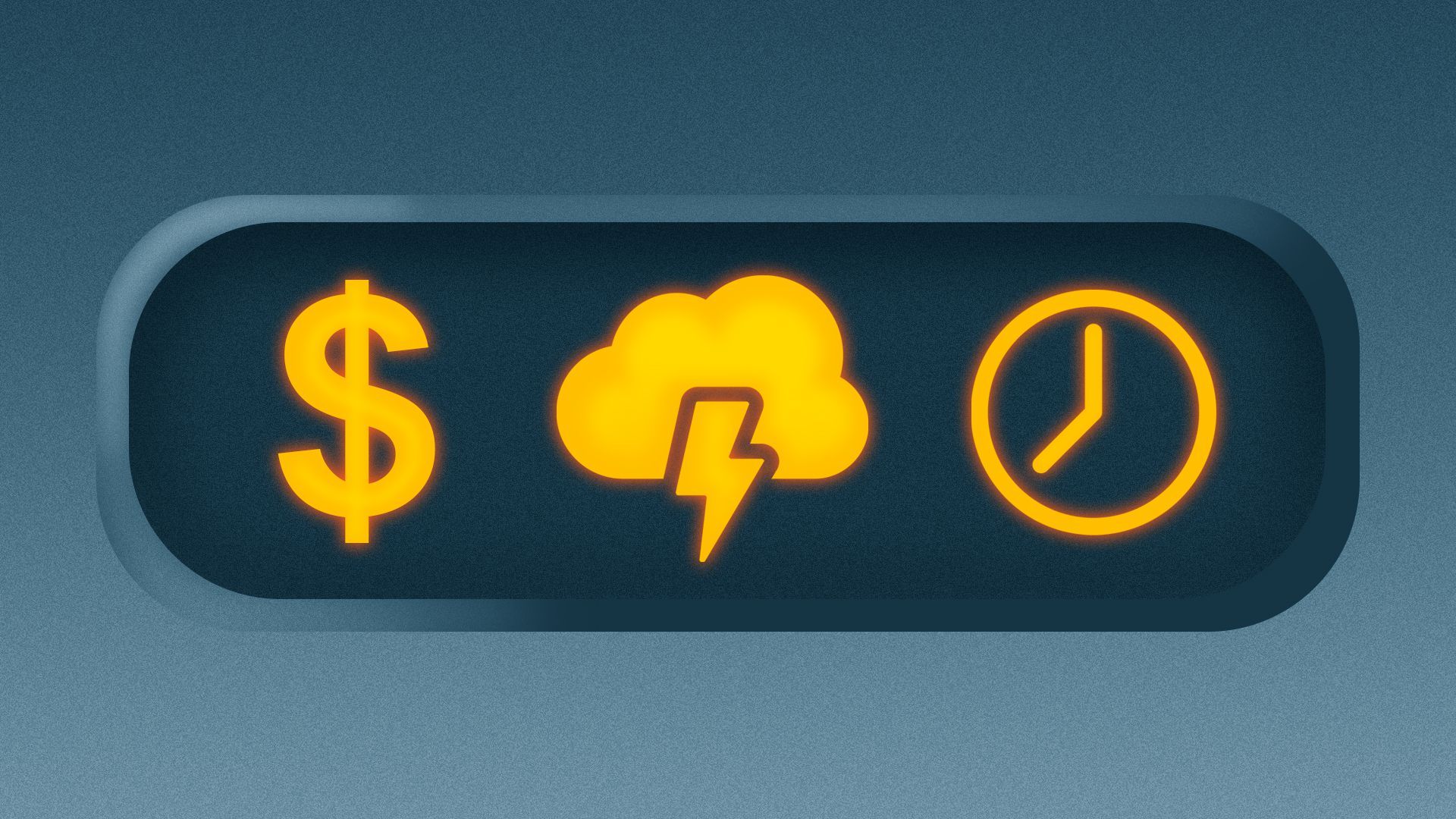
Illustration: Sarah Grillo/Axios
If last weekend was any indication, we're in for a turbulent summer for air travel, with staff shortages and severe weather interrupting our long-delayed getaways, Joann writes.
Why it matters: The summer of revenge travel is pushing up against the limits of airlines' capability to recover from the pandemic. Passengers should be prepared for fewer choices, higher prices and more delays.
Driving the news: U.S. airlines canceled more than 2,800 flights over Memorial Day weekend, according to FlightAware.
- Bad weather in Florida, New York and the mid-Atlantic were a factor, along with air traffic control and staffing issues, airlines say.
Labor shortages across the board — pilots, gate agents, baggage handlers, ground crews — are causing carriers to rethink their summer schedules.
- Almost all major U.S. airlines have proactively cut flights, some by as much as 15%.
- COVID-19 outbreaks among airline and airport workers are exacerbating the staffing crisis.
Between the lines: It doesn't take long for a staff shortage in one airport to ripple across the entire country, given the complexity of the national air system.
- Plus, airlines "don't have the bench crew that they used to," Madhu Unnikrishnan, editor of Skift's Airline Weekly, tells Axios.
Compounding the labor shortage is that more people are heading to or passing through areas that are seeing more severe weather, according to the Federal Aviation Administration.
- In Florida, for example, traffic is 150% to 170% higher at some airports compared to pre-pandemic levels.
- The Sunshine State is also seeing more frequent thunderstorms, causing "significantly more weather delays in the area than normal," per the FAA.
The bottom line: There are a few things you can do to minimize headaches, The Points Guy CEO Brian Kelly tells Axios.
- Book direct flights whenever possible: "A 45-minute layover is just a recipe for disaster," he says.
- Enroll in TSA PreCheck or Global Entry to save time at security or customs.
- If your flight is canceled, seek help from your credit card provider, which could be faster than dealing with an overburdened airline.
- Take advantage of technology like self-tagged bags, facial recognition security systems or CLEAR's new security reservation lane to speed through the lines.
Editor's note: An outdated reference to long security lines in Austin, Texas has been removed from this story.
2. Techies reject worker surveillance

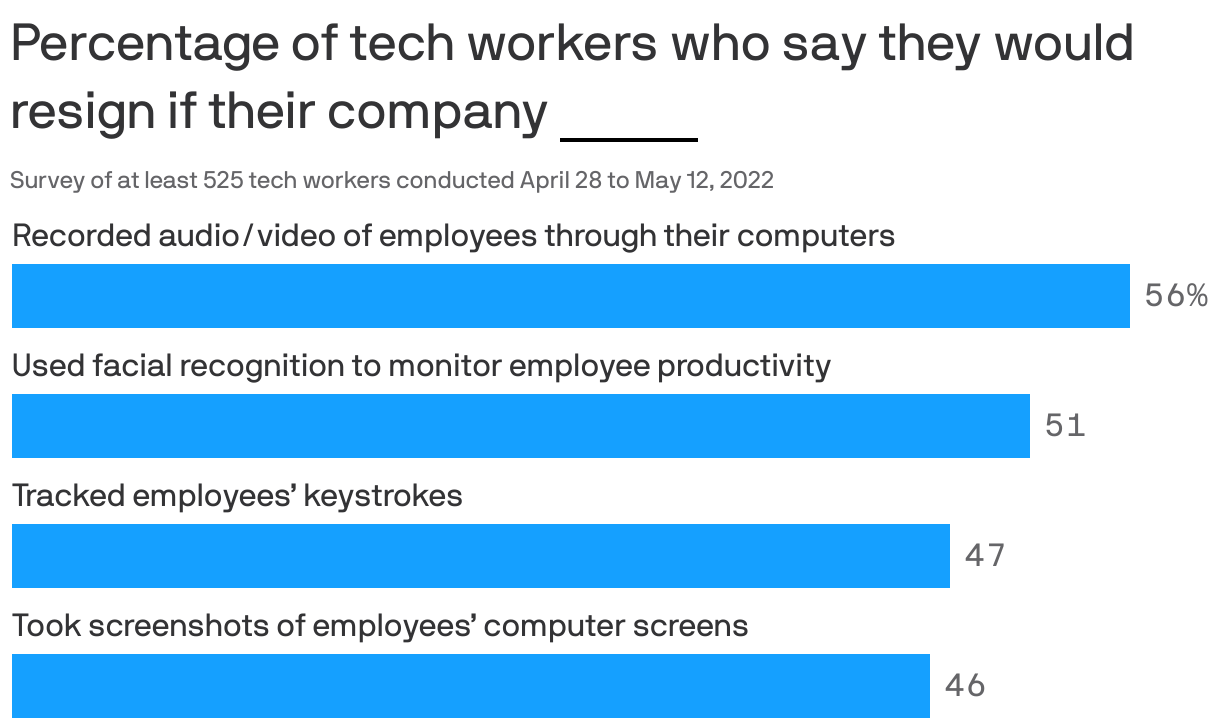
About half of tech employees would jump ship rather than have their productivity monitored via audio/video recording, keystroke tracking or similar methods, according to a Morning Consult poll shared exclusively with Axios' Ina Fried.
Why it matters: Employers are experimenting with new, often controversial ways of keeping tabs on an increasingly remote workforce.
By the numbers:
- More than half of tech workers wouldn't take a new job at a company that surveils its employees, the survey found.
- About 3 in 5 tech workers who are currently working either partially or entirely remotely said they have no interest in returning to the office full time.
- About 3 in 5 tech workers also said they would be open to using virtual reality for training and professional development.
3. It's the commute
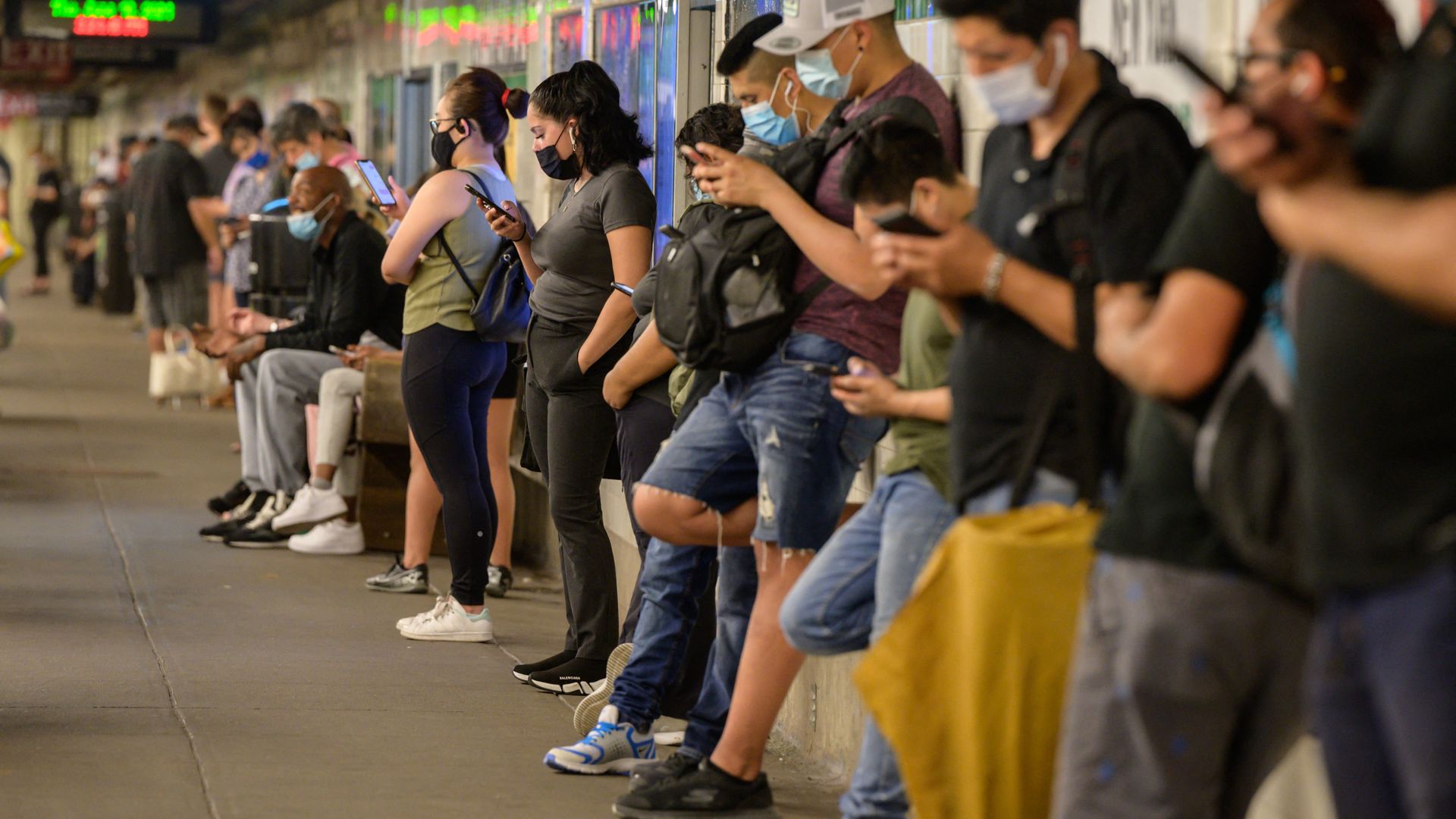
Riders wait for the subway in New York City on June 10, 2021. Photo: Ed Jones/AFP via Getty Images
By and large, U.S. cities with relatively long commutes now have the emptiest offices, a Wall Street Journal analysis found.
- "Eight of the 10 major cities with the biggest drop in office occupancy during the pandemic had an average one-way commute of more than 30 minutes in 2019," reads the paper's findings. "Meanwhile, six of the 10 cities with the smallest drop in office occupancy have average commutes of less than 30 minutes."
Why it matters: Office workers are the economic lifeblood of urban cores, and there's a big debate over why so many have embraced remote or hybrid work even as many employers encourage returning to the mothership.
The details: New York City had the country's longest pre-pandemic average commute time, with each one-way trudge consuming 37.7 minutes of straphangers' lives. It has also suffered a huge drop in office occupancy — down 62% since early 2020 compared to major cities' average of 57%.
Between the lines: Shortening commutes and improving mass transit may be key to reversing cities' fortunes. But that requires big funding, which is hard to come by as ridership plummets.
Yes, but: This may be the chance for worker-oriented urban cores to reinvent themselves as more resident-friendly hoods. "The end result is more balanced communities,” Richard Florida, a professor at the University of Toronto’s Rotman School of Management and School of Cities, told the Journal. "But — and it is a big but— the adjustment will be painful."
4. Manicure robot nails it
The Clockwork manicure robot, plus the results. Photo: Audrey Kennedy/Axios
When Axios Twin Cities' Audrey Kennedy learned that a Minnesota Target was offering the "world's first robot manicure," she knew she had to try it for herself.
- The robot, made by a California startup called Clockwork, offers a 10-minute manicure for $10.
How it works: Users pick one of 25 colors (Audrey chose a neutral pink), watch the tutorial, and insert their fingers one by one.
- The machine scans each nail and paints it, starting around the edges and working into the center. It applies two coats simultaneously.
How it went: Clockwork delivered on its promise of a cheap and quick manicure, Audrey writes. The robot missed a couple spots, but did well for a non-human, she says.
- There's just one big problem with the Target partnership: It's hard to shop with freshly painted nails, so get your groceries beforehand.
5. A weekend of gas guzzling
Illustration: Brendan Lynch/Axios
Alex here. Joann's story last week on gas vs. electric driving costs had me keeping a close eye on my mileage during my weekend drive.
- I drove about 400 miles to see family on Long Island, and spent $52.36 on gas. That's about $0.13/mile, though I got back with fuel to spare, so let's say $40, at $0.10/mile.
- That's pretty good compared to the examples of gas vehicles in Joann's story — but still more expensive than it would have been in an EV. I also could have made both one-way journeys on a single charge in most modern electrics, though I probably would have had at least a little range anxiety.
- I'd like to go electric, but I need to upgrade my house's exterior outlets first — and it seems wasteful to replace my otherwise fine 2016 Volkswagen. Still, with gas prices hitting record highs last weekend, going electric is more tempting than ever.
Was this email forwarded to you? Get your daily dose of What's Next magic by signing up for our free newsletter here.
Sign up for Axios What's Next

The next decade of big, sweeping changes will unfold in cities and communities where new technologies like 5G, AI and drones are transforming how we work, live and play together. What’s Next will guide you through the revolution.