Axios What's Next

November 07, 2022

1 big thing: EV charging made simple
Illustration: Sarah Grillo/Axios
Drivers typically know whether their car takes "regular" or "premium" gasoline. But when their fuel is electricity, filling up can be downright confounding, Joann Muller writes.
- A new startup aims to fix that via a color- and number-coded system that helps electric vehicle (EV) drivers find the best chargers and plugs for their particular car.
Why it matters: Helping car buyers understand how charging works — and managing their expectations — is one of the biggest hurdles facing the EV movement.
- EV consumer anxiety isn't just about finding chargers. Drivers also need to know which chargers work with their vehicle, how long it will take to "fill up" and how to pay.
- One problem: different cars require different connectors. A Nissan Leaf or Mitsubishi Outlander can use one type of plug, while most other EVs use a different connector — except for Teslas, which use a third, proprietary connector.
Also important to know: Home chargers and many of those often found at parking garages, grocery stores, malls and hotels are much slower than DC fast chargers.
- Yet some fast chargers are quicker than others, with outputs ranging from 24 kW to 350 kW.
- It might seem intuitive to seek chargers with the highest output, but many cars are limited in how much power they can accept.
For example: Ford's F-150 Lightning and Hyundai's Ioniq 5 can both be plugged into a 350 kW DC fast charger. But the Ford only accepts up to 120 kW or 155 kW, depending on the truck's battery size.
- In the nebulous world of EV charging etiquette, that pickup driver would be seen as a "charger hog" if they plugged into a 350 kW charger (because they would fill up just as quickly at a less powerful charger).
What's needed: A massive education effort.
- "It's a big shift," acknowledges Jonathan Levy, chief commercial officer at charging provider EVgo.
- "Americans don't speak kilowatts or kilowatt-hours in their home, even though their monthly electricity bill says, 'here is how many kilowatt-hours you consumed.'"
Yes, but: The average driver doesn't want to learn a new language just to refuel their car, says Matt Teske, founder and CEO of Chargeway, a startup aiming to simplify EV charging.
How it works: Chargeway's app uses colors to show your car's plug type and numbers to show the maximum power level it can accept:
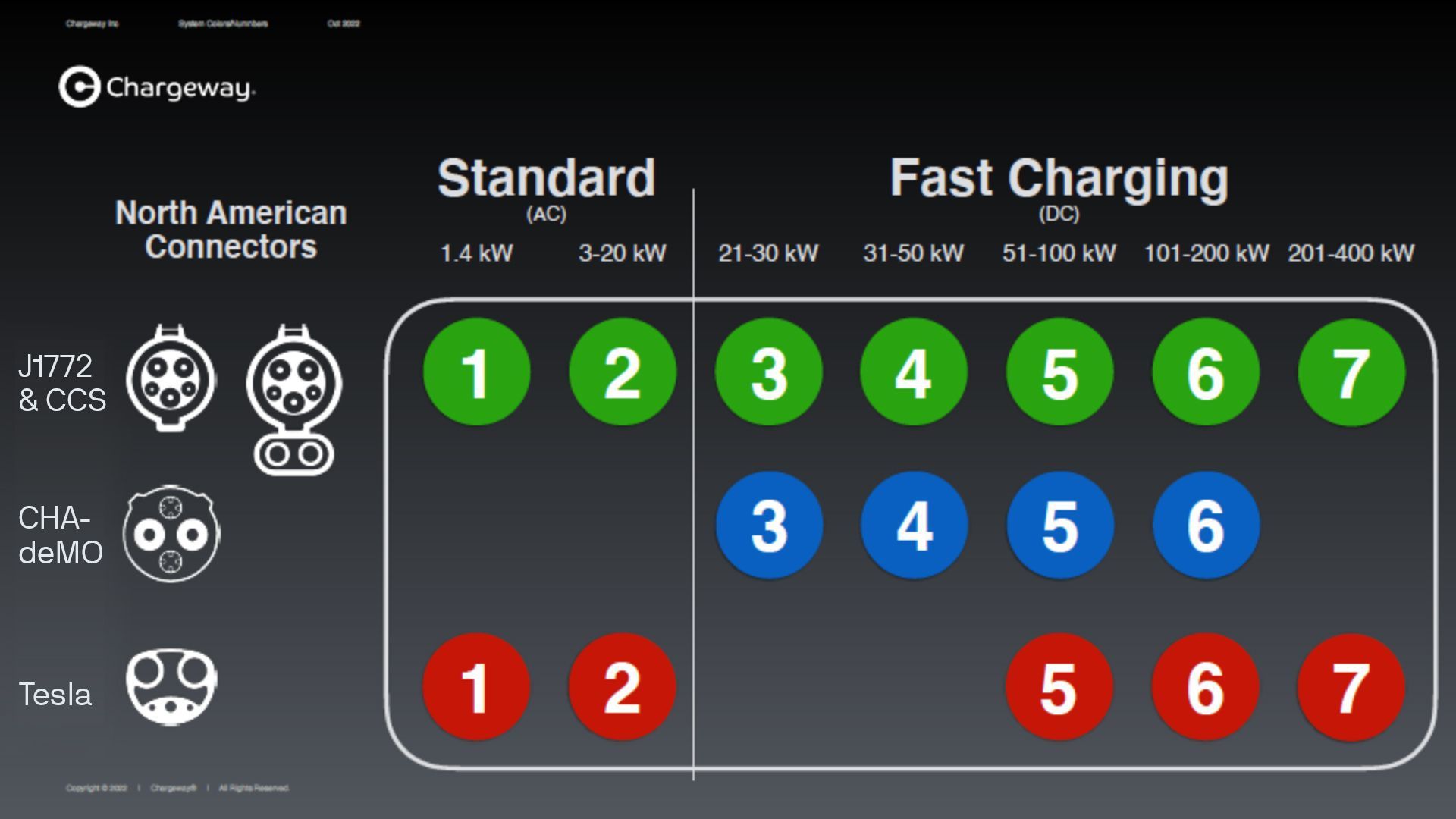
The app also includes a map showing the types of plugs and power levels offered at each charging site.
- A timer feature helps users estimate how long they'll need to recharge.
- And if you plan a road trip, Chargeway will calculate where you should charge, based in part on factors like the weather and your typical driving habits.
What to watch: Teske hopes to create a universal language for charging and reports positive responses so far from government officials, carmakers and industry groups.
2. 📊 America's EV hot spots


Speaking of EVs: L.A., San Francisco and New York accounted for the largest shares of electric car registrations from January through August, Joann reports.
- Those three metro areas made up more than a third of total EV registrations nationwide during that time period, per S&P Global Mobility data shared with Axios.
While it may seem like EVs are a coastal phenomenon, they're starting to get more popular in other parts of the country.
- "More acceptance and much broader consumer awareness is resulting in a natural progression of adoption from the coasts to the heartland," said Tom Libby, associate director of loyalty solutions and industry analysis at S&P Global Mobility, in the firm's latest report.
Yes, but: Heartland adoption still has a ways to go.
3. Office-to-apartment conversions are skyrocketing

Office building-to-apartment conversions hit a high last year and are poised to grow even more, according to a new report from rental platform RentCafe, Axios' Kate Marino writes.
Why it matters: America had a housing shortage even before the pandemic drove demand for larger living spaces. Conversions are one way to attack the problem, especially if office occupancy stays low.
By the numbers: Overall apartment conversions — including those of warehouses, hotels and health care buildings — jumped 25% during 2020-2021, to about 28,000 units, compared to the prior two-year period.
- Office building conversions jumped the most — by 43%, to 11,090 units.
Look ahead: 77,000 apartment conversions are now in the works, RentCafe says.
What we're watching: Cities such as New York, Los Angeles and Chicago are proposing plans to relax building rules and create tax breaks to encourage even more conversions.
4. California pauses $1B in homeless funds

Photo illustration: Brendan Lynch/Axios. Photo: Allen J. Schaben/Los Angeles Times via Getty Images
5. One fun thing: DC -> NYC, by air and sea

Tailwind Air lands on the East River and docks at 23rd Street and FDR Drive. Photo: Kristen Hinman/Axios
What's it like to fly aboard Tailwind Air, a seaplane operator flying between the Washington, D.C. area and New York City? Axios Local bureau chief Kristen Hinman recently found out.
Catch up quick: Tailwind's Dulles International Airport -> East River service began in mid-October.
- Flights take about 80-95 minutes aboard a Cessna Caravan on floats, with room for eight passengers, two pilots — and lots of snacks.
At $395+ one way, tickets are 💰💰💰, Kristen writes. "But trust me, you've never had this much fun getting to and from Manhattan."
- First and foremost, the trip is nearly frictionless. You depart from Dulles' private jet terminal and arrive at East 23rd Street and FDR Drive.
- You can show up 20 minutes before your flight, as there's no TSA checkpoint.

Yes, but: The company's schedule is limited, and approaches and departures can be more herky-jerky than you're used to in a big jet.
Axios What's Next

The next decade of big, sweeping changes will unfold in cities and communities where new technologies like 5G, AI and drones are transforming how we work, live and play together. What’s Next will guide you through the revolution.