Axios What's Next

March 08, 2024
Rivian's three new EVs β two of them a surprise β are carrying the upstart automakers' hopes and dreams, Joann reports today.
Today's newsletter is 1,073 words ... 4 minutes.
1 big thing: Rivian's new EVs
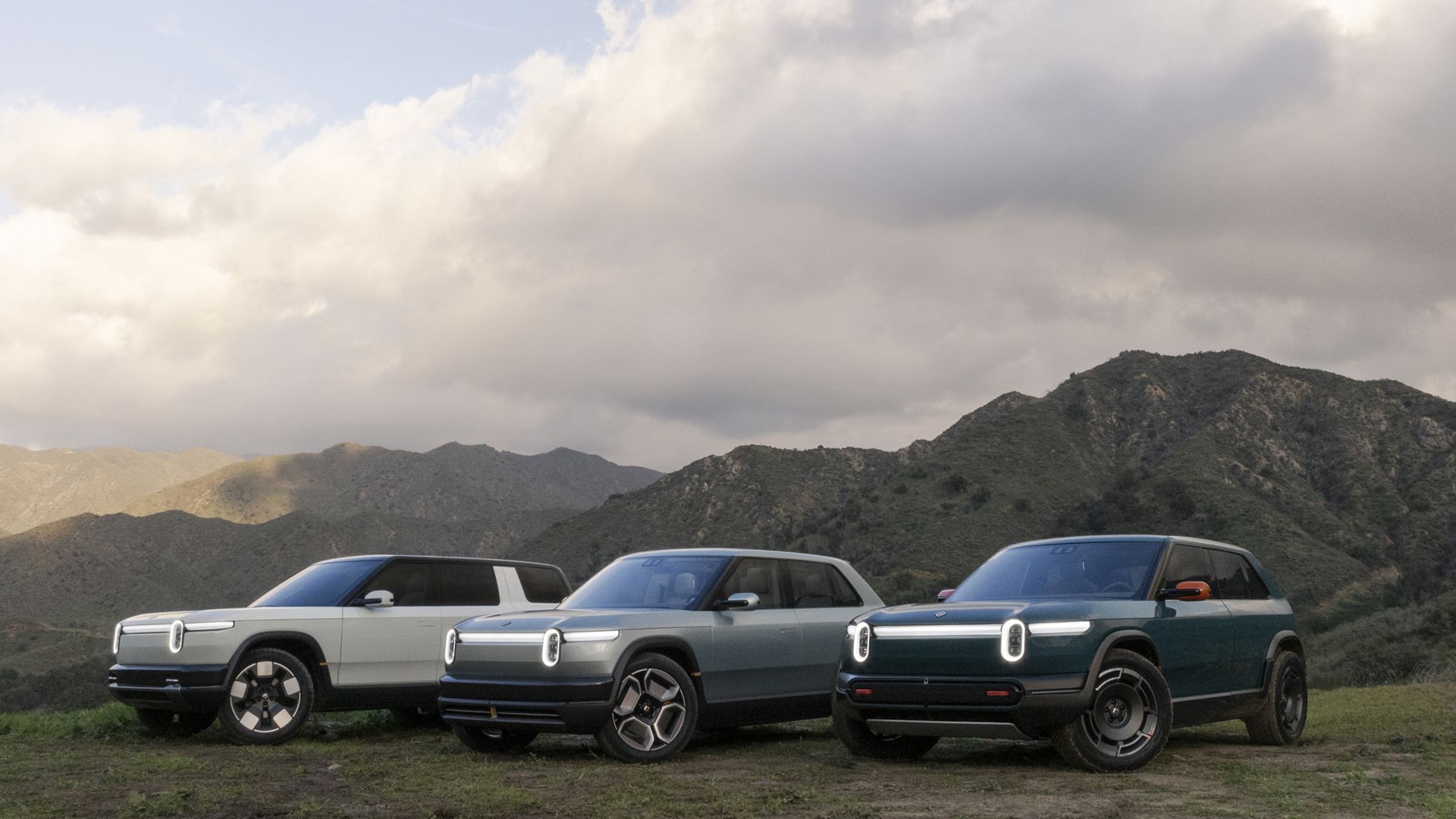
The Rivian R2, R3 and R3X. Photo courtesy of Rivian
Rivian has introduced not one but three smaller, more affordable electric vehicles (EVs) that it hopes will persuade more consumers to replace their gasoline-powered cars and cement the company's status in the automotive world, Joann reports.
Why it matters: Increasing the breadth of its lineup with cheaper models could help accelerate EV adoption while enabling Rivian to scale faster toward profitability to survive a cutthroat market.
Driving the news: Yesterday's reveal of the midsize R2 SUV had been widely anticipated as a sequel to Rivian's initial flagship electric models, the R1T pickup and R1S SUV.
- The surprise unveiling of two additional models βΒ the R3 and R3X crossover utilities β was reminiscent of a Steve Jobs "one more thing" product introduction at Apple.
- Yes, but: The company is pausing construction of a planned factory, potentially complicating the new vehicles' rollout.
Zoom in: The R2 is a traditional five-seat SUV aimed at the heart of the mainstream market, while the slightly smaller R3 and R3X performance variants are crossover utilities with more of a sporty, hatchback design.
- All three are expected to have a battery range of more than 300 miles.
- The R2 will go on sale in the first half of 2026, starting at around $45,000.
- The cheaper R3 and R3X will follow at a later date.
Caveat: The R2 will initially be produced at the company's Illinois factory, rather than a new $5 billion Georgia plant, to save billions in costs.
- Construction of that new plant has been paused, the company said yesterday.
Between the lines: The R2 and R3 share a new midsize vehicle platform developed to significantly reduce manufacturing and maintenance costs, Rivian says.
- They're built using high pressure die castings (instead of traditional body welding), for example, and feature a new "structural" battery pack that doubles as the vehicle floor β all part of a broader simplification effort.
The big picture: The auto industry is wringing its hands about slower-than-expected EV growth, and investors have beaten down Rivian shares after a disappointing fourth quarter.
- But none of that seems to phase Rivian CEO RJ Scaringe, who launched his first models into the teeth of the COVID-19 pandemic.
- Back then, Rivian's startup pains were compounded by work-from-home mandates, chip shortages and soaring battery component prices.
- Without a proven track record, Scaringe had no leverage with suppliers.
- "We had to do everything we could just to get enough parts to build vehicles," he recalls in an interview with Axios.
Today's business environment is dramatically different, Scaringe says.
- "I've never been more bullish on our business," he says.
State of play: Commodity prices are falling, helping to create a faster path to profitability.
- Meanwhile, the Rivian brand is resonating with consumers, Scaringe says, and the company is gaining industry credibility.
- Suppliers who wouldn't take his calls a couple of years ago are now eager partners, he adds.
- "It was very painful, but it's made us a stronger company. What I'm excited about ... with R2 is, we're going in as a much more mature, much more capable company."
What's at stake is often overlooked in the EV debate, Scaringe says.
- "We're talking about the health of our planet, the only place we as a species can live, and the potential of making this an unlivable environment for thousands of years to come."
- "I can say with true certainty that the entire automotive industry will electrify."
- "Now, does it happen in five years or 20 years or 30 years? That's the debate. Of course, from our vantage point we really hope and think it will happen faster."
2. DIY airport screenings
Illustration: Natalie Peeples/Axios
A new self-service screening system is about to open up at Las Vegas' Harry Reid International Airport, Alex reports.
Why it matters: It's the latest in a broader TSA effort to boost efficiency and traveler convenience via new screening tech.
How it works: The system guides travelers through a self-screening process.
- Flyers drop their bags onto a conveyor belt to be fed into an imaging device, then walk into a glass scanning booth to be checked themselves. They then grab their luggage and get on their way.
- TSA officers will still be present if needed, but won't be prodding people along quite as much as usual, the Associated Press reports.
Yes, but: For now, the self-service lane is only available to English-speaking PreCheck users.
What's next: If the Vegas test goes well, expect to see similar tech pop up at other airports nationwide.
3. EV charging prices, mapped

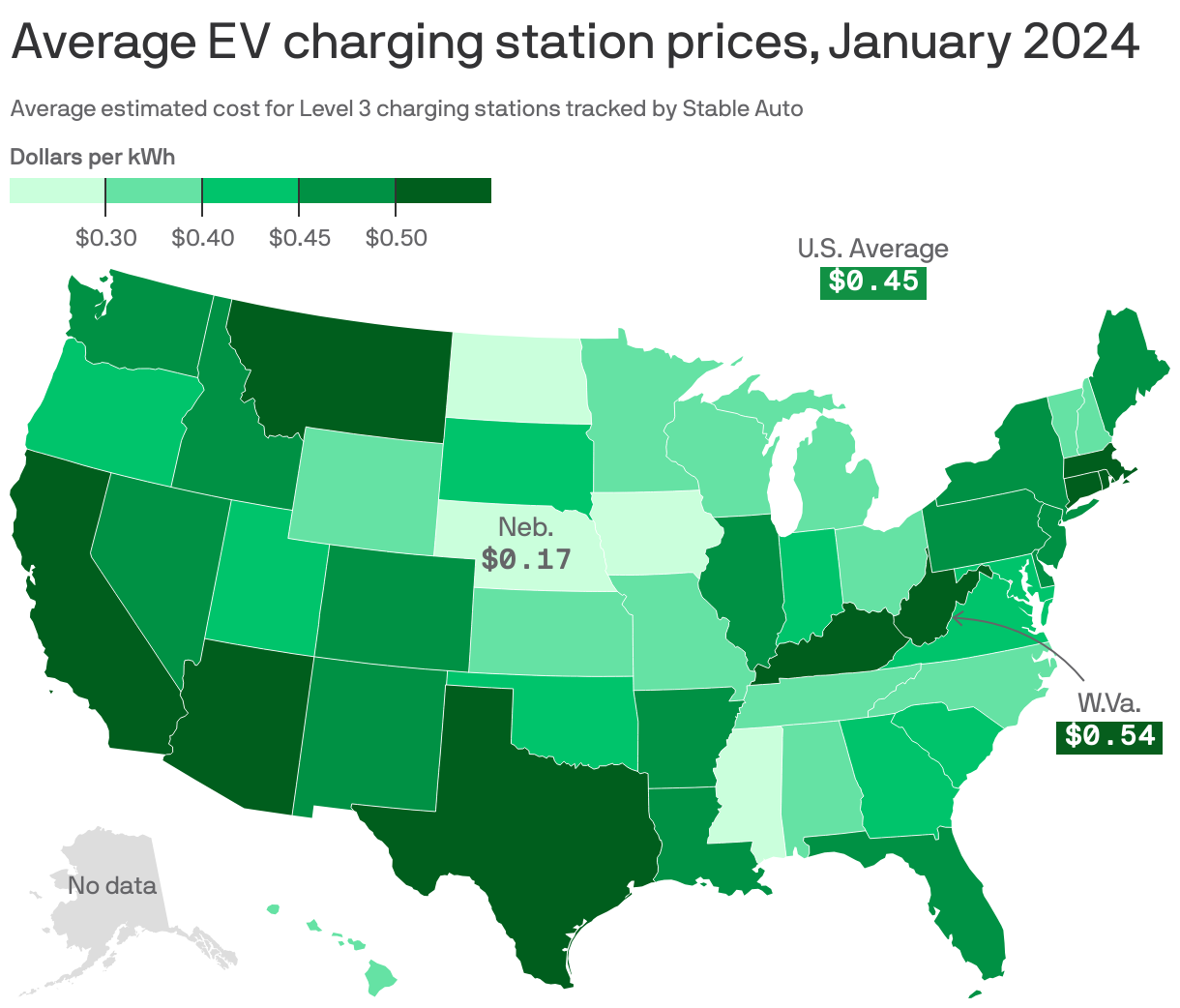
Charging an electric vehicle (EV) costs three times as much on average at a public charging site in West Virginia than at one in Nebraska, Axios Pro: Climate Deals' Alan Neuhauser reports from data gathered by Stable, an EV charger software developer.
Why it matters: The gap suggests companies are still figuring out what to charge drivers when topping off their EVs.
By the numbers: West Virginia, Connecticut, Arizona, Massachusetts and Kentucky have the most expensive charging stations, according to Stable's survey of about 9,000 Level 3 fast-charging stations in January.
- Prices there ranged from $0.52 to $0.54 per kilowatt-hour.
- Nebraska, Mississippi, Iowa, North Dakota and Kansas were the cheapest, with prices spanning $0.17 to $0.31.
What's happening: Charging networks such as Electrify America, EVgo and ChargePoint consider a host of factors in setting their charging price β not least the local electricity rate.
- Cheap electricity in America's Midwest, for example, may explain the discounts in Nebraska, Iowa, North Dakota and Kansas, which aren't exactly hotbeds of EV adoption.
If you need smart, quick intel on dealmaking in the climate industry for your job, get Axios Pro.
4. Colorado's psychedelic therapy rules

Illustration: Allie Carl/Axios
Colorado has released preliminary rules for the psychedelic therapy industry, Axios Denver's Esteban L. Hernandez reports.
Why it matters: The state is drawing closer to establishing a regulatory framework for licensing facilitators, or people who can administer natural psychedelics for medicinal purposes.
The big picture: Colorado is only the second state, after Oregon, to develop such a framework.
- Therapeutic use was a major driving force behind the effort to legalize substances like magic mushrooms.
What's inside: The preliminary requirements needed to obtain a license to operate healing centers in Colorado include:
- Being at least 21 years old, showing proof of basic life-support training (like CPR), having no felony convictions and completing 190 hours of training programs in natural medicine.
- There will be "alternate" paths for obtaining a license for people who have previous experience and training in natural medicine, officials say.
Big thanks to What's Next copy editor Amy Stern.
Was this email forwarded to you? Get your daily dose of What's Next by signing up here for our free newsletter.
Sign up for Axios What's Next

The next decade of big, sweeping changes will unfold in cities and communities where new technologies like 5G, AI and drones are transforming how we work, live and play together. Whatβs Next will guide you through the revolution.