
Axios What's Next

August 01, 2022
There's no denying EV ownership is skyrocketing β yet only a handful of states are driving the country's electrification revolution, Joann reports today.
Today's Smart Brevity count: 1,007 words ... 4 minutes.
1 big thing: These 5 states have (almost) all the EVs
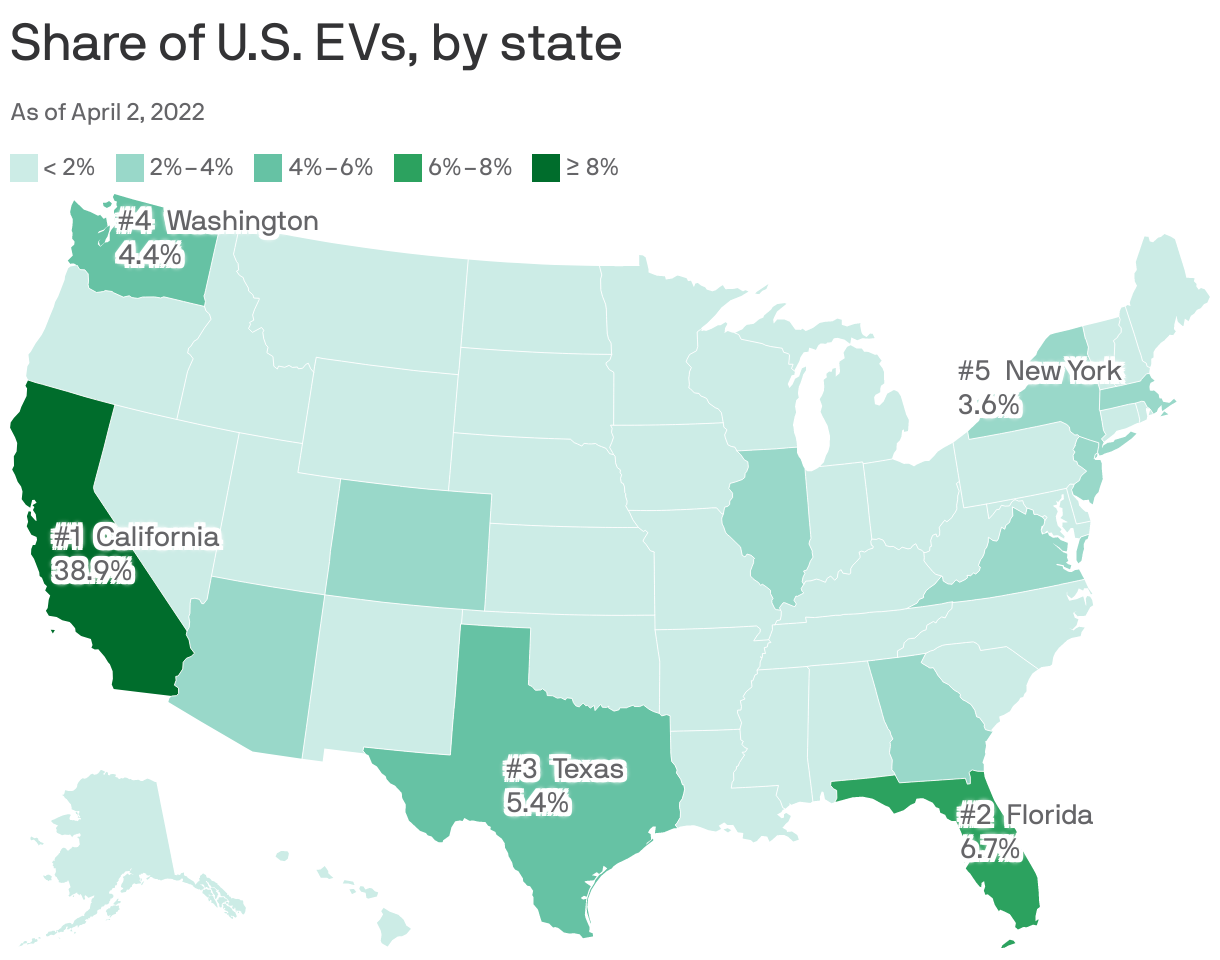
California leads the U.S. in electric vehicle ownership, accounting for 39% of all EVs registered nationwide, Joann Muller reports.
- Look more closely at the numbers, however, and it turns out EVs represent less than 2% of all vehicles on the road in the Golden State.
Reality check: We're a long way from a "tipping point" for electric vehicles. In fact, the EV revolution has barely begun in the U.S. and it's playing out in super-slow motion β even in places where plug-in cars make the most sense.
Why it matters: Automakers are pouring billions of dollars into electric vehicle development in the face of urgent warnings about climate change. But with more than 278 million cars, SUVs, and pickups on U.S. roads, the historic shift away from gasoline will take years β if not decades β to play out.
- Axios is tracking the transition, using monthly vehicle registration data from S&P Global Mobility.
The latest data: 4.6% of the new vehicles registered in the U.S. this past May were electric, according to the research firm's most recent data.
- That's more than double EVs' share of monthly registrations in May 2021 (1.9%).
Yes, but: EVs still account for only about 0.6% of all registered vehicles in the U.S. overall. Take California's EVs away, and itβs just 0.4%.
By the numbers: As of April 1, Florida has the second-highest share of the country's EVs at 6.7%. Then comes Texas (5.4%), Washington (4.4%), and New York (3.6%).
- Yet EVs account for only 1% or less of all vehicles within each of these states.
- Besides California, the states or areas with the highest share of EVs within their own borders: Hawaii (1.3%) and the District of Columbia (1.2%).
Tesla still commands the EV space, even though consumers have more choices now β 46 electric models were available in May 2022, vs. 25 a year ago.
- Two Teslas β the Model 3 and Model Y β accounted for more than half of the 53,000 electric vehicles registered nationwide in May.
- However, Ford's Mustang Mach-E is growing in popularity, along with two Korean models: the Hyundai Ioniq 5 and Kia EV6.
What to watch: There will be 63 EVs on the market by year's end, according to S&P Global Mobility's forecast. Expect 192 EVs to choose from by 2026, and 253 by the end of 2030.
- Congress' new climate package could spark further EV adoption βΒ if it passes.
2. A troubled bridge over water
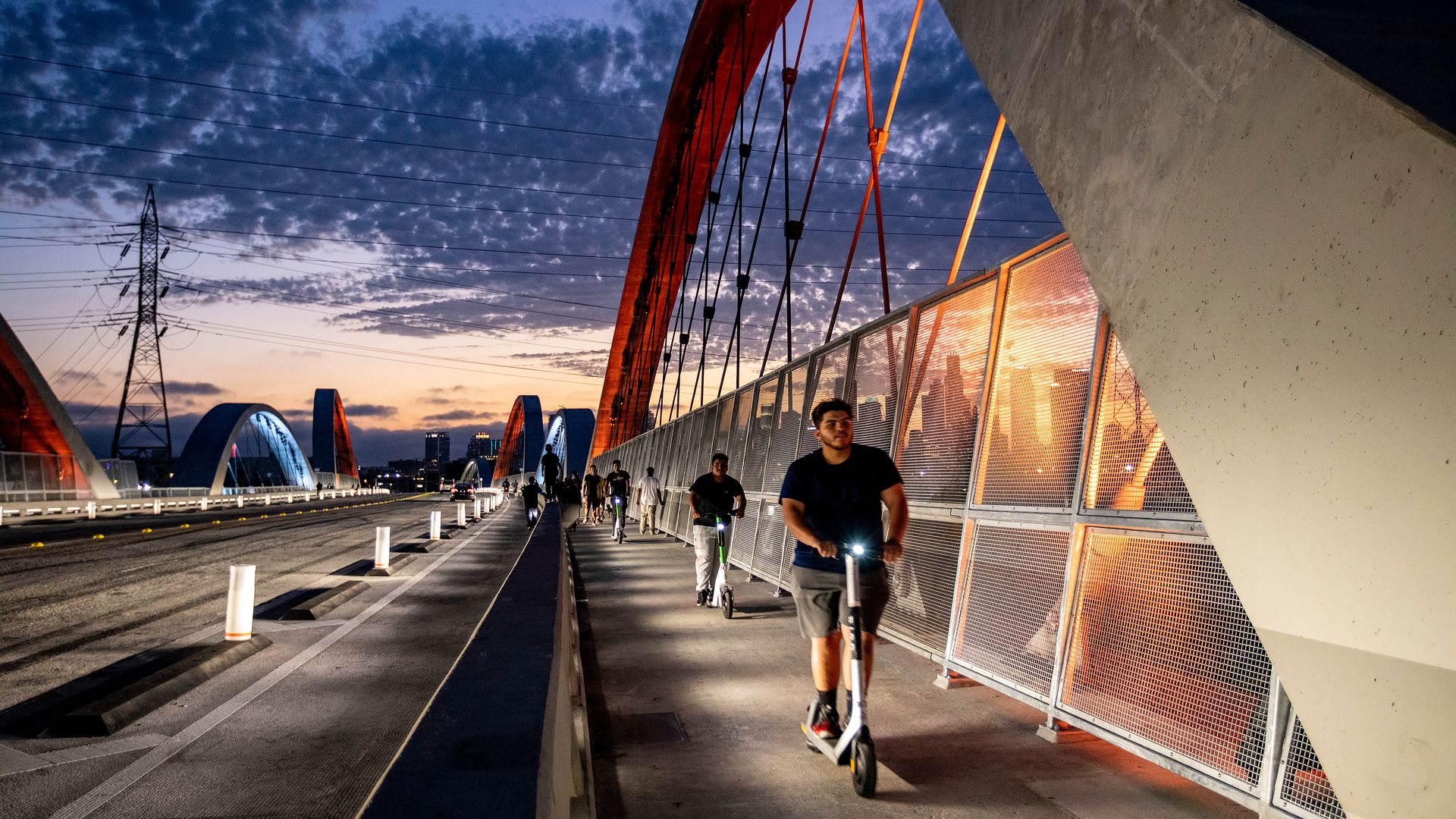
Pedestrians at dusk ride scooters on the 6th Street Viaduct in Los Angeles, July 27, 2022. Photo: Jill Connelly/Bloomberg via Getty Images
A brand-new, $588-million bridge in Los Angeles has been forced to close several times since its mid-July opening due to crashes and social media stunts, Alex Fitzpatrick reports.
Why it matters: The problems plaguing L.A.'s 6th Street Viaduct are a high-profile example of cities' struggles to modernize their infrastructure.
Details: The viaduct, which connects L.A.'s Arts District and Boyle Heights neighborhoods, was meant to be a "love letter to the city," Mayor Eric Garcetti said during an opening ceremony, per the Associated Press.
- But collisions, "street takeovers" by internet clout-chasing drag racers, and bridge-climbing daredevils have forced repeated closures.
Cyclist and pedestrian advocates say the bridge has obvious everyday safety flaws, too.
- "There are four lanes of fast-moving traffic separated from its two bike lanes by plastic tubes mounted on rubber slabs screwed into the roadway more than a vehicle-width apart," writes Curbed's Alissa Walker.
What they're saying: Garcetti "has no tolerance for behavior that keeps Angelenos from enjoying this new landmark," Garcetti press secretary Harrison Wollman said in a statement. "The city is reviewing additional safety options and is taking immediate action to ensure the bridge is safe and accessible for everyone."
3. How climate change is driving heat waves

Smoke columns rise from Dartford, Kent, England on July 19, 2022. Photo: William Edwards/AFP via Getty Images
Human-caused climate change tipped the scale dramatically in favor of the record-shattering heat wave that recently struck the United Kingdom, according to a new study, Axios' Andrew Freedman writes.
The big picture: The researchers sought to find out how climate change from the burning of fossil fuels is altering the odds and severity of extreme heat events.
Details: The study found that the U.K. heat wave β which set a record for the hottest temperature in the country's history at 104.54Β°F (40.3Β°C) β was at least 10 times more likely to occur in today's climate compared to the preindustrial era.
- Plus, the heat wave's two-day average high temperatures were 7.2Β°F (4Β°C) above what they would have been in a world without added concentrations of greenhouse gases.
4. Workers are forking over more cash for health needs

Illustration: Gabriella Turrisi/Axios
People with employer-sponsored health coverage on average paid for a larger share of their medical costs between 2013 and 2019, according to a new analysis, Axios' Caitlin Owens reports.
Why it matters: As costs rise, even many insured patients are struggling to afford care.
Yes, but: Out-of-pocket spending decreased during 2020 β likely in part because fewer people sought routine care during the height of the pandemic.
By the numbers: The share of medical expenses paid by those enrolled in employer-sponsored coverage increased from 17.4% in 2013 to 19% in 2019, the Employee Benefit Research Institute report found.
- It declined to 16.2% in 2020.
- Enrollees spent a median $249 out-of-pocket in 2013, $287 in 2019, and $205 in 2020. (This includes people without any medical expenses.)
- The average out-of-pocket costs rose from $737 in 2013 to $906 in 2019, falling to $811 in 2020.
5. One fun thing: The Choco Taco lives on, kinda

Photo: Monica Eng/Axios
Ice cream purveyor Klondike may be retiring the Choco Taco, but one Chicago restaurant is keeping the what-if-ice-cream-but-tacos dream alive, Axios Local's Monica Eng reports.
- Mexican eatery Lonesome Rose in the Windy City's Logan Square neighborhood is selling an $8 artisanal version β and Monica recently headed over to dig in.
"I motored to the restaurant intent on ordering the taco to go," she writes. "That is, until I realized it would be soup before I got home."
- "And that, my friends, is how I ended up at a table eating a giant ice cream taco for dinner."
Monica's pro tip: "Share this horchata ice-cream-filled, chocolatey waffle sprinkled with peanut-pretzel topping for dessert with pals."
The intrigue: Klondike parent company Unilever may yet revive the fan-favorite treat, the Wall Street Journal reports.
A hearty thanks to today's What's Next copy editor, Patricia Guadalupe.
Was this email forwarded to you? Get your daily dose of What's Next magic by signing up here for our free newsletter.
Sign up for Axios What's Next

The next decade of big, sweeping changes will unfold in cities and communities where new technologies like 5G, AI and drones are transforming how we work, live and play together. Whatβs Next will guide you through the revolution.


