Axios What's Next

October 26, 2021
An unexpected way to repurpose old shipping containers: Turn them into swanky new swimming pools.
- Plus you're invited: Join Erica Pandey tomorrow at 12:30pm ET for a virtual event on the future of education and whatβs next for career readiness. Guests include Guild Education CEO & co-founder Rachel Carlson and Education Design Lab CEO & founder Kathleen deLaski. Register here.
- Today we're featuring some of your thoughtful and funny responses to our story on Tinder wedding dates.
- Keep your anecdotes and photos depicting "what's next" coming to [email protected].
Today's Smart Brevity count: 1,179 words ... 4.5 minutes.
1 big thing: Hot commodities β shipping container swimming pools
Photo courtesy of Seventeen Pools
Demand for swimming pools made out of recycled cargo containers is through the roof, and the few companies that offer them can barely meet demand, Jennifer A. Kingson writes.
Why it matters: For all the news about pandemic-induced cargo backups at sea, many shipping containers only make one-way trips from Asia to North America, and those tend to be repurposed for housing and industrial uses β or, increasingly, for fun.
Driving the news: Work-from-home rules have contributed to record demand for new swimming pools. Refurbished shipping containers tend to be less expensive than traditional high-end pools β and they're more durable, portable and eco-friendly, builders say.
- While prices are on the rise, a modular cargo pool can cost about $60,000 for an 8-by-40-foot model, which β while high β is often cheaper than an equivalent in-ground pool.
- The container pools are lowered by crane into a customer's yard, where they sit at ground level or just below it.
- The pools can easily be picked up and relocated when the owner moves. And they're considered "plug-and-play," meaning that virtually all they need on arrival is gas, electricity and water.
Prices for this type of pool are going up β and not just because the cargo containers themselves are more expensive.
- "The pool equipment shortage is absolutely bonkers," says Kurt Witten of Seventeen Pools, which exclusively builds pools from shipping containers. "Two years ago, you could get a pool heater, no problem, and now trying to find a pool heater is almost impossible."
- Demand is so high that "it's to the point now we're just turning down a lot of people, because we're about eight months out on our builds," Witten tells Axios.
The intrigue: Shipping container pools are very much a luxury niche item, and their sleek and unusual look is viewed as hip and chic.
- "They're very contemporary-looking," says Tom Pappas of Steelwater Pools, a North Carolina company. "They have a small footprint, so you can fit them just about anywhere. Most of them are [in] private residences, but weβve done them for hotels, restaurants, bars."
- At Modpools, they're built to a "lifestyle depth" of 4-foot-8, which "seems to be the sweet spot where adults can hold a drink" and hang out with children but is "still a good swimmable depth," says Paul Rathnam, the company CEO.
2. Try an electric vehicle before you buy one
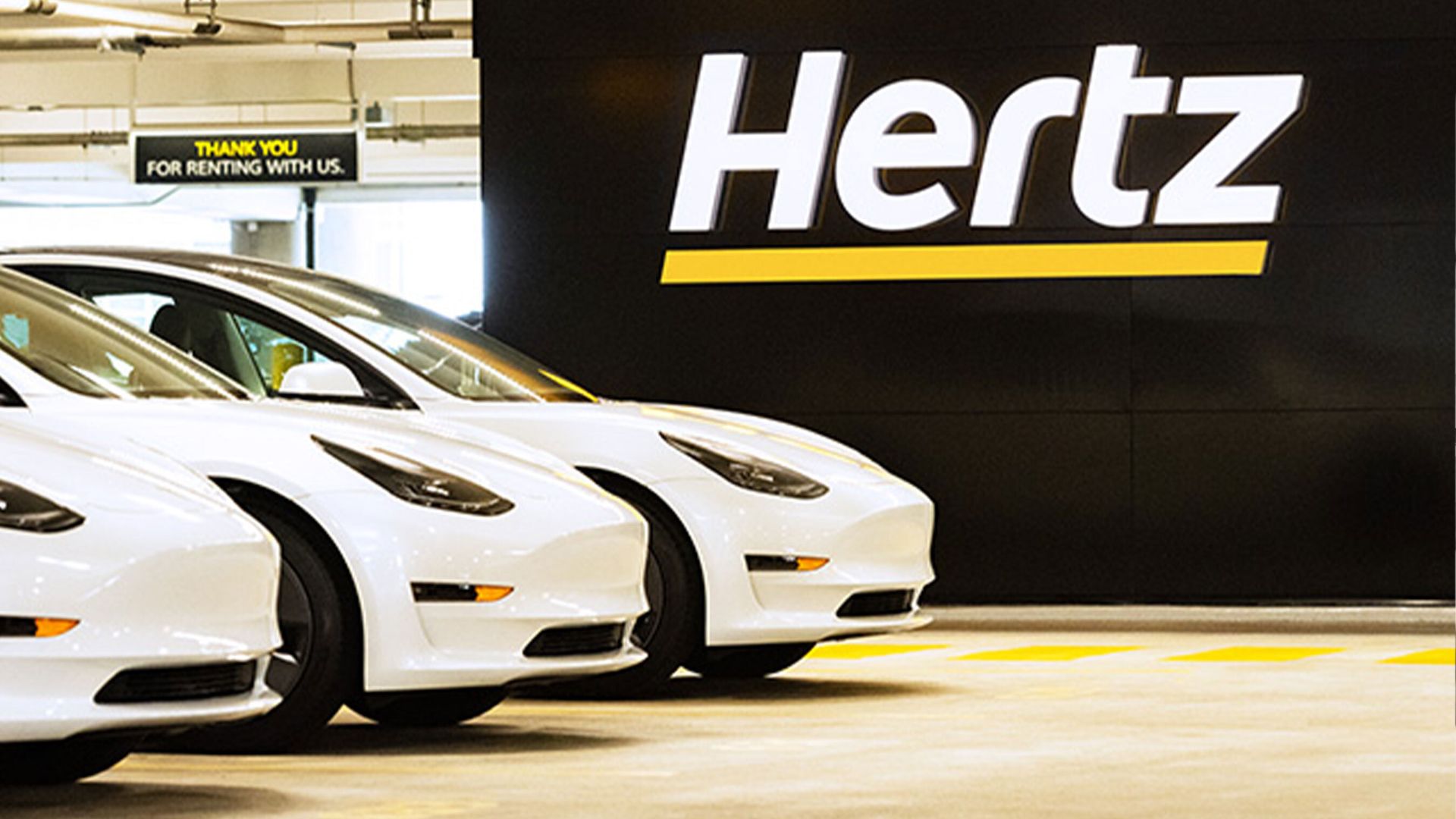
Hertz is adding 100,000 Teslas to its rental fleet in a big push toward electrification. Photo: Hertz
People who are on the fence about buying an electric vehicle β or who can't afford one βΒ can now rent one from Hertz, Joann Muller reports.
Driving the news: The giant rental car company said Monday it is adding 100,000 Teslas to its fleet as the first step in a major shift toward electrification.
- The order represents $4.2 billion in revenue for Tesla and is the carmaker's biggest-ever order, Bloomberg reported. Tesla's market cap reached $1 trillion following the deal.
- The vehicles will account for more than 20% of Hertz's global fleet. Hertz is also adding thousands of charging stations to its rental locations and hiring seven-time Super Bowl champ Tom Brady to pitch EVs to consumers.
Why it matters: Broader availability of electric cars on rental lots could give the EV movement a needed boost by allowing cautious consumers a no-risk way to try before they buy.
The big picture: President Biden wants half of all new cars sold to be electric by 2030, and many carmakers are making the pledge to switch away from gasoline-powered vehicles by the middle of the next decade.
- But consumer demand remains low, with battery-electric vehicles accounting for less than 5% of auto sales.
Yes, but: Consumers are getting more curious about plug-in models.
- "Consumer confidence and acceptance of EVs is growing gradually," says Michelle Krebs, executive analyst for Cox Automotive, adding that the opportunity to try one for a few days could snag more interest.
- Surveys show that when people gain experience with new technologies, they become more accepting, she said.
3. Charted: Wages rise in America

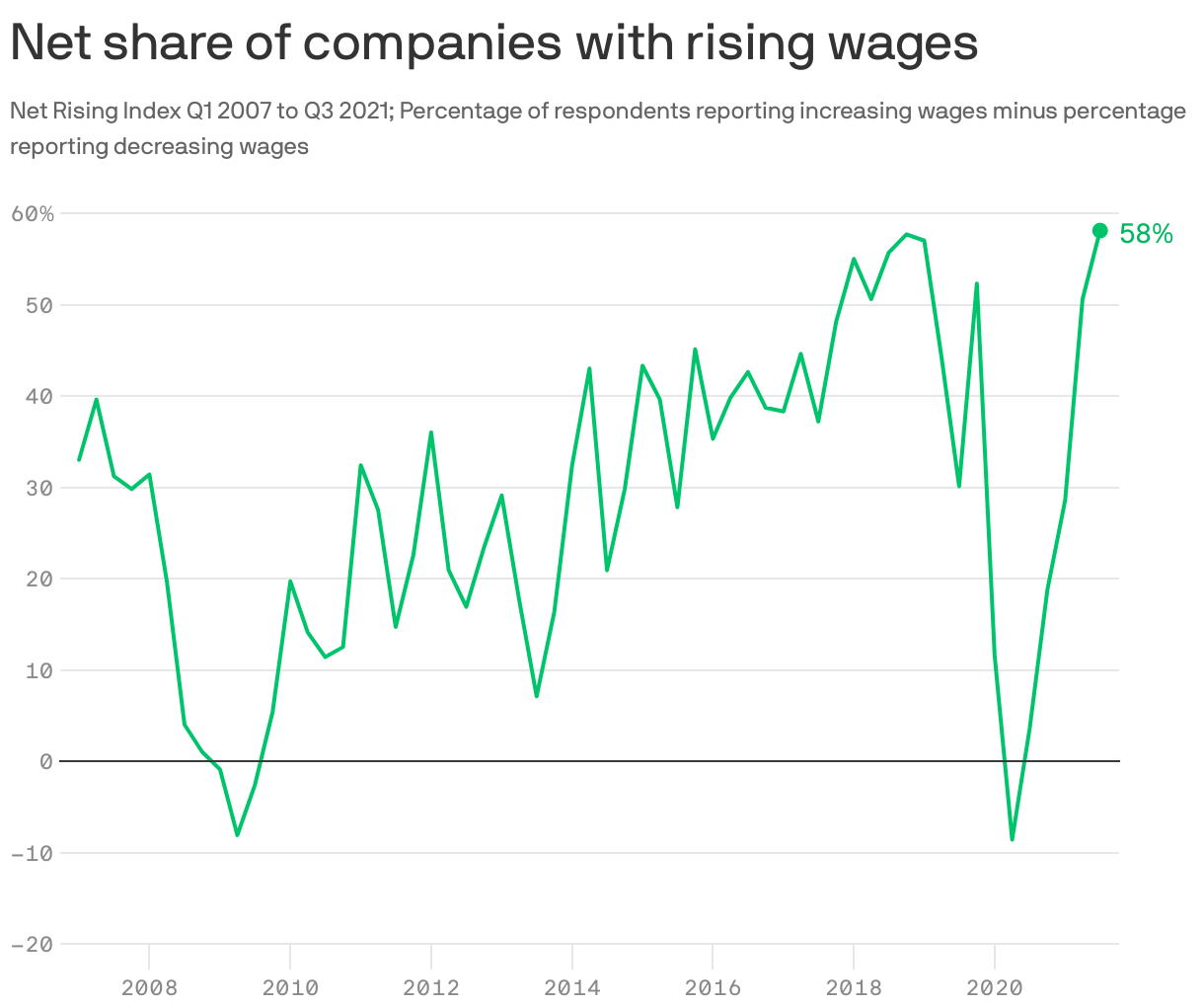
America's companies are waging a war for talent β and more and more employers are raising wages to recruit workers, Erica Pandey writes.
By the numbers: A record-high 58% of U.S. employers bumped pay in the last three months, according to a new quarterly survey released today by the National Association for Business Economics, reports Axios' Kate Marino. And 0% of companies lowered wages.
But, but, but: Companies are still having a hard time finding talent. The number of open roles has outnumbered the number of job seekers in the U.S. since May.
One reason for the disconnect is that, while firms have raised wages, they have been slow to improve benefits.
- Less than a quarter of employers have bolstered benefits in order to reduce turnover, per a new survey from Joblist. But a whopping 70% of workers surveyed for the same study said they'd like to see better benefits.
- The perks that workers say they're looking for from their employers include flexible schedules and options for fully remote work. Many workers β especially working mothers β are continuing to balance work with responsibilities like child care, and they're looking for companies that allow them to do so.
4. ICYMI: America's murder surge

Photo illustration: Sarah Grillo/Axios. Photo: Erik McGregor/LightRocket via Getty Images
Homicides rose at the fastest rate in at least six decades last year β and the upward trend is continuing in 2021, Axios future correspondent Bryan Walsh reports.
Why it matters: The murder surge represents a sharp break from decades of reductions in violent, gun-driven crime in the U.S., and experts are divided on what caused the increase β and therefore, what to do about it.
- Curbing the rise in shootings will require addressing the root causes of violence, while mending social trust between the communities most at risk and the police.
Axios' comprehensive deep dive into the state of gun crime is worthy of your time.
5. Would you bring a Tinder date to a wedding?

Photo: Oscar Gonzalez/NurPhoto via Getty Images
Last week, we reported on "Plus One," the dating app Tinder's response to the post-pandemic wedding boom. It's a feature that lets users swipe to find dates for weddings.
- And we asked our readers: Would you use this?
Here's what some of you told us:
- "Go solo," reader Deanna Fox writes. "In my previous life, I was a photo retoucher and have airbrushed many folks out of the photo that the photographer has purposely put at either end of the photo."
- "I'd rather attend solo and be seated at a table for singles," reader Kristin Dion tells us. "I've been single a long time, and have grown to prefer to attend as my fabulous self than to attend while vouching for someone unknown to me and the hosts.
- "I hope that the pressure to attend formal events with a date relaxes in general, and that wedding guests refrain from succumbing to the urge to bring a new date [from Tinder or anywhere else!] to a wedding!"
- "I would do it for a friend's wedding but not family, and the guy would have to be able and willing to dance," writes reader Frann Shore.
The bottom line, via reader Stephen Power: "I donβt know if a Tinder date for a wedding is a good idea, but the rom-com writes itself."
Was this email forwarded to you? Get the daily dose of What's Next magic by signing up for our free newsletter here.
Sign up for Axios What's Next

The next decade of big, sweeping changes will unfold in cities and communities where new technologies like 5G, AI and drones are transforming how we work, live and play together. Whatβs Next will guide you through the revolution.