Axios What's Next

January 02, 2024
Welcome back! We're headed into the year of the delivery drone, Joann reports today.
Today's newsletter is 1,075 words ... 4 minutes.
1 big thing: Year of the delivery drone

Illustration: Natalie Peeples/Axios
After more than a decade of development, delivery drones are finally going mainstream this year, Joann reports.
- Still, they won't be quite as ubiquitous as the blue Amazon vans or brown UPS trucks in your neighborhood — yet.
What's happening: With some (but not all) regulatory hurdles cleared, retailers, medical centers and logistics platforms will start offering drone delivery in many more suburban neighborhoods in 2024.
- That means receiving meals, prescriptions and household items at your doorstep in less than 30 minutes.
Why it matters: More electric drones in the sky means fewer noisy trucks on the road and less tailpipe emissions.
- Your grandchildren will wonder why anyone used a multi-ton vehicle to deliver a 5-pound package.
Catch up quick: Until recently, commercial drone operators weren't permitted to fly their aircraft long distances without visual spotters.
- Having observers staged every mile or so along a drone's route is impractical and costly, which is why companies couldn't afford to scale up drone deliveries.
- Instead, they were limited to trips within a mile or so of retail partners like Walmart and Walgreens.
Driving the news: That changed last fall when the Federal Aviation Administration began authorizing some drone operators to fly their aircraft "beyond the visual line of sight" (BVLOS).
- That key breakthrough has opened the door for companies like Zipline, Wing and Amazon to begin more widespread drone deliveries this year.
Amazon, whose executive chairman Jeff Bezos first floated the idea of drone delivery back in 2013, is ramping up toward a goal of 500 million drone deliveries a year by the end of the decade.
- Until now, Amazon has been operating in just two communities (Lockeford, California, and College Station, Texas) using dedicated drone fulfillment hubs.
- In 2024, Amazon will add a third U.S. site, plus two more in Europe, before accelerating its push in later years.
- It's also introducing a smaller, quieter delivery drone, which will be fully integrated into Amazon's delivery network this year.
- That means Amazon trucks, vans and drones will depart from the same building, giving customers access to faster delivery of a greater selection of items.
Zipline, which started out delivering medical supplies to outposts in Rwanda and Ghana, has already flown more than 60 million commercial autonomous miles and is rapidly expanding its U.S. operations.
- In 2024, it'll begin deploying its next-generation delivery drones, which includes an autonomous droid lowered by a tether for gentle, precise deliveries. (Until now, it's been dropping packages via parachute.)
- Customers include restaurants and retailers like Mendocino Farms, Sweetgreen and GNC, as well as medical centers like Cleveland Clinic and Michigan Medicine. Zipline will also be delivering prescriptions and medical supplies in the U.K. starting this year.
Wing, a subsidiary of Alphabet, has completed over 350,000 deliveries so far, the vast majority in Australia.
- In the U.S., it's making deliveries for Walmart within a 6-mile range of two superstores in the Dallas area and for certain retailers in Christiansburg, Virginia.
- Its new Wing Delivery Network is a next-generation logistics platform designed to enable high-volume drone delivery across wider areas.
What's next: The FAA is focused on developing a standard set of rules for BVLOS operations to make these kinds of deliveries routine, scalable and economically viable, an agency spokesperson tells Axios.
The bottom line: 2024 is the year that drone delivery becomes a reality.
- Yes, but: The excitement will wear off quickly, Zipline CEO Keller Renaudo Cliffton predicts.
- "If our experience in Salt Lake City and Bentonville tells us anything, it's that people go from science fiction to entitlement in seven days."
- "For seven days, it's pure magic. Then on day eight they're looking at their watch and saying, 'You're 30 seconds late.'"
2. 2023's biggest discoveries
Photo illustration: Shoshana Gordon/Axios; Photos: NASA, Marilyn Sargent/Berkeley Lab
Gene-editing used for medical treatment. An early chapter in human history revised. A slew of possible new materials predicted by AI.
- 2023's scientific discoveries expanded the edges of human knowledge, Axios Science's Alison Snyder writes.
Here are some of the biggest findings and advances of 2023...
AI-assisted discovery: The push to use AI for science notched big advances in 2023 — including solving a famous math problem, finding a new class of antibiotics, and predicting the structure of nearly 400,000 possible new materials needed for next-generation batteries, solar cells and computing.
Gene-editing cure: The FDA approved the first therapy using CRISPR gene editing — a treatment for sickle cell disease.
- The approach could be used for other diseases, but it's expensive, raising access concerns.
Synthetic biology milestone: Scientists completed synthetic versions of the chromosomes in a yeast cell.
- The feat moves scientists closer to their goal of creating cellular factories that can be programmed to produce biofuels, medicine and materials.
Human history revised: A genetic analysis provided more evidence that modern humans emerged from at least two populations that migrated across Africa and mixed with one another.
3. 🗺️ Homeownership by age, mapped

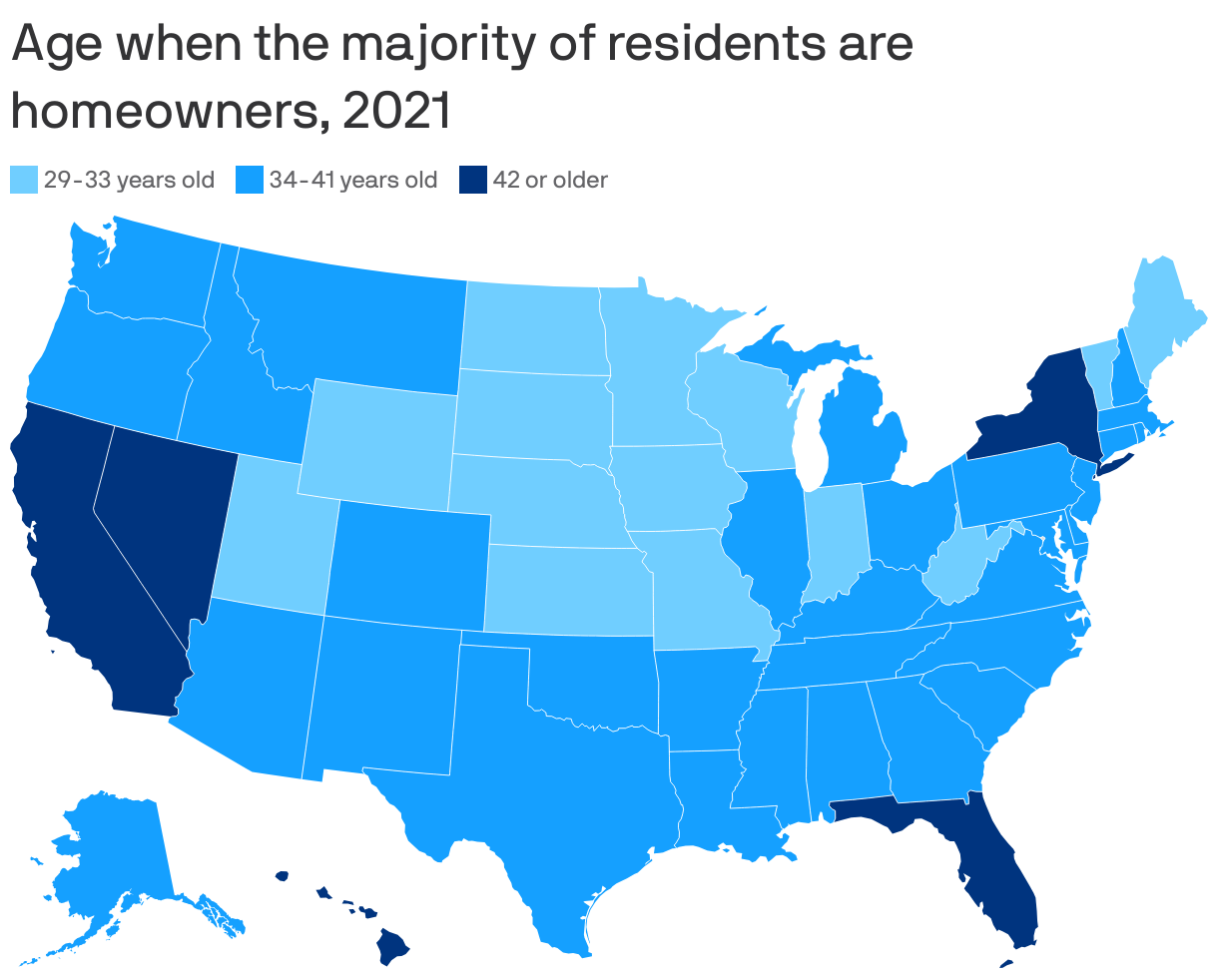
U.S. homebuyers are getting much older, Axios' Brianna Crane reports from a recent University of California, Berkeley study.
Why it matters: For young people especially, homeownership is increasingly out of reach.
Zoom in: Homeownership is most delayed in California, where 49 is the age at which more than half of the residents are homeowners, according to the study — compared to age 35 across most of the country.
- In comparison to 1980, people are buying homes at least a decade later in life in California, Florida, Georgia, Hawaii, Mississippi, Nevada and New York.
4. Superhero boom goes bust


Superheroes were knocked off their pop culture throne in 2023, Axios Pro: Media Deals' Tim Baysinger reports.
Why it matters: The underperformance of several blockbuster Marvel and DC movies has led to fears that the once-bulletproof genre is running out of gas.
The latest: "Aquaman and the Lost Kingdom" was the latest superhero film to misfire at the box office, with a disappointing $40 million opening over the four-day Christmas weekend.
- That was below the $67.8 million the first "Aquaman" earned in December 2018.
The big picture: Last year was filled with comic book sequels that drew less money than their predecessors, including new entries for "Guardians of the Galaxy," "Ant-Man," "Shazam!" and "The Flash."
- "The Marvels," the follow-up to 2019's "Captain Marvel," became the lowest-grossing movie in the Marvel Cinematic Universe's 15-year history.
Yes, but: It wasn't an entirely lost year for the comic book genre — Sony's animated "Spider-Man: Across the Spider-Verse" was a critical and commercial hit.
A version of this story first appeared in Axios Pro: Media Deals. Sign up here.
Editor's note: Joann's delivery drones story has been corrected to reflect that Zipline has flown more than 60 million commercial autonomous miles, not 28 million.
Big thanks to What's Next copy editor Amy Stern.
Was this email forwarded to you? Get your daily dose of What's Next by signing up here for our free newsletter.
Sign up for Axios What's Next

The next decade of big, sweeping changes will unfold in cities and communities where new technologies like 5G, AI and drones are transforming how we work, live and play together. What’s Next will guide you through the revolution.