Axios What's Next

February 01, 2023

New tax incentives meant to spur a U.S. electric vehicle supply chain haven't gotten as much attention as tax credits for EV buyers. But as Joann reports today, they are working almost too well.
Today's newsletter is 1,096 words ... 4 minutes.
1 big thing: Big battery bucks
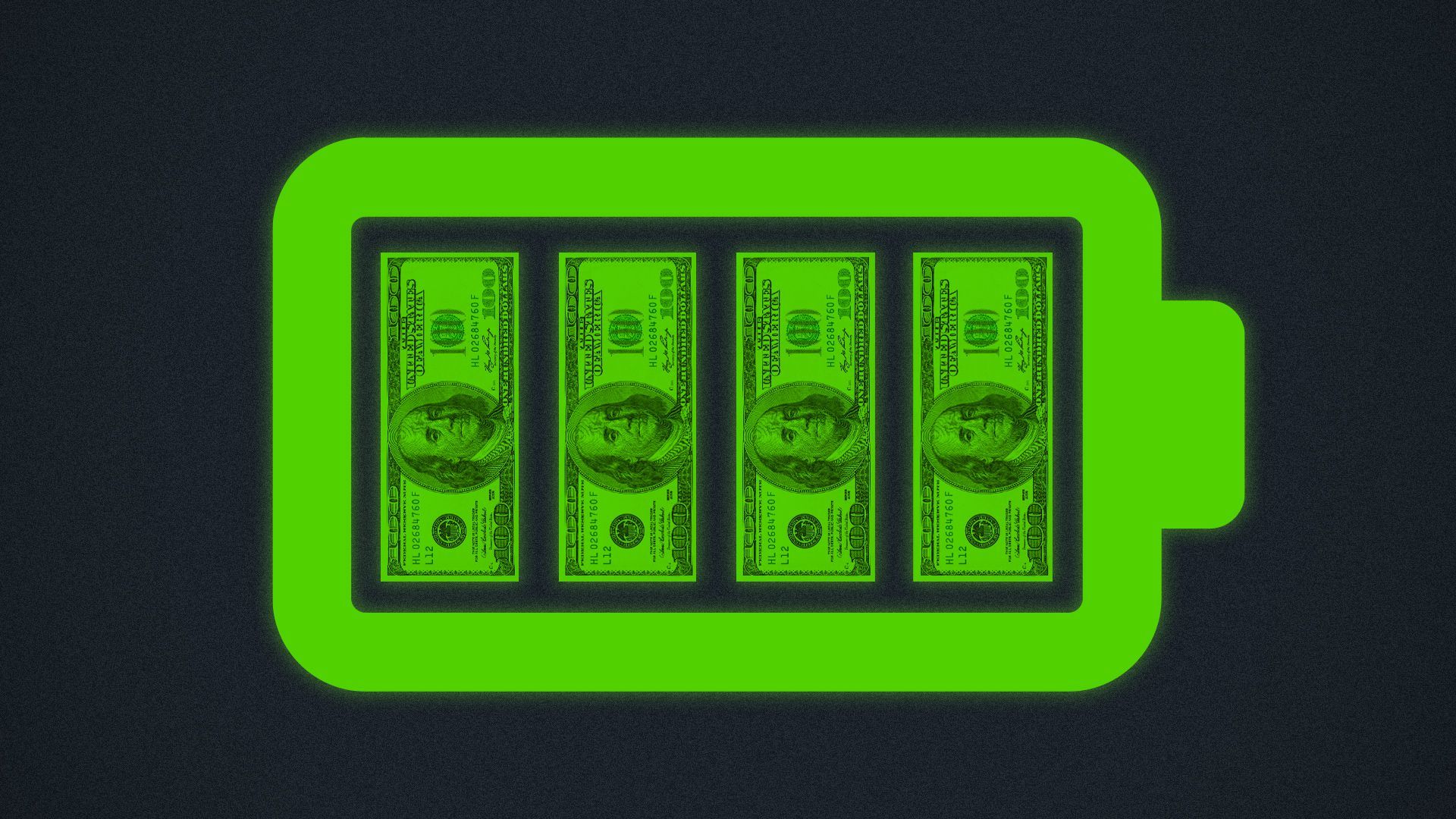
Illustration: Aïda Amer/Axios
The Biden administration's plan to jump-start a domestic supply chain for electric vehicles (EVs) is on track to shatter expectations, Joann Muller reports.
The big picture: Democrats offered carmakers new tax credits as an incentive to scale up domestic battery manufacturing — and they're racing to take advantage.
- Some experts say the value of those tax credits may be four times higher than Congress' budget experts anticipated.
Why it matters: This is what President Biden and congressional Democrats wanted — to seed a domestic EV supply chain and reduce America's dependence on China, while accelerating the transition to cleaner transportation.
- Companies announced more than $73 billion in planned U.S. battery plants in 2022 alone, according to Atlas Public Policy.
Details: The Inflation Reduction Act, passed last year, is loaded with goodies for consumers and carmakers to spur EV sales.
- The most lucrative incentive offers battery manufacturers a tax credit of $35 per kilowatt-hour for each U.S.-made cell, which slices their production costs by a third.
Example: If a manufacturer produces 70-kWh batteries for 1 million vehicles, its total credits would be worth $2.45 billion a year.
By the numbers: When the bill was being debated last summer, the Congressional Budget Office projected the tax credits would add up to about $30.6 billion over 10 years (including credits for solar and wind manufacturing).
- The actual total will almost surely be much higher, thanks to a surge of new battery plants across the country.
- One estimate, prepared by Benchmark Mineral Intelligence for Axios, pegs the cost of the battery rebates at $136 billion over 10 years — and Tesla has already announced new plans that will drive the number even higher.
Between the lines: This will add up to big money for automakers. If they pass those savings on to consumers, it could drive down the cost of new electric cars and spur sales.
- Tesla alone expects to earn up to $1 billion in battery tax credits this year.
- In a recent earnings call, CEO Elon Musk said the value of such credits could become "very significant" and potentially "gigantic" in future years.
- Tesla's Nevada plant, for example, will soon be able to produce 100 gigawatt-hours of battery cells, and that could grow to 500 gigawatt-hours in the future. At an annual production rate of 500 gigawatt-hours, the credits would be worth a staggering $17.5 billion per year.
The big picture: Other companies also stand to reap huge credits as they ramp up domestic battery production, including General Motors and Ford Motor, and their Korean joint venture partners, such as LG Energy and SK Battery Innovation.
What they're saying: "We have already seen hundreds of billions of dollars in new private sector investments across clean energy industries, including batteries, electric vehicles and solar panels," said White House assistant press secretary Michael Kikukawa in a statement to Axios.
- "No one should be surprised that the historic Inflation Reduction Act will lead to an explosion in new EV plants that will showcase how American workers are the finest in the world."
The bottom line: The battery production tax credits are just one of many U.S. policy initiatives intended to accelerate the transition to electric vehicles — but they're clearly among the sweetest.
2. In AI arms race, ethics may be the first casualty
Illustration: Allie Carl/Axios
As the tech world embraces ChatGPT and other generative AI programs, the industry's longstanding pledges to deploy AI responsibly could quickly be swamped by beat-the-competition pressures, Axios' Scott Rosenberg writes.
Catch up quick: While machine learning and related AI techniques hatched in labs over the last decade, scholars and critics sounded alarms about potential harms that could result, including misinformation, bias, hate speech and harassment, loss of privacy and fraud.
- In response, companies made reassuring statements about their commitment to ethics reviews and bias screening.
- High-profile missteps — like Microsoft Research's 2016 "Tay" Twitterbot, which got easily prompted to repeat offensive and racist statements — made tech giants reluctant to push their most advanced AI pilots out into the world.
Yes, but: Smaller companies and startups have much less at risk, financially and reputationally.
- That explains why it was OpenAI — a relatively small maverick entrant in the field — rather than Google or Meta that kicked off the current generative-AI frenzy with the release of ChatGPT late last year.
What's next: Whatever restraint giants such as Google and Meta have shown to date could now erode as they seek to demonstrate that they haven't fallen behind.
3. Tesla confirms Autopilot probe
The interior of a Tesla vehicle. Photo: Sjoerd van der Wal via Getty Images
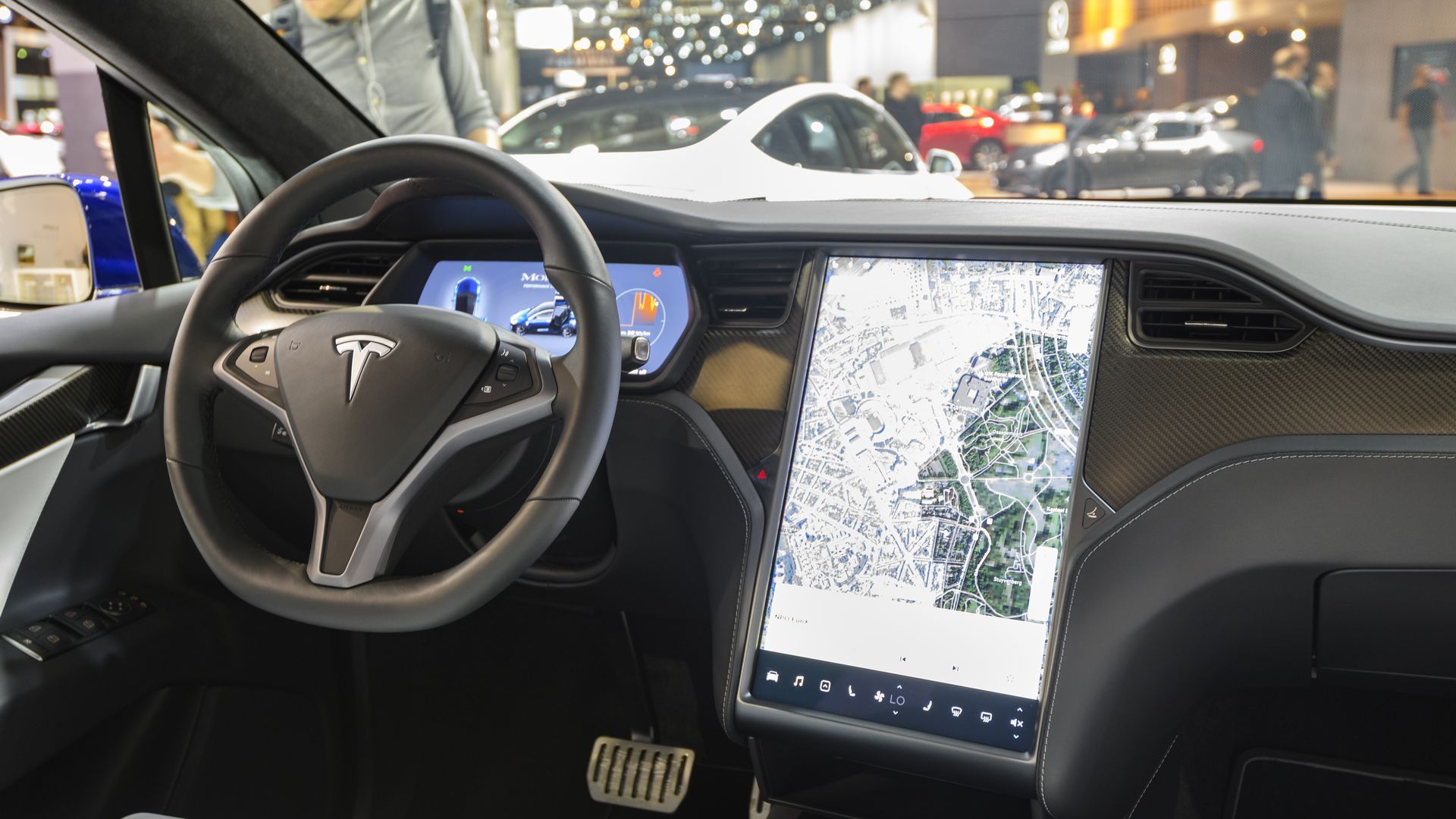
The Department of Justice has asked Tesla for information about its Autopilot driver-assist technology, the automaker confirmed Tuesday, Axios' Nathan Bomey reports.
The big picture: Autopilot has been under fire for years from auto safety watchdogs who say the system inspires too much faith in users who don't understand its shortcomings.
Driving the news: "The company has received requests from DOJ for documents related to Tesla's Autopilot and FSD features," Tesla said in a public filing, referring to its "full self-driving" capability.
- "To our knowledge no government agency in any ongoing investigation has concluded that any wrongdoing occurred," Tesla added.
- The Justice Department, which typically does not discuss ongoing investigations, did not immediately respond to a request for comment.
Backstory: Reuters reported in October that Tesla is under criminal investigation.
4. 📸 Biden's tunnel tour
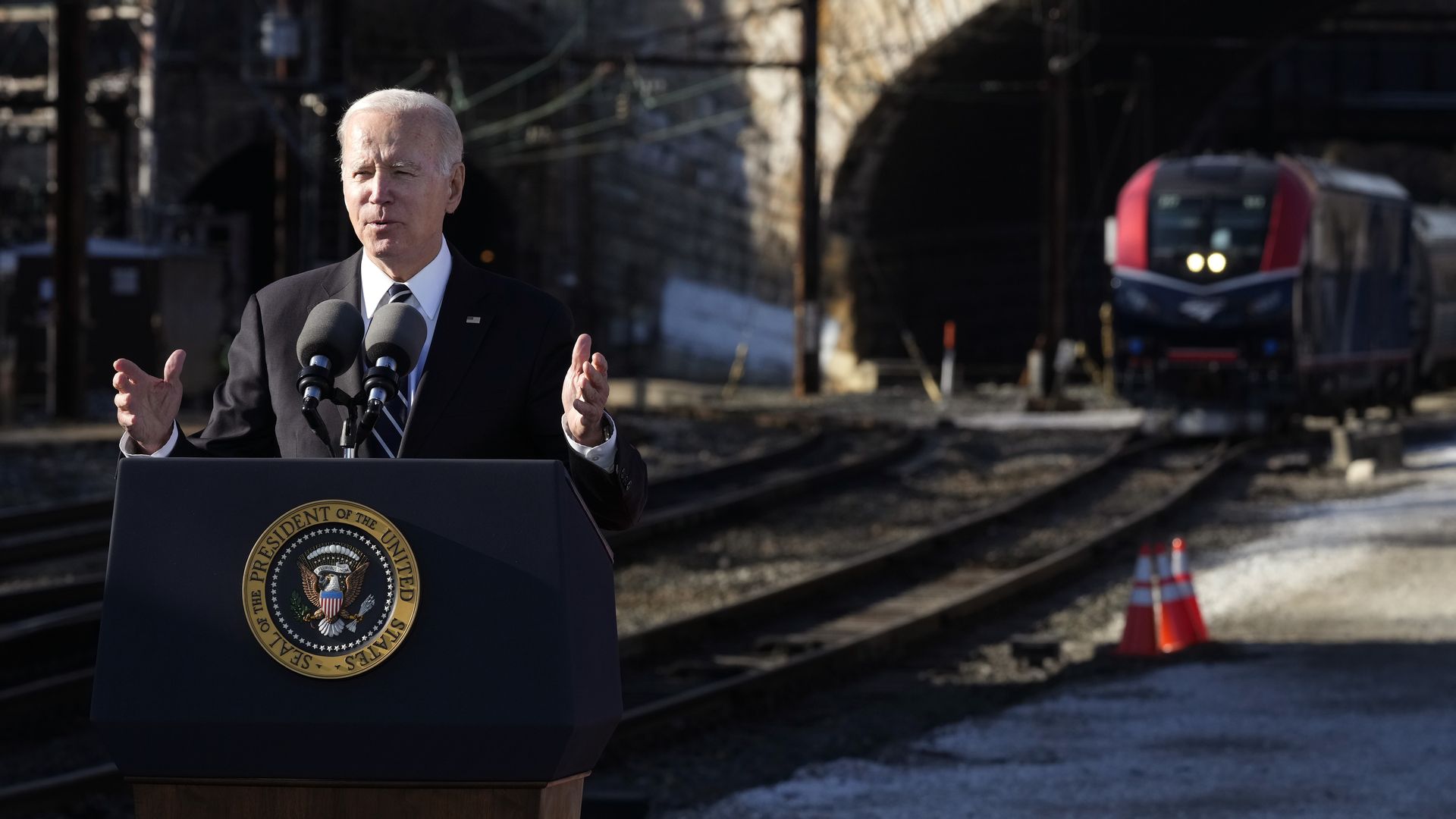
Photo: Drew Angerer/Getty Images
President Biden visited Maryland's 150-year-old Baltimore and Potomac Tunnel on Monday to promote his $1 trillion infrastructure plan.
- $4 billion from that package is slated for repair and improvement of the aging tunnel, a major chokepoint for Amtrak trains traveling between Philadelphia and Washington, D.C.
- Today, trains passing through the tunnel must slow to 30 mph. When the upgrades are completed, they could speed through at over 100 mph, per the Associated Press.
Biden followed up his Maryland visit with a Tuesday trip to New York City, where he announced a nearly $300 million grant to upgrade another major train tunnel, this one running under the Hudson River.
5. Umbrellas in Seattle? It could happen
Illustration: Brendan Lynch/Axios
Seattle has long been known for its umbrella-shunning ways — but more extreme weather and heavier rain may put that ethos to the test, Axios' Christine Clarridge writes.
Why it matters: It's yet another example of climate change forcing big shifts in people's behaviors and thinking.
By the numbers: Based on 80 years of weather records, Seattle is seeing more days with over 1 inch of rain, National Weather Service meteorologist Logan Johnson told Axios.
- Eight of the city's 10 wettest three-day stretches on record have come in the last 23 years.
The big picture: Climate model predictions indicate that heavy rainfall events will become more common across the Pacific Northwest.
Big thanks to What's Next copy editor Amy Stern.
Was this email forwarded to you? Get your daily dose of What's Next by signing up here for our free newsletter.
Sign up for Axios What's Next

The next decade of big, sweeping changes will unfold in cities and communities where new technologies like 5G, AI and drones are transforming how we work, live and play together. What’s Next will guide you through the revolution.