Axios What's Next
March 22, 2024

Kids shouldn't get smartphones or access to social media until they're truly young adults, a new book argues.
Today's newsletter is 1,164 words ... 4½ minutes.
1 big thing: No phones for kids
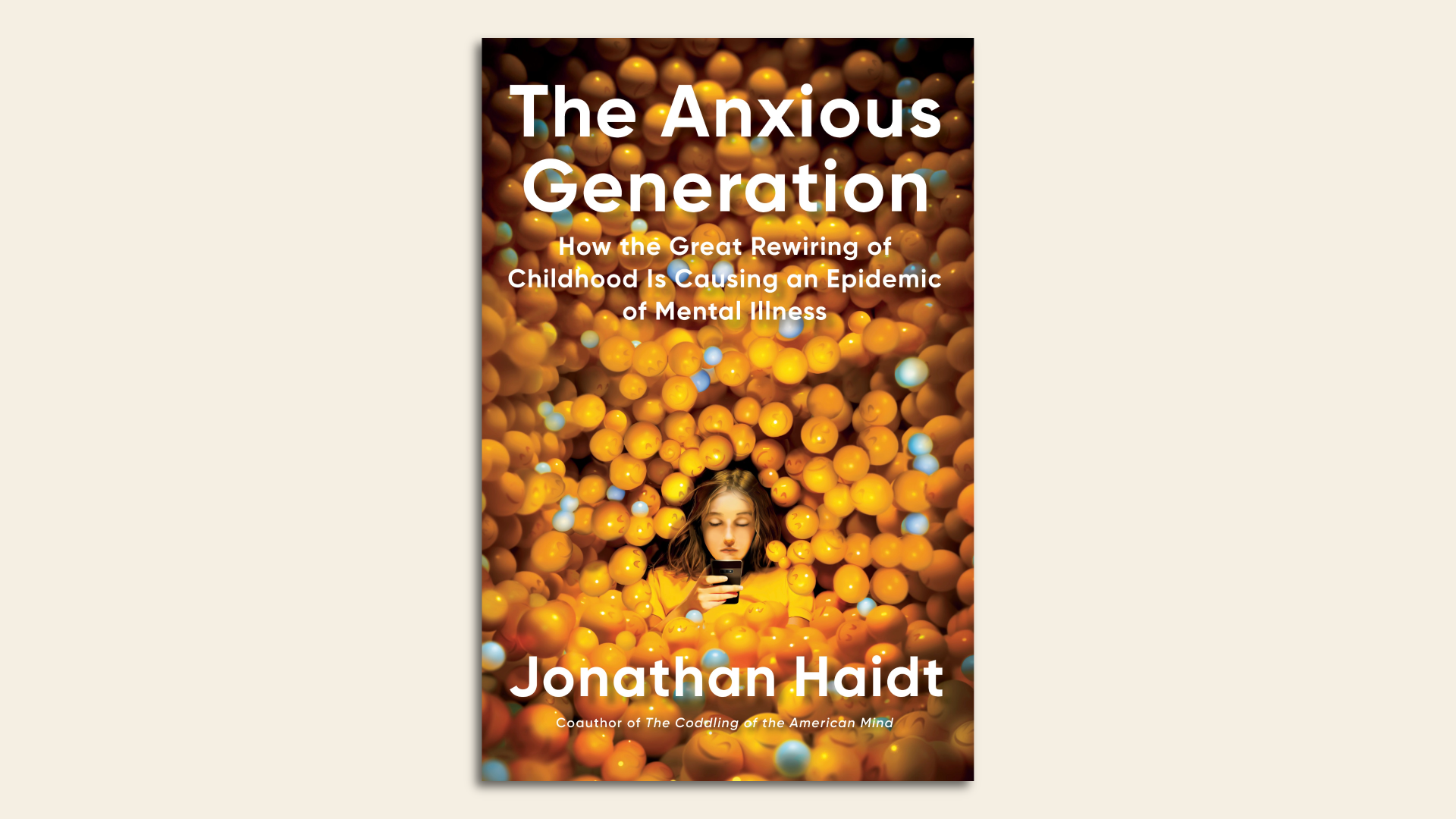
"The Anxious Generation" will be released March 26. Photo courtesy of Penguin Random House
Don't give your kid a smartphone before high school, and don't let them use social media before age 16, New York University social psychologist Jonathan Haidt argues in a new book, Jennifer reports.
Why it matters: The shift from "play-based" to "phone-based" childhoods is making our kids sick and miserable, Haidt argues.
Driving the news: In "The Anxious Generation: How the Great Rewiring of Childhood Is Causing an Epidemic of Mental Illness," out March 26, Haidt says that staring at screens all the time is terrible for human development.
- A "phone-based" childhood causes "social deprivation, sleep deprivation, attention fragmentation and addiction," Haidt writes.
- A "play-based" childhood is essential for developing physical and social skills, like conflict resolution.
"Children learn through play to connect, synchronize, and take turns," the book says. "They enjoy attunement and need enormous quantities of it."
- Social media, by contrast, "is mostly asynchronous and performative," Haidt writes. "It inhibits attunement and leaves heavy users starving for social connection."
What they're saying: Haidt offers four controversial suggestions:
- No smartphones for kids before high school — give them only flip phones in middle school.
- No social media before age 16.
- Make schools phone-free, by putting devices in phone lockers or Yondr pouches.
- Give kids far more free play and independence, including more and better recess.
Zoom in: Banning phones in schools "is the easiest and fastest step we can take to improve youth mental health," Haidt writes.
- "We could, in theory, have all K-12 schools in the U.S. enact the policy for this coming September," Haidt wrote on Substack.
- "That would give all young people six or seven hours a day away from TikTok and texting, freeing up enormous amounts of time for learning from their teachers and developing friendships with other students."
By the numbers: The "teen mental illness epidemic began around 2012," Haidt asserts, presenting ample research to back it up.
- The numbers started rising noticeably in 2010 — three years after the introduction of the iPhone.
- Rates of depression and anxiety among U.S. adolescents were "fairly stable in the 2000s" but "rose by more than 50% in many studies from 2010 to 2019," Haidt writes in The Atlantic.
- The suicide rate rose 48% for adolescents ages 10 to 19. For girls ages 10 to 14, it rose a staggering 131%.
The big picture: "The primary thing that we are trying to understand is why adolescent mental health fell off the cliff right around 2010," Zach Rausch, Haidt's research partner, tells Axios.
- "The core thesis that we make in the book is that we started overprotecting kids long before 2010 — it really began in the 1980s."
- "We started pulling kids indoors, giving them much more supervision in highly structured activities and much less independence, free play and responsibility."
- By 2010, "social life for adolescents in particular moved almost entirely onto smartphones and social media platforms, and completely away from this in-person, real-world childhood and adolescence."
The other side: Critics such as statistician Aaron Brown praise Haidt's integrity, but question his conclusions and methodology.
- Used in moderation, social media can help kids beat loneliness and enhance friendships, some experts say.
Reality check: Putting the cellphones-and-social-media genie back in the bottle for kids is going to be a tough sell.
- Parents are often the ones demanding to be able to reach their kids during the school day.
- They're also the ones pleading with their kids to put the phones down — without success.
The bottom line: "Teens and parents are caught in this social trap, and the only way to get out of it is through collective action," Rausch says.
2. Reddit shares pop, then settle

Illustration: Brendan Lynch/Axios
Reddit shares soared before settling down in the company's stock market debut yesterday, opening at $47 a piece after the company's initial public offering on Wednesday raised $748 million, Axios' Tim Baysinger reports.
Why it matters: The high-profile listing is the first social media IPO in nearly five years, and could set the tone for future tech and media deals.
By the numbers: Reddit priced its IPO at $34 per share on Wednesday — hitting the top end of its expected range, in a sign of high demand.
- The stock opened 38% higher yesterday, at $47 per share. It continued to soar as much as 60% before settling back down.
- It closed at $50.31 per share, representing a 7% increase on the day.
What's next: Reddit, which only just started to earn a profit late last year, now has a cash pile to distribute.
- Company leaders say they plan to invest in the business, possibly through mergers and acquisitions.
3. Dryad raises $6M for wildfire detection tech

A forest network built by startup Dryad can detect gases from the early smoldering of wildfires. Photo courtesy of Dryad
Dryad Networks has raised about $6 million to sell its fire detection technology to more global customers, the company tells Axios Pro: Climate Deals' Katie Fehrenbacher.
Why it matters: Cutting-edge tech can help firefighters better manage wildfires, which are becoming more intense and destructive because of climate change.
How it works: Dryad builds out networks of fire-sniffing, solar-powered, AI-enabled nodes around forests. Each node can be nailed directly onto a tree.
- CEO Carsten Brinkschulte says a small pilot could typically use 400 of its nodes, while a large commercial deployment could use hundreds of thousands.
- The nodes detect gases — hydrogen, carbon monoxide and volatile organic compounds — that are present in an early smoldering fire, and alert customers to extinguish it.
State of play: Companies are using a variety of tech — including satellites, drones, cameras and AI — to try to tackle the surge in wildfires.
What's next: Dryad also wants to use its forest networks to collect information about forest health, as well as to create an audio node to listen for the sound of chainsaws or guns to detect poaching.
If you need smart, quick intel on dealmaking in the climate industry for your job, get Axios Pro.
4. Boston's office-to-residential edge

Illustration: Annelise Capossela/Axios
Transforming Boston's vacant office buildings into homes is an uphill battle, Axios Boston's Mike Deehan writes — but the city has one advantage: its sky-high residential rents.
Friction point: Residential space is simply less profitable per square foot than office space, meaning each converted building will generate less profit for owners and less tax revenue for the city.
Yes, but: Boston is considered one of the top metro areas where such conversions could be feasible, per a National Bureau of Economic Research report.
- Boston is among high-cost cities like New York, San Francisco and Washington, D.C., where rents are so high that developers can charge more and stand a better chance of making their money back on conversions.
What's happening: Local governments are offering conversion tax incentives to entice developers.
- Boston Mayor Michelle Wu is offering a 75% discount on the residential tax bill for converted buildings.
- Massachusetts Gov. Maura Healey's office recently launched a $1 million program to help other municipalities find conversion targets.
The latest: Boston's first office-to-housing conversion project was approved last week.
What's next: Developers plan to convert over 100,000 square feet of Boston offices in eight buildings into housing.
Big thanks to What's Next copy editor Amy Stern.
Was this email forwarded to you? Get your daily dose of What's Next by signing up here for our free newsletter.
Sign up for Axios What's Next

The next decade of big, sweeping changes will unfold in cities and communities where new technologies like 5G, AI and drones are transforming how we work, live and play together. What’s Next will guide you through the revolution.