Axios Vitals

April 06, 2026

Welcome back, Vitals gang. Today's newsletter is 775 words, a 3-minute read.
1 big thing: Medicare dips a toe into hemp for seniors

For the first time, Medicare is covering some cannabis products under a pilot program that opens up more of the nearly $30 billion hemp industry to seniors.
Why it matters: The effort is part of a White House push to reschedule marijuana and tracks with Health Secretary Robert F. Kennedy Jr.'s interest in non-pharmaceutical, alternative treatments.
- Policy experts say it also taps into public dissatisfaction with how the health system treats chronic pain and other health problems.
- "There is a flavor here of, 'We as a society, across the political spectrum, are not happy with the options that we have available to us,'" said Edo Banach, co-chair of the health care department at the law firm Foley Hoag.
How it works: In certain payment arrangements, Medicare providers can get reimbursed as much as $500 per patient each year to discuss and provide certain CBD products.
- Providers have to front the cost and can't instruct seniors to buy their own products.
- Any CBD solutions can't exceed concentrations of 0.3% of delta-9 THC, the main psychoactive ingredient in cannabis, or more than 3 milligrams of THC per serving.
- They also must be tested by a third party and meet state and local standards. The program excludes patients who have certain medical conditions, including substance use disorder and COPD.
Between the lines: Marijuana is subject to a patchwork of standards. Even though most states have legalized medical marijuana and about half allow recreational use, the substance remains illegal at the federal level.
- President Trump's rescheduling push wouldn't legalize it.
- Last week, FDA commissioner Marty Makary stipulated in a memo that his agency won't enforce prohibitions on oral CBD products that are eligible under the Medicare program.
Zoom out: Seniors who are already using cannabis products for pain, insomnia and a variety of ailments usually do so without guidance from health care providers.
- That's raised concerns about interactions with other drugs and inappropriate dosing.
2. Hospitals again challenge safety-net cuts
Hospitals are back in court challenging the way HHS calculates payments for facilities that serve a higher percentage of low-income patients.
The big picture: The Supreme Court just last year sided with the government in a case over whether safety net hospitals that care for low-income seniors were being underpaid by Medicare.
- But the so-called disproportionate share payments remain a major source of friction.
Driving the news: More than 130 hospitals sued HHS last week, seeking to overturn a 2023 Biden administration policy they say retroactively changed the way the payments were calculated, with billions of dollars on the line.
- CMS "failed adequately to consider and to weigh financial reliance interests against the considerations that animated its policy," the hospitals wrote in the complaint.
In asking that the rule and payment calculations be tossed, the hospitals referenced the Supreme Court's 2024 ruling that struck the long-standing precedent in which courts deferred to regulators when the law was ambiguous.
What's next: The U.S. District Court for the District of Columbia will decide whether HHS overstepped its statutory authority and acted arbitrarily.
3. Surrogacy laws are all over the map

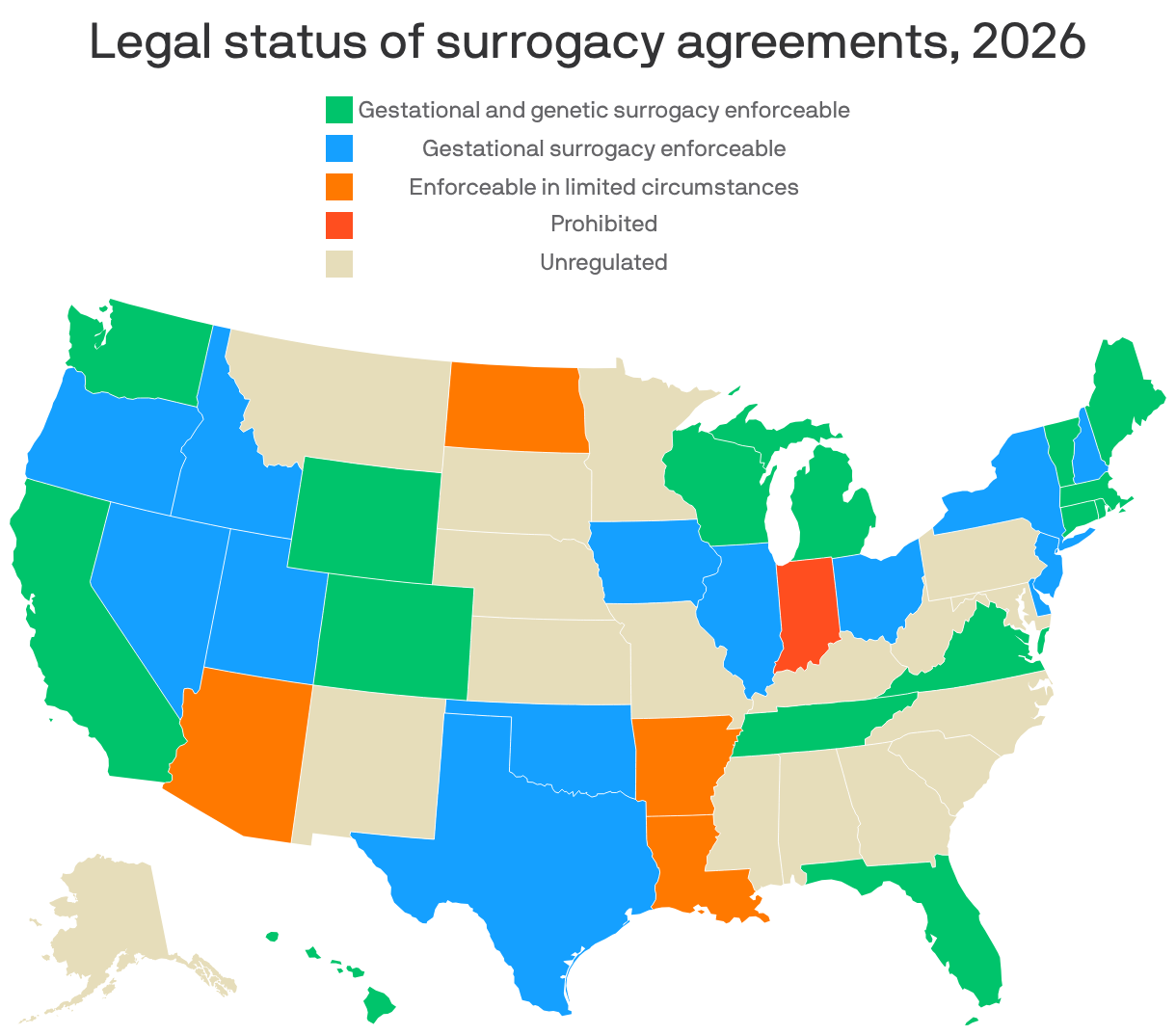
Surrogacy is going mainstream thanks in part to expanded insurance coverage. But the lack of a federal law means it's subject to a patchwork of state regulations.
Why it matters: At times confusing, varied local rules can decide critical questions like who is recognized as a parent at birth or whether agreements are legally binding.
By the numbers: Surrogacy agreements are enforceable in 31 states (with some limitations), void in one, and unregulated in 17, per Surrogacy360, which provides advice to intended parents.
Major differences between state laws include how a surrogate must be compensated, who becomes the legal parents of a child born via surrogate and whether a surrogate can use their own egg.
Between the lines: Some state regulations have barriers for intended parents who are single, unmarried, not a heterosexual couple and/or not genetically related to the child.
- And, often, surrogacy agreements happen across state lines, so multiple state laws might need to be considered.
4. While you were weekending

💉 HHS is quietly laying the groundwork to revive a vaccine advisory committee whose membership and decisions were frozen by a federal judge. (NYT)
💰 Tax time is bringing surprises for some with Affordable Care Act coverage, including owing money back to the government for premium subsidies. (KFF Health News)
🤧 A better understanding of food allergies and a new use of an old asthma drug have opened up a potentially huge market in biopharma. (Endpoints News)
Thanks for reading Axios Vitals, and to editors Adriel Bettelheim and David Nather and copy editor Matt Piper. Please ask your friends and colleagues to sign up.
Sign up for Axios Vitals