Axios Vitals

March 25, 2025
Welcome to Tuesday, Vitals readers. Today's newsletter is 874 words or a 3.5-minute read.
🔮 Tune in to Axios' fourth annual What's Next Summit happening live today from Washington, D.C., to hear from Sen. Amy Klobuchar (D-Minn.), Sen. Tim Scott (R-S.C.), former House Speaker Paul Ryan, Oura CEO Tom Hale and more.
Livestream here starting at 2:30pm ET.
1 big thing: 23andMe bankruptcy raises privacy alarms
The demise of 23andMe illustrates the vulnerable state of Americans' health data, as med tech companies vacuum up more personal information with little regulatory oversight.
Why it matters: Fitness trackers, wellness apps, genetic tests and other direct-to-consumer tools that capture personal health information aren't subject to federal health data privacy laws. That could open the door to fraud or discrimination.
- "We're getting into an era where we have more entities sitting on these big datasets," said Sara Gerke, an associate law professor at the University of Illinois Urbana-Champaign.
Where it stands: 23andMe said in a release that Sunday's bankruptcy filing won't change the way it protects customer data and that data privacy will be a key consideration in a future sale.
- But as things currently stand, a buyer could change the privacy policy after the sale.
Zoom out: In reality, there isn't much federal protection for customer data shared with 23andMe, or other companies that circle the health care space but aren't actually health providers.
- The landmark health privacy law HIPAA only applies to health providers, insurers, clearinghouses and their business associates, leaving a big gap as the market for consumer and digital health gadgets grows.
States have tried to fill that gap, creating what's at best a patchwork health privacy system.
2. Trump reveals new pick for CDC director
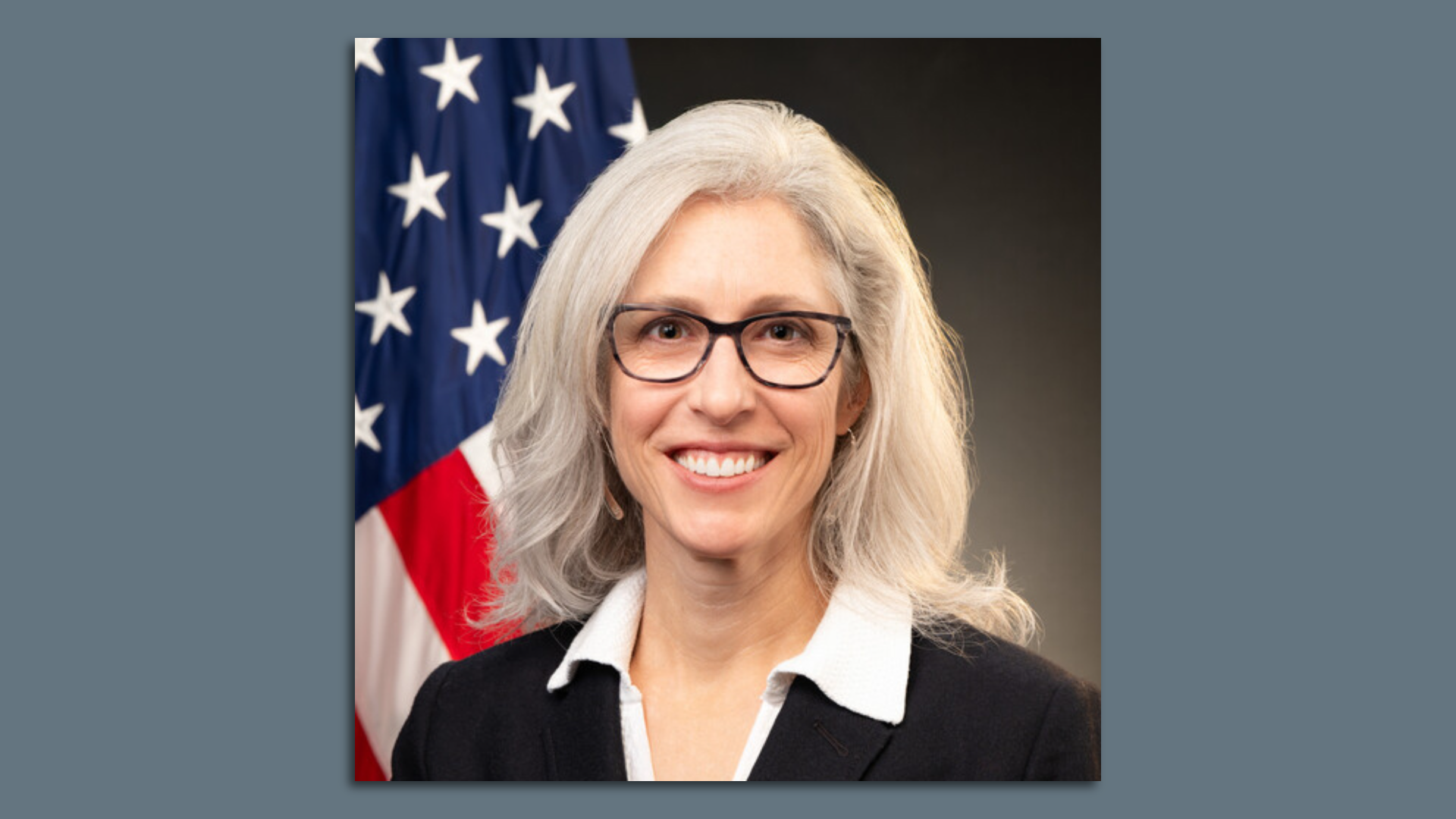
President Trump on Monday nominated Susan Monarez, the CDC's acting director, to be the agency's full-time leader.
Why it matters: Monarez would be the first CDC director-designate to face Senate confirmation under a law Congress passed in 2023.
- Her selection comes after the White House abruptly withdrew the nomination of Dave Weldon earlier this month after multiple GOP senators expressed concerns.
Background: Monarez served as deputy director of the Advanced Research Projects Agency for Health, or ARPA-H, which focuses on breakthrough cures and technology and is modeled on the Pentagon's research arm.
- She was involved in initiatives such as the ethical use of AI and ending the opioid epidemic.
- She's also served in the White House in the Office of Science and Technology Policy and on the National Security Council.
What to watch: If confirmed, Monarez would take the helm of the public agency as it responds to the bird flu and outbreaks of measles.
- She'll likely face scrutiny about the agency's response to date around both, as well as a decision to postpone a key advisory vaccine advisory committee. The CDC also temporarily paused publication of its flagship Morbidity and Mortality Weekly Report, a weekly journal of public health research.
3. 2025's early spate of hospital closure plans

Ten U.S. hospitals have announced plans to close so far in 2025, including five in the month of February alone, Becker's Hospital Review reported.
Why it matters: When hospitals close, it can rock entire communities if alternatives aren't available nearby to fill gaps in patient care left in their wake.
- It can strain remaining hospitals in a region and also impact local economies if they result in large scale layoffs.
The big picture: While many of America's hospitals see improving balance sheets, a growing number of hospitals — often smaller nonprofits in rural areas — face the threat of shuttering critical services or complete closure.
- They are potentially on track to beat Becker's count of 25 hospital closures in 2024 and 14 in 2023.
Driving the news: Among the closure announcements included in the Becker's report is the planned closure of the nearly 700-bed Mount Sinai Beth Israel hospital in New York City.
- They also counted Rockledge Hospital, a 298-bed facility in Florida that was among three hospitals Orlando Health acquired from Dallas-based Steward Health Care in Florida.
Yes, but: Some of these closures are accompanied by openings of new facilities.
4. Data du jour: Avoidable deaths

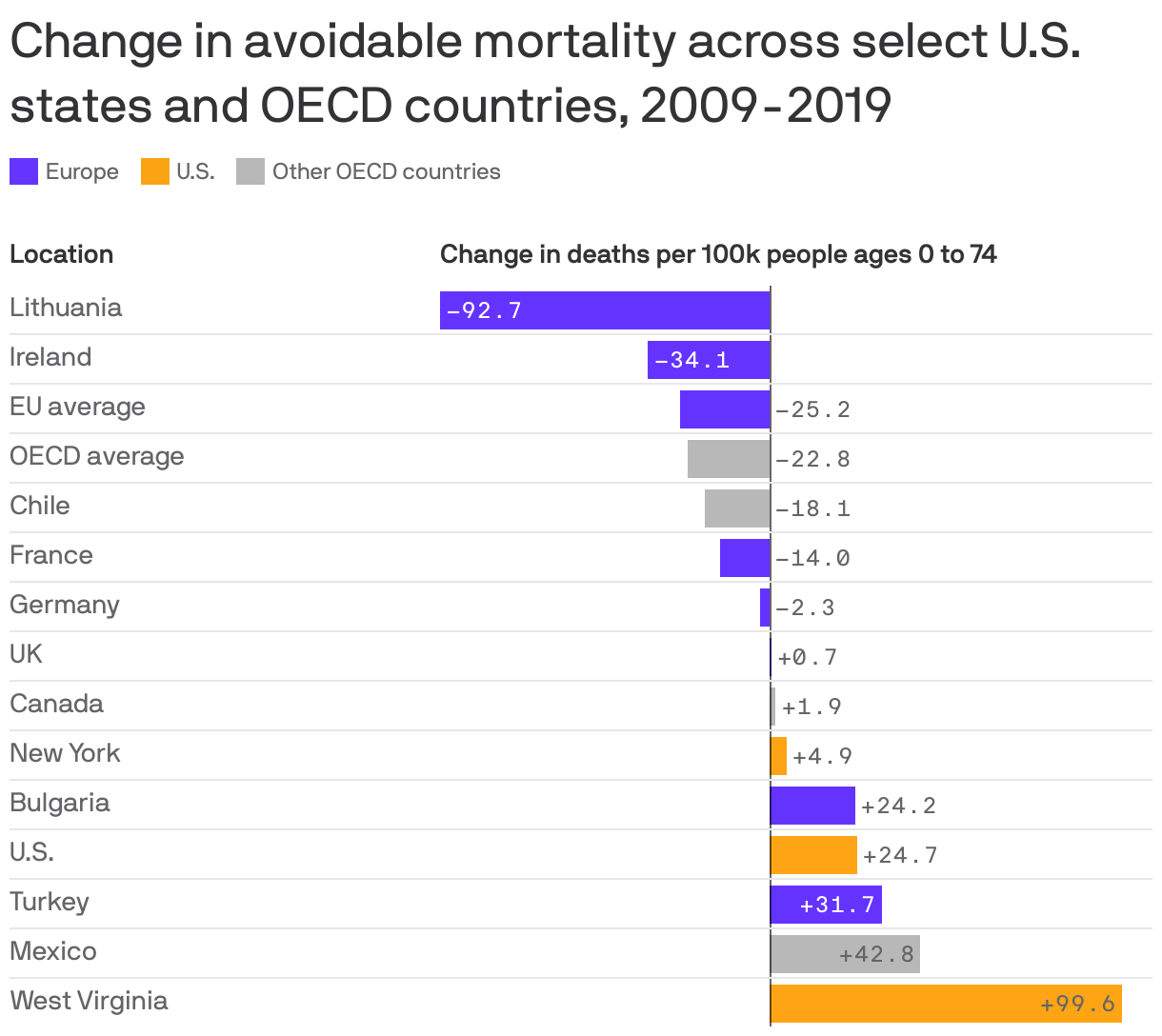
Avoidable mortality rose across every U.S. state between 2009 and 2019, jumping about 25 deaths per 100,000 people across states over that time frame, according to a study published Monday in JAMA Internal Medicine.
Why it matters: At the same time, many of America's peer nations in the European Union (EU) and the Organisation for Economic Co-operation and Development (OECD) were seeing improvements.
What they found: Avoidable mortality refers to annual deaths in the population before 75 years "that could have been prevented through timely, effective health care and public health interventions."
- Between 2009 and 2019, total avoidable mortality in the U.S. increased from nearly 256 deaths per 100,000 people to 280.
- There was a wide variation in avoidable deaths state-to-state compared with other countries.
Reality check: Between 2019 and 2021, avoidable mortality increased for all U.S. states and nearly all comparator countries, the authors pointed out.
The bottom line: "Despite spending more on health care than every other high-income country, the U.S. had comparably higher avoidable mortality," the authors wrote.
- "U.S. policymakers should more closely examine population health across states in international comparative studies with the U.S., particularly as health policy and responses to health shocks vary across states," they wrote.
5. Catch up quick
👉 A health benefits company co-founded by Dr. Oz could be a conflict of interest. (WaPo)
💰 With Medicaid cuts hanging in the balance, here's a look at how the program actually works. (WSJ)
🌎 NIH will no longer fund studies on the health effects of climate change. (ProPublica)
🏳️🌈 The Trump administration canceled at least 68 grants focused on LGBTQ health questions. (AP)
Thanks for reading Axios Vitals, and to senior health care editor Adriel Bettelheim, managing editor Alison Snyder and copy editor Matt Piper. Please ask your friends and colleagues to sign up.
Sign up for Axios Vitals