Axios Vitals

January 23, 2024
Good morning, Vitals crew. Today's newsletter is 899 words or a 3.5-minute read.
Situational awareness: The FDA is requiring "boxed warnings" on CAR-T therapies after investigating reports of some patients developing a type of blood cancer following treatment, per Reuters.
1 big thing: Unusual drug pricing bedfellows

Illustration: Aïda Amer/Axios
An unusual bipartisan coalition of lawmakers is teaming up on drug pricing legislation, proving the issue may defy election-year partisanship as health care costs remain a top voter concern.
Why it matters: The effort highlights the increased scrutiny some influential Republicans are giving an industry the GOP has long allied itself with, writes Axios' Peter Sullivan.
Driving the news: Some of the most liberal Democrats in Congress and the House GOP's lead budget writer are backing a plan targeting "patent thickets" — the practice of taking out overlapping patents around one drug that the bill's sponsors say drug companies use to fend off competition.
Zoom in: It's among the strategies that drugmakers have been accused of deploying to delay the introduction of cheaper generics or biosimilars.
- So-called "pay-for-delay" deals, in which branded drug companies pay generic makers to keep their products from the market, and drugmakers' improper listing of patents in a federal registry have also faced bipartisan scrutiny.
- The involvement of Rep. Jodey Arrington (R-Texas), chair of the House Budget Committee, in patent thicket legislation has raised some eyebrows in the pharmaceutical industry and highlights the continued pressure on the sector after Democrats passed Medicare drug price negotiations.
Yes, but: Republicans are still broadly aligned with drugmakers on opposing Medicare negotiations and the Biden administration's recent proposal to seize patents of high-priced drugs developed with taxpayer support, which the industry argues will undermine research and development.
- Overcoming pharmaceutical industry opposition is still a major hurdle for the patent thickets measure and a related bipartisan Senate bill.
- Arrington acknowledged that his effort had made the pharmaceutical industry "nervous" but said he is focused on patent system abuses, not on stopping innovation.
A version of this story was published first on Axios Pro. Unlock more news like this by talking to our sales team.
2. NYC joins cities erasing medical debt

Illustration: Annelise Capossela/Axios
New York City's plan to buy up medical debt for up to a half-million low- and middle-income residents could erase over $2 billion in medical bills, city officials said.
Why it matters: It marks the largest municipal effort yet to wipe out medical debt, a leading cause of bankruptcy and a threat to people's health.
Details: New York is investing $18 million over three years in a partnership with the nonprofit RIP Medical Debt, which buys up medical debt in bulk on the cheap.
- There's no application process — residents will be told if their debt has been paid off.
The big picture: The federal government has taken steps to erase medical debt from credit scores, while states have sought other measures to ease the financial burden.
- But a growing number of cities and counties are simply wiping the slate clean for some residents.
- Among those that have leveraged federal pandemic relief funds to erase medical debt are Illinois' Cook County (which has eliminated $281 million), New Orleans and St. Paul.
- Los Angeles County, the nation's most populated, is weighing a plan to eliminate over $2 billion in medical debt. A county report last summer found that about 810,000 residents have medical debt, with disproportionate impacts on lower-income and minority residents.
3. Employers weigh expanding parental leave

Illustration: Annelise Capossela/Axios
1 in 5 companies offering paid parental leave are planning to make their policies more generous in the next two years, according to a new survey by global advisory and brokerage firm Willis Towers Watson.
Why it matters: It's the latest example of how employers are rethinking their benefits packages amid a tight labor market, rising costs, and changing expectations for how workplaces should accommodate parents.
- "The leave landscape is evolving at a rapid pace due to social, political and regulatory changes," said Alex Henry, who leads employer benefits work for Willis Towers Watson.
Between the lines: The survey, conducted last fall, includes responses from 517 companies ranging from 100 workers to more than 25,000. They employ a combined total of 7.9 million employees.
- 17% said they'll extend the amount of time they provide for maternity leave, while similar shares said they would increase paternity and adoptive parents' benefits.
- The vast majority of the companies (86%) already offer maternity leave, while 82% offer paternity leave. Almost 1 in 10 said they planned to start offering the benefits.
Of note: The survey group appears to be more generous on parental leave than most employers. A 2020 survey from the Society for Human Resource Management found just over half of employers offered maternity leave, while just under half offered paternity leave.
4. Maternity care deserts

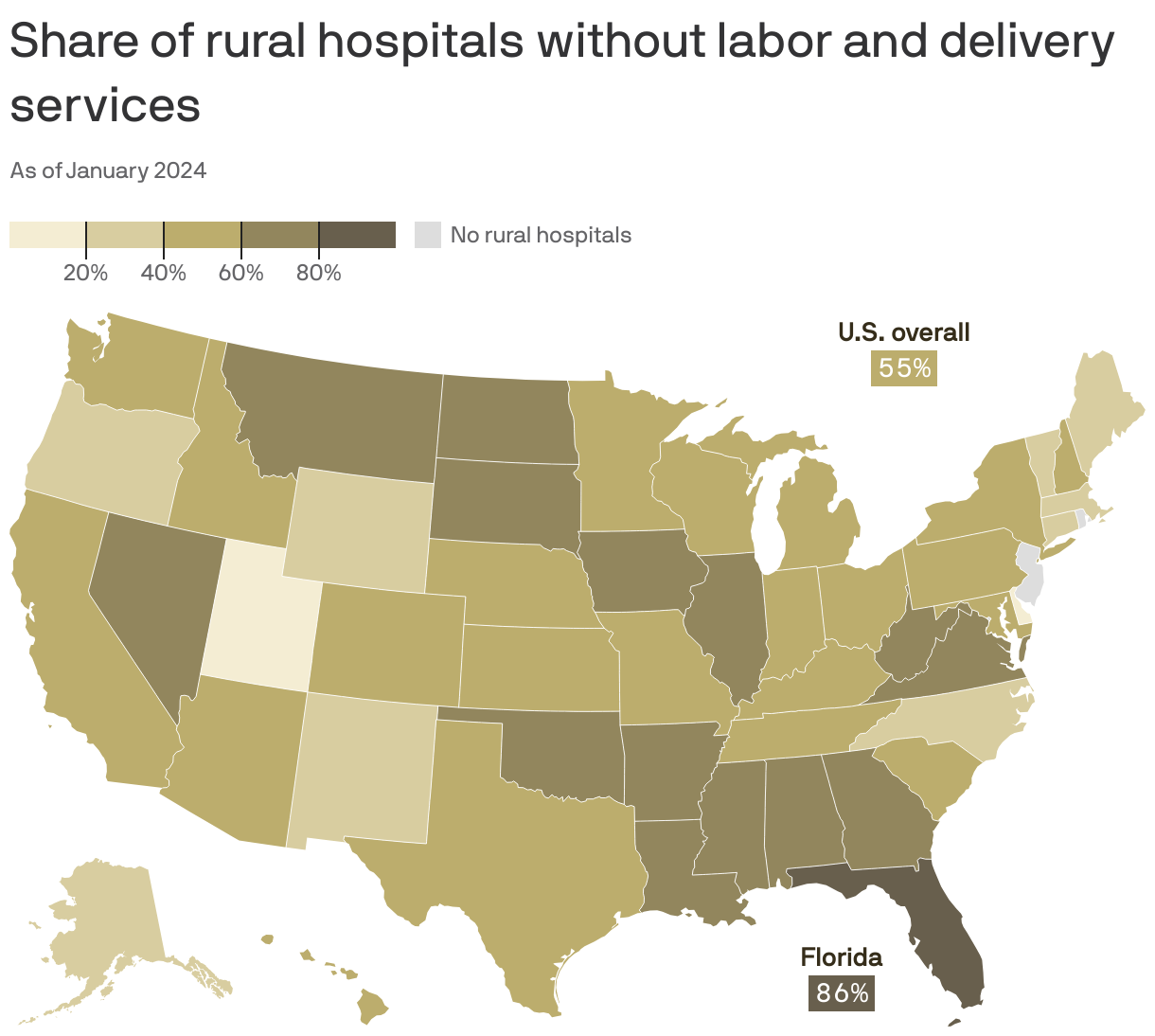
More than half (55%) of the nation's rural hospitals don't offer maternity care, as challenging economics and labor shortages force more rural facilities to stop providing labor and delivery services.
Zoom in: In more than 10 states, more than two-thirds of rural hospitals don't offer maternity care, according to a new report from the Center for Healthcare Quality and Payment Reform that also finds:
- While patients in most urban areas can reach labor and delivery services in less than 20 minutes, rural patients typically have a travel time of 30 minutes or more.
- More than 200 U.S. rural hospitals have stopped delivering babies in the past decade.
5. Catch up quick
🧠 A blood test that can detect Alzheimer's disease before symptoms start may be closer to reality. (CNN)
😷 Lingering cough may be worse than usual this winter — or the pandemic may have just made us more vigilant. (Washington Post)
🏛️ Some lawmakers are backing limits on how opioid settlement funds are used. (KFF Health News)
Thanks for reading Axios Vitals, and to health care editor Jason Millman and copy editor Matt Piper. Please ask your friends and colleagues to sign up.
Sign up for Axios Vitals

Healthcare policy and business analysis from Tina Reed, Maya Goldman, and Caitlin Owens.