
Axios Vitals

April 22, 2022
😎 Happy Friday, Vitals readers. Only a few more hours until the weekend. Today's newsletter is 999 words, or a 4-minute read.
1 big thing: The tricky business of weighing COVID risks now
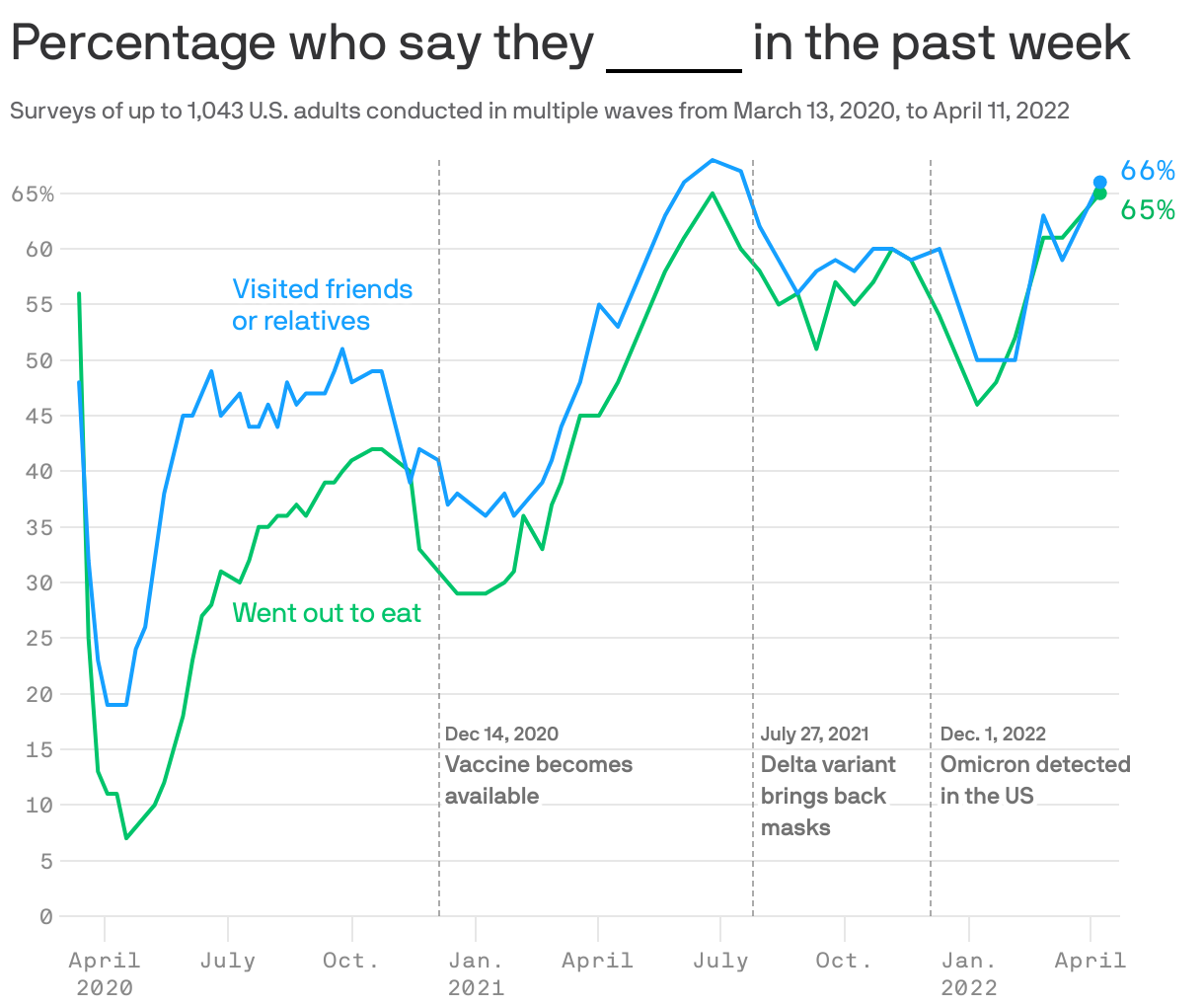
The end of the federal transportation mask mandate this week may have removed the last big pandemic mitigation measure, but many Americans were ready to move on as far back as last summer, data from the Axios-Ipsos poll shows.
The big picture: This data on Americans' willingness to dine out and socialize offers a window into how they've perceived risk and made judgment calls with public health regulations serving as guardrails.
What's happening: Now freed of regulatory shackles, the public is largely on their own to make value judgments about which behaviors are acceptable or risky.
- Those judgments are largely based on a combination of perceived individual risk, the norms of those around them, as well as just how important a particular activity is to them.
Understanding risk: As the New York Times reported this week, experts have tried to offer different ways of describing the relative risk of dying from COVID, such as the tool COVID-Taser or a unit of risk known as a "MicroMort."
What they're saying: "My bias is to wear a mask unless I'm sure the people I'm sitting with are fully vaccinated and would tell me if they didn't feel well — and if the pleasure and joy I get out of taking my mask off outweighs the small risk and the small amount of anxiety I have when I do," Bob Wachter, chairman of the University of California, San Francisco Department of Medicine, told Axios.
- "That leads me to feel comfortable going out to dinner with small and medium-sized groups of people. It leads me to feel comfortable having people over to my house," he said.
- But he masked at a recent conference. "Is sitting there watching a lecture that much less enjoyable with a mask on? To me, it wasn't worth the risk."
2. Stanford Health, Packard Children's nurses plan strike
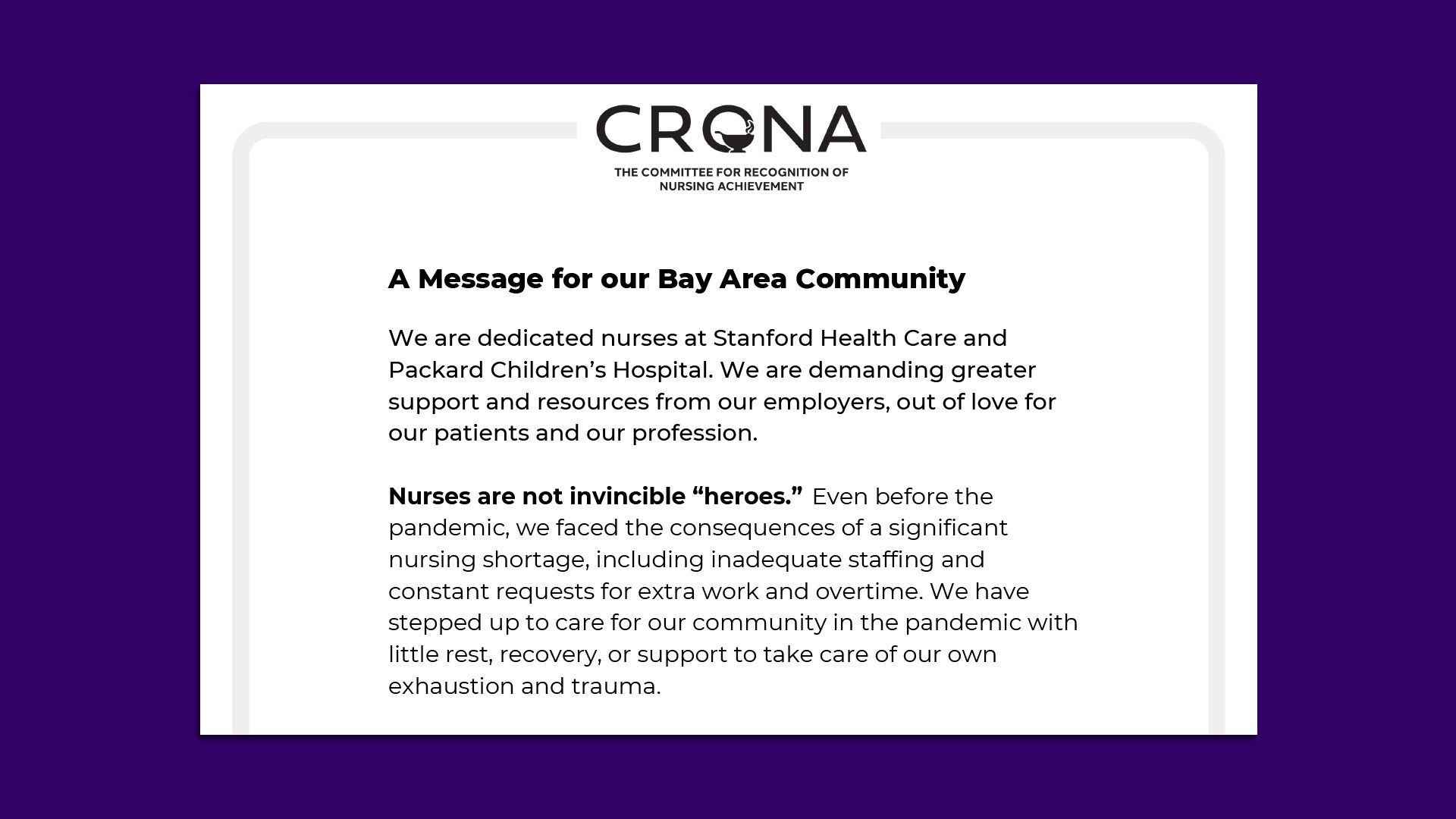
An image of the open letter planned to run in the San Francisco Chronicle. Courtesy of CRONA
A union representing thousands of nurses at Stanford Health Care and Packard Children's Hospital has a full-page ad in the San Francisco Chronicle today calling for support for nurses who've reached a "breaking point."
Why it matters: It's the latest move by the union, the Committee for Recognition of Nursing Achievement, to engender community support after thousands of its members voted to approve a strike next week after contract negotiations broke down.
- They are seeking improved pay and benefits, better staffing and mental health support, including more paid time off in the wake of the stress of the pandemic, they said.
- "Nurses are not invincible heroes," the letter says.
The big picture: It's just one of a number of labor actions threatened by health care workers around the country.
- Sutter Health nurses recently walked off for a day.
- Alleging anti-union behavior, Providence Health nurses in Oregon threatened this week to strike while Howard University Hospital nurses picketed in D.C. earlier this month.
What they're saying: "Maybe it was naive of me. But I was expecting them to say ... 'Thanks for helping us weather one of the most horrific pandemics humanity has seen in the modern era,' and then show gratitude through our contractural process. They did not," Mark O'Neill, a Stanford health nurse, told Axios. "Their proposals were all about how they could keep us at the hospital longer."
The other side: "At Stanford Health Care and Lucile Packard Children's Hospital Stanford, we value our nurses and have proposed highly competitive contract terms, including market-leading pay and proposals that further our commitment to enhanced nurse staffing and wellness," said Dale Beatty, chief nurse executive and vice president of patient care services for Stanford Health Care in a statement.
- He pointed to a hospital website for details on the negotiations.
3. More than 230,000 preventable deaths
Roughly 234,000 COVID deaths since last June could have been prevented with a primary series vaccination, Axios' Adriel Bettelheim writes about a newly updated Kaiser Family Foundation analysis.
Why it matters: The deaths account for 60% of total adult COVID deaths since June and a quarter of the nearly 1 million fatalities since the pandemic began.
The big picture: The researchers say COVID-19 vaccines remain highly effective in preventing hospitalization and death — even in the face of new, highly contagious variants like Omicron.
- CDC estimates that in February and March, unvaccinated people were 10 times more likely to die from COVID-19 than people were vaccinated with at least the primary series.Â
- The analysis didn't attempt to estimate the potential effect of booster protection.
- Researchers used Kaiser tracking data for COVID deaths and a CDC dataset from 25 jurisdictions that shows the share of adult deaths that are among unvaccinated and vaccinated people.Â
4. Substance abuse contributes to worker shortage


The labor force participation rate, or the share of the adult population either working or looking for work, has not quite recovered from pre-pandemic levels. A new paper sheds light on one factor behind the shortfall: Substance abuse, Axios' Emily Peck reports.
What it says: Somewhere between 9% and 26% of the decline in workforce participation between February 2020 and January 2022 among people ages 25–34, is probably due to a rise in dependency on substances like opioids and methamphetamines.
The increase in drug abuse is related to a broader problem: The mental and physical health issues also driving the labor shortage, as Axios' Felix Salmon wrote last year.
- Long COVID could be keeping 1.6 million out of the labor market as well, according to one recent estimate.
5. Drug lobby taps Biden aide's brother
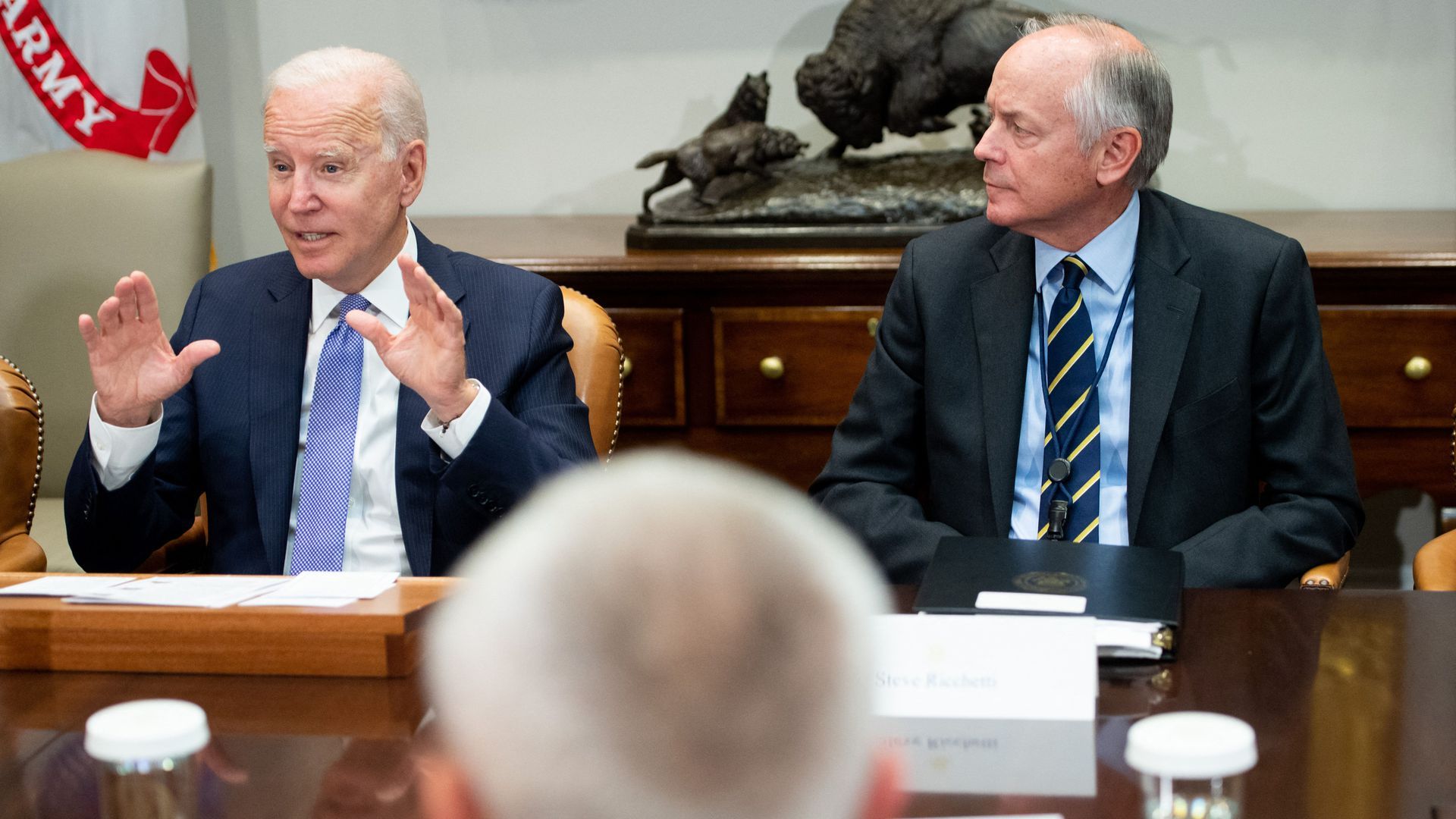
President Biden speaks alongside Steve Ricchetti. Photo: Saul Loeb/AFP Via Getty Images
Jeff Ricchetti, the brother of senior White House official Steve Ricchetti, has been lobbying for the drug industry's top trade group, Axios' Lachlan Markey reports.
Why it matters: Ricchetti has pledged not to lobby the West Wing, but his newly disclosed deal with the Pharmaceutical Research and Manufacturers of America, a top K Street spender, shows corporate America still sees significant value in his services.
- The White House declined to comment.
Editor’s note: The headline of the second story in this newsletter has been changed to reflect that the nurses planning the strike are from Stanford Health Care and Packard Children’s Hospital in Palo Alto, not San Francisco.
Sign up for Axios Vitals

Healthcare policy and business analysis from Tina Reed, Maya Goldman, and Caitlin Owens.