Axios Vitals

May 06, 2024


Back at it, Vitals crew. Today's newsletter is 1,029 words or a 4-minute read.
1 big thing: MA's struggle with hospice
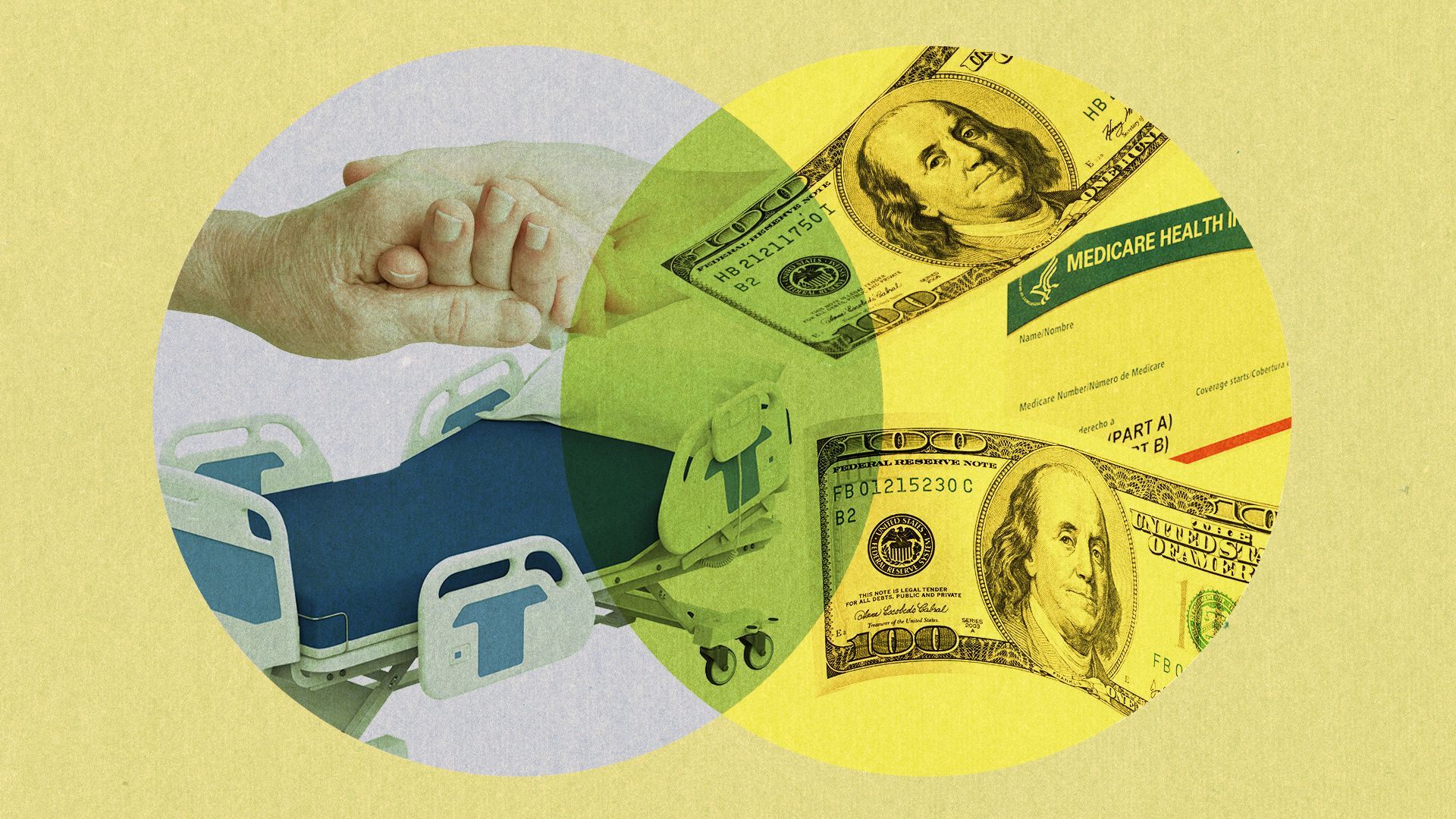
As Medicare Advantage grows bigger and bigger, there's one area the industry and regulators haven't figured out how to make work yet: hospice.
Why it matters: The end-of-life care option is the only Medicare service that can't be offered in the private-run alternative, which now covers over half of enrollees.
- Medicare is winding down an experiment — years earlier than expected — that let some Medicare Advantage plans offer a hospice benefit, citing operational challenges and limited interest from insurers and hospices.
Catch up quick: Usually, when a Medicare Advantage beneficiary decides to enter hospice after receiving a terminal diagnosis, traditional Medicare pays for this care while they remain enrolled in their private plan.
- That could make navigating insurance during hospice "very, very clunky" for beneficiaries, especially for care unrelated to their terminal illness, said Lynne Sexten, CEO of Agrace Hospice.
- And this affects a lot of people. Nearly half of the 1.7 million Medicare Advantage beneficiaries who died in 2022 used hospice services, according to the Medicare Payment Advisory Commission (MedPAC).
What they did: Medicare's Innovation Center began an experiment in 2021 that allowed Medicare plans to contract directly with hospice providers.
- The program was supposed to run through 2030, but now it's shutting down in December.
- Hospices largely cheered the decision. Lower reimbursement rates, delayed payment from insurers and burdensome quality reporting made the experiment difficult for hospices that chose to contract with insurers, an independent evaluation of the program found.
- The experiment tried to do too much too fast, said Kevin Kappel, vice president at SCAN Health Plan, a nonprofit insurer that joined Medicare's hospice experiment last year.
Yes, but: Hospices and insurers said they still need to figure out how to make care more seamless for Medicare Advantage beneficiaries.
2. Insulin cap's uncertain fate
President Joe Biden's call to limit insulin costs for all Americans faces a holdup in the Senate, leaving the fate of a key campaign issue uncertain, Peter Sullivan wrote first on Axios Pro.
Why it matters: Biden in his State of the Union address two months ago urged lawmakers to extend Medicare's new $35 monthly insulin cap to the commercial market and uninsured Americans, as his reelection effort plays up efforts to lower health care costs.
- Senators from both parties who also hope to campaign on the issue have called for a vote this year, but they still haven't reconciled dueling bipartisan bills or tamped down concern that legislation could become a magnet for more controversial health proposals that may doom it.
Zoom in: Sen. Jeanne Shaheen (D-N.H.), co-sponsor on one of the bills, said they're still sorting out details of how to cover the uninsured and that she hasn't gotten an update from Majority Leader Chuck Schumer about possible vote timing.
- Schumer has touted the idea for over a year and again called it a "high priority" last week but said the chamber is still working through some opposition to the idea.
Friction point: Sens. Bernie Sanders (I-Vt.) and Chuck Grassley (R-Iowa) expressed their desire to attach legislation reforming pharmacy benefit managers' business practices — an effort that's largely been bipartisan, but one that Grassley said could cost some votes on an insulin bill.
- Even if the Senate passes legislation to cap insulin costs, it's unlikely the GOP-controlled House would also approve it.
If you need smart, quick intel on health care policy for your job, get Axios Pro.
3. Dairy worker's bird flu symptoms

The Texas dairy worker who had the only known human case of bird flu in the current outbreak never had respiratory symptoms, according to a case report Friday in the New England Journal of Medicine.
Why it matters: It appears to be the first documented case of bird flu spreading from a mammal to a human, report authors said.
What they found: The worker reported no contact with sick or dead wild birds or other animals, but he reported having close and direct exposure with sick dairy cows that showed "the same signs of illness" as other cows in the area with confirmed infection.
- His only known symptom was pinkeye, and he and household contacts were given an antiviral. None of them got sick, but health officials said they couldn't do further investigation.
- "While the authors of the new report could not rule out the possibility that the Texas dairy worker was infected through respiratory droplets, they wrote that the man likely got infected by rubbing his eyes with a contaminated hand," NBC News reported.
Go deeper: Bird flu's wild range
4. A disease's ongoing rebrand

A common liver condition — non-alcoholic fatty liver disease — is in the midst of a rebrand.
Why it matters: The name of the condition, which affects 1 in 4 U.S. adults, was changed by several medical societies in the last year, and is part of a broader effort to eliminate stigmatizing language from medicine.
- The name was changed to metabolic dysfunction-associated steatotic liver disease, or MASLD, to more accurately reflect the science of the condition as a metabolic disorder.
- Notably, it's missing potentially jarring terms no patient wants to hear: "fatty" and "alcoholic."
- The change is happening slowly, with government and health system websites — and doctors — still commonly referencing fatty liver disease.
Between the lines: The shift was recently flagged to me by Vitals reader Don Chalfin, an ICU doctor who works in medical affairs for Siemens Healthineers, after I wrote about the changing language around obesity.
- "It's bad enough being a patient. You shouldn't have to be ashamed for it," Chalfin said.
- Chalfin is speaking from firsthand experience after unexpectedly being diagnosed with liver disease so advanced he needed a transplant.
- Something as simple as a name can be a barrier to someone deciding to get screened, he said.
5. While you were weekending

🔎 A $16.5 billion deal meant to ramp up production of Ozempic and Wegovy is under close FTC scrutiny. (Wall Street Journal)
🩺 A new FDA effort looks to make chemo less brutal and more effective. (KFF Health News)
🍭 The hour after leaving day care is a sugar explosion for kids, research shows. (Washington Post)
🐮 Cow cuddling, the social media-fueled trend that's exactly what it sounds like, could soon find itself out of favor. (Reuters)
Thanks for reading Axios Vitals, and to health care editor Jason Millman and copy editor Matt Piper. Please ask your friends and colleagues to sign up.
Sign up for Axios Vitals